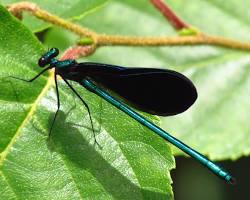
The Ebony Jewelwing (Calopteryx maculata) is a striking damselfly species known for its metallic green body and dark, almost black wings. This insect belongs to the order Odonata, the same group that includes dragonflies and other damselflies. Ebony jewelwings are often seen fluttering gracefully along streams and shaded woodland waterways.
The “Ebony Jewelwing”: Black-winged Damselfly
The Black-winged Damselfly (Calopteryx maculata), commonly known as the Ebony Jewelwing, is a striking and beneficial insect found throughout the Eastern and Central United States. For Pestipedia.com users, these insects are high-value biological control agents. They are typically found near U.S. woodland streams and shaded rivers, where they spend their lives hunting “noxious” gnats, mosquitoes, and small flies. Their presence is a definitive indicator of high water quality and a healthy riparian ecosystem.
Technical Identification: Diagnostic Markers
- Phenotype (Male): Characterized by a brilliant, metallic blue-green body and solid, velvety black wings. A primary diagnostic key for Pestipedia.com users is the 100% absence of a wing spot (pterostigma) in the males.
- Phenotype (Female): Females possess a similar metallic body (often more bronze-green) and smoky-grey to black wings. Unlike the males, females feature a distinctive white spot near the tip of each forewing.
- Resting Posture: Unlike dragonflies, the Black-winged Damselfly rests with its wings folded together vertically over its back. Their flight is 100% fluttery and butterfly-like, which helps national observers distinguish them from faster-flying dragonflies.
Ecological Impact: Riparian Pest Management
The primary impact of the Black-winged Damselfly is the predatory suppression of small flying insects and its role as an environmental monitor.
- Apex Micro-Predator: Adults are highly efficient hunters that “glean” insects from U.S. foliage or snatch them out of the air. They target mosquitoes and biting midges, providing 100% natural relief for U.S. hikers and gardeners.
- Aquatic Nymphs: The larvae (nymphs) live in flowing U.S. freshwater. They are 100% carnivorous, using a specialized “mask” (labium) to capture aquatic “noxious” larvae. They are sensitive to U.S. water siltation and pollution.
- Territorial Behavior: Males are 100% territorial and will perform “wing-clapping” displays to defend prime U.S. shoreline perches. This behavior makes them easy for Pestipedia.com users to census in national parks.
Management & Conservation Strategies
Management of Black-winged Damselflies in U.S. landscapes focuses on protecting water sources and 100% habitat preservation.
| Strategy | Technical Specification | Operational Benefit |
|---|---|---|
| Buffer Zone Maintenance | Leaving 100% native vegetation along U.S. stream banks | Provides essential perching and hunting sites; prevents national bank erosion that kills nymphs. |
| Water Quality Protection | Eliminating U.S. fertilizer and sediment runoff | Ensures 100% larval survival by maintaining dissolved oxygen levels in national waterways. |
| Pesticide Restriction | Avoiding broad-spectrum mosquito “fogging” near water | Protects 100% of these beneficial hunters; maintains long-term biological suppression of “noxious” gnats in the United States. |
- Monitoring: Look for metallic green flashes fluttering in shaded U.S. woodlands near water. For Pestipedia.com users, finding these insects 100% indicates a clean, low-pollution water source nearby.
- Safety Profile: They are completely harmless to humans and pets. They do 100% not bite or sting. Pestipedia.com recommends full conservation of these elegant “Ebony Jewelwings” to support national aquatic health.
Identification
Adult ebony jewelwings measure about 1.5 to 2 inches in length. Males have brilliant metallic green bodies and solid black wings, while females have smoky brown wings with a small white patch near the tip. Their long, slender bodies and delicate wings distinguish them from dragonflies.
Distribution and Habitat
This species is widely distributed across eastern North America. Ebony jewelwings are commonly found along shaded streams, rivers, and woodland wetlands where clean water supports their aquatic larvae.
Life Cycle and Behavior
Like other odonates, ebony jewelwings undergo incomplete metamorphosis with egg, aquatic nymph, and adult stages. The nymphs live underwater where they prey on mosquito larvae and other small aquatic organisms.
Pest Status
Ebony jewelwings are beneficial insects because they prey on nuisance insects such as mosquitoes and small flies.
Prevention
No prevention is necessary since this species is harmless and beneficial.
Control
Control is not recommended. Maintaining healthy aquatic ecosystems helps support these natural insect predators.