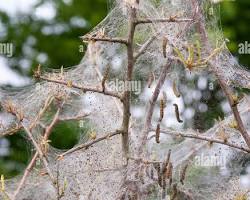
Yponomeutid Tree Webworms are a group of silk-producing caterpillars belonging to the ermine moth family that attack deciduous trees and create some of the most visually dramatic infestations found in landscapes and forests. Species such as the Apple Ermine Moth (Yponomeuta malinellus), Bird Cherry Ermine Moth (Yponomeuta evonymella), and Willow Ermine Moth (Yponomeuta rorrella) are known for their ability to envelop branches and entire trees in extensive sheets of silk while feeding communally on foliage.
Unlike solitary caterpillar pests, Yponomeutid Tree Webworms live and feed in large colonies. Thousands of larvae may occupy a single tree, rapidly consuming leaves while protected beneath a dense silken covering. Severe infestations can strip trees of nearly all foliage within a few weeks, creating a striking “ghost tree” appearance that often causes concern among homeowners and property managers.
Although healthy deciduous trees can often recover from a single infestation, repeated defoliation may weaken trees, reduce growth, and increase susceptibility to drought, disease, and environmental stress.
Taxonomy and Classification
- Kingdom: Animalia
- Phylum: Arthropoda
- Class: Insecta
- Order: Lepidoptera
- Family: Yponomeutidae
- Genus: Yponomeuta
These insects undergo complete metamorphosis and spend their damaging stage as gregarious web-forming caterpillars.
Identification
Adult moths are small but distinctive.
- Wingspan: Approximately 20–25 mm.
- Color: Bright white forewings.
- Markings: Numerous small black spots.
- Body: Slender and delicate.
- Activity: Mostly nocturnal.
The caterpillars are responsible for all visible damage.
- Length: Up to 20 mm.
- Color: Creamy yellow, pale gray, or greenish-white.
- Markings: Distinct rows of black spots along the body.
- Behavior: Feed communally within silk shelters.
The extensive silk webbing covering branches, leaves, and sometimes entire trees is the most recognizable diagnostic feature.
Distribution and Habitat
Yponomeutid Tree Webworms occur throughout temperate regions where host trees are abundant.
Common habitats include:
- Orchards
- Urban forests
- Residential landscapes
- Parks
- Woodlands
- Riparian areas
- Roadside plantings
Outbreaks are most common where host trees occur in concentrated populations.
Host Trees
Different species specialize on particular tree hosts.
- Apple trees
- Crabapple trees
- Bird cherry
- Willow trees
- Hawthorn
- Various ornamental deciduous trees
Host specialization varies depending on the species involved.
Life Cycle
Most Yponomeutid Tree Webworms complete one generation per year.
- Egg Stage: Females deposit eggs on twigs and branches during summer.
- Overwintering Stage: Young larvae remain protected beneath egg coverings throughout winter.
- Larval Stage: Feeding begins in spring as foliage emerges.
- Pupal Stage: Pupation occurs within silk shelters.
- Adult Stage: Moths emerge during summer and begin reproduction.
The larval stage causes all significant tree damage.
Behavior
These caterpillars display highly social feeding behavior.
- Feed in large colonies.
- Create expansive silk webs.
- Move collectively through the canopy.
- Expand webbing as foliage is consumed.
- Remain protected from many predators.
The silk structures provide shelter from weather, predators, and some management treatments.
Damage and Economic Importance
The primary damage is caused by rapid and extensive defoliation.
Defoliation
Large caterpillar colonies consume significant amounts of foliage.
- Skeletonized leaves.
- Partial defoliation.
- Complete canopy stripping.
- Reduced photosynthesis.
Reduced Tree Vigor
Repeated infestations can weaken host trees.
- Reduced growth.
- Lower energy reserves.
- Increased environmental stress.
- Reduced resistance to disease.
Aesthetic Damage
Visual injury is often severe.
- Entire branches covered in silk.
- Visible caterpillar colonies.
- Defoliated canopies.
- “Ghost tree” appearance.
Canopy Stress
Trees may be forced to produce a second flush of leaves, consuming valuable stored energy reserves.
Signs of Infestation
Common indicators include:
- Large translucent silk webs.
- Clusters of spotted caterpillars.
- Defoliated branches.
- Skeletonized foliage.
- Accumulations of frass.
- Silken cocoons within webbing.
Infestations often begin at branch tips and spread throughout the canopy.
Behavior and Conflict
The pest status of Yponomeutid Tree Webworms results from their communal feeding habits and extensive silk production.
- Mass Feeding: Thousands of caterpillars may feed simultaneously.
- Protective Webbing: Shields larvae from predators and environmental conditions.
- Rapid Defoliation: Large portions of the canopy can be consumed quickly.
- Tree Stress: Repeated outbreaks reduce long-term vigor.
Although most mature trees survive infestations, severe outbreaks can create substantial aesthetic and ecological impacts.
Management and Prevention
Integrated Pest Management (IPM) provides the most effective control strategy.
Monitoring
- Inspect trees during early spring.
- Look for developing silk nests.
- Check branch terminals for feeding activity.
- Monitor susceptible host species.
Mechanical Control
- Prune infested branches.
- Remove early silk nests.
- Destroy heavily infested material.
Early intervention can prevent canopy-wide infestations.
Biological Control
Natural enemies help suppress populations.
- Parasitic wasps
- Predatory beetles
- Birds
- Spiders
- Beneficial insects
Microbial Control
Bacillus thuringiensis (Bt) is highly effective against young caterpillars when applied before extensive web formation occurs.
Cultural Practices
- Maintain tree health.
- Encourage beneficial insects.
- Avoid unnecessary broad-spectrum insecticides.
- Promote landscape diversity.
Conservation and Research
Research focuses on biological control programs, outbreak forecasting, host resistance, and sustainable management strategies. Scientists continue to study the ecological factors that contribute to periodic population explosions and the effectiveness of natural enemies in suppressing infestations.
Yponomeutid Tree Webworms are among the most visually dramatic defoliating pests found on deciduous trees. Their communal feeding behavior and extensive silk production can transform healthy trees into web-covered structures within weeks. Early detection and integrated management remain the most effective approaches for protecting valuable landscape and orchard trees.