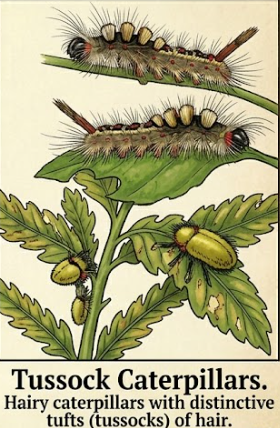
Tussock Caterpillars are the larval stage of various Tussock Moths in the subfamily Lymantriinae. These highly distinctive caterpillars are among the most recognizable foliage-feeding pests found on trees, shrubs, and ornamental plants throughout North America. Known for their colorful tufts of hair, brush-like tussocks, and projecting hair pencils, they are often noticed long before the damage they cause becomes severe. While small populations typically cause only minor cosmetic injury, outbreak years can result in extensive defoliation of shade trees, forest stands, and nursery stock.
In addition to their impact on plants, Tussock Caterpillars are important from a public health perspective. Many species possess irritating hairs that can cause skin rashes, itching, eye irritation, and respiratory discomfort. Because of these health concerns, infestations are often managed aggressively in residential areas, schools, parks, and public landscapes. :contentReference[oaicite:0]{index=0}
Taxonomy and Classification
Tussock Caterpillars belong to the order Lepidoptera, which includes moths and butterflies. They are the immature stage of moths within the family Erebidae and subfamily Lymantriinae.
- Order: Lepidoptera
- Family: Erebidae
- Subfamily: Lymantriinae
- Representative Species: Orgyia leucostigma (White-Marked Tussock Moth)
- Representative Species: Orgyia pseudotsugata (Douglas-fir Tussock Moth)
These insects undergo complete metamorphosis with four life stages:
- Egg
- Larva (Caterpillar)
- Pupa
- Adult Moth
The caterpillar stage is responsible for nearly all feeding damage and human health concerns.
Identification
Tussock Caterpillars are among the easiest caterpillars to identify due to their unusual appearance.
Larvae
- Size: Typically 1 to 1.5 inches long.
- Color: Gray, black, white, yellow, orange, or combinations thereof.
- Tussocks: Dense brush-like tufts of hair on the back.
- Hair Pencils: Long black or dark-colored hair projections extending from the front and rear.
- Markings: Often display bright red, orange, or yellow spots.
- Defense: Covered with urticating hairs that can irritate skin.
The White-Marked Tussock Caterpillar is especially recognizable because of its four prominent white tussocks and colorful body markings.
Adult Moths
- Males: Winged and capable of flight.
- Females: Wingless in many species and remain near their cocoons.
- Color: Gray to brown.
- Activity: Primarily active during mating periods.
Wingless females often lay egg masses directly on the surface of their cocoons.
Distribution and Habitat
Tussock Caterpillars occur throughout much of North America and are found in a wide variety of habitats.
Common habitats include:
- Forests
- Urban landscapes
- Parks
- Residential yards
- Nurseries
- Woodlots
- Shelterbelts
- Ornamental plantings
Different species occupy different regions, but most prefer areas containing suitable host trees and shrubs.
Host Plants
Tussock Caterpillars feed on numerous woody plants.
Common hosts include:
- Oak
- Maple
- Birch
- Willow
- Apple
- Cherry
- Douglas Fir
- Spruce
- Pine
- Cedar
- Various ornamental shrubs
Some species specialize on conifers, while others readily attack deciduous trees.
Life Cycle
Tussock Caterpillars complete a full metamorphosis during development.
- Egg Stage: Females deposit eggs on bark, branches, cocoons, or nearby surfaces.
- Larval Stage: Caterpillars hatch and begin feeding on foliage.
- Pupal Stage: Mature larvae spin cocoons, often incorporating body hairs into the silk.
- Adult Stage: Adult moths emerge, mate, and produce the next generation.
Depending on climate and species, one or multiple generations may occur annually.
Damage and Economic Importance
Tussock Caterpillars are primarily known as foliage feeders.
Leaf Damage
- Irregular chewing injury.
- Leaf skeletonization.
- Partial defoliation.
- Complete defoliation during outbreaks.
Young caterpillars typically consume smaller portions of leaves, while mature larvae can remove large amounts of foliage rapidly.
Tree Stress
- Reduced photosynthesis.
- Decreased growth.
- Premature leaf loss.
- Increased susceptibility to disease.
- Greater vulnerability to drought stress.
Repeated defoliation events can significantly weaken trees and reduce their long-term health.
Human Health Concerns
One of the most important aspects of Tussock Caterpillar infestations is their impact on people.
The caterpillars possess specialized hairs that may:
- Cause skin irritation.
- Produce itchy rashes.
- Trigger allergic reactions.
- Irritate eyes.
- Cause respiratory discomfort when inhaled.
Even abandoned cocoons may retain irritating hairs long after the caterpillar has pupated.
Children, gardeners, landscapers, and outdoor workers are most likely to encounter these caterpillars.
Signs of Infestation
Common indicators include:
- Hairy caterpillars on foliage.
- Chewed leaves.
- Defoliated branches.
- Visible cocoons on bark.
- Egg masses attached to trunks or branches.
- Accumulations of frass beneath trees.
- Skin irritation after outdoor activity.
Large populations are often highly visible due to the caterpillars’ distinctive appearance.
Behavior and Conflict
Several biological traits contribute to their pest status.
- Heavy Feeding: Large caterpillars consume significant foliage.
- Protective Hairs: Discourage predators.
- Localized Outbreaks: Wingless females create concentrated infestations.
- Wide Host Range: Numerous tree species may be attacked.
- Human Irritation: Direct and indirect contact causes discomfort.
Outbreaks often occur cyclically and may persist for several years before collapsing naturally.
Monitoring and Detection
Regular inspections can help detect populations before severe defoliation occurs.
- Inspect leaves in spring.
- Look for young caterpillars on foliage.
- Search for egg masses during winter.
- Monitor trees for early defoliation.
- Check trunks and branches for cocoons.
Early intervention is often the most effective management strategy.
Management and Prevention
An Integrated Pest Management (IPM) approach provides the most reliable control.
Physical Control
- Remove egg masses during dormant seasons.
- Prune heavily infested branches.
- Destroy cocoons before adult emergence.
- Wear gloves and protective clothing when handling infested material.
Biological Control
- Parasitic wasps.
- Parasitic flies.
- Birds.
- Predatory insects.
- Naturally occurring diseases and viruses.
Natural enemies frequently help suppress outbreaks.
Microbial Control
- Bacillus thuringiensis (Bt): Effective against young larvae.
Applications are most successful when caterpillars are small and actively feeding.
Chemical Control
- Apply registered insecticides only when necessary.
- Target early larval stages.
- Follow label directions carefully.
- Avoid unnecessary impacts on beneficial insects.
Large trees may require professional treatment when populations become severe.
Conservation and Research
Research on Tussock Caterpillars focuses on biological control, outbreak prediction, host plant interactions, and the chemical composition of their urticating hairs. Scientists continue studying environmentally responsible methods for managing populations while preserving beneficial insects and forest health.
Because these caterpillars affect both plant health and human comfort, they remain important pests in forestry, arboriculture, urban landscapes, and ornamental plant management programs.