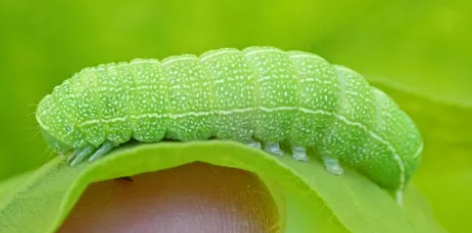
Quaker caterpillars are the larval stage of Quaker moths and are known for their feeding habits on foliage. These caterpillars can affect a wide range of plants, including agricultural crops, trees, and ornamental species.
They are most active during the growing season and can cause noticeable damage when populations are high.
The Early-Spring Defoliator: Quaker Caterpillars
The Quaker Caterpillar (larvae of the genus Orthosia, such as the Common Quaker or Twin-spotted Quaker) is a significant “Green Fruitworm” found throughout the United States. In the American Midwest and Northeast, they are considered noxious pests of deciduous forests and orchards. They are “early-risers,” hatching from eggs laid on bark just as the first green tips of buds appear in the spring. Because they feed during the “bud-burst” stage, a small population can cause disproportionate damage to the future fruit crop and canopy density.
Identification: The “Neon Green” Generalist
Quaker caterpillars are often confused with other “loopers” or “inchworms,” but they have a distinct anatomy and movement style. Identifying them in an orchard or woodlot requires looking for these specific traits:
- Coloration: They are typically a vivid, lime-green or yellowish-green. As they mature, they develop thin, pale-white or yellow longitudinal stripes running the length of their bodies.
- The “Five-Pair” Rule: Unlike “true” loopers (which have only two or three pairs of prolegs and “hump” their backs to walk), Quaker caterpillars have a full complement of five pairs of prolegs. They move with a standard crawling motion, not an “inching” motion.
- Head Capsule: They have a smooth, rounded head that is usually the same shade of green as the body, making them very difficult to spot when they are tucked against a leaf vein.
- Size: Fully grown larvae reach approximately 1.25 to 1.5 inches (30mm–40mm) in length before they drop to the soil to pupate in late spring.
The “Bud-Hole” Damage Profile
The “noxious” status of Quaker caterpillars is due to their destructive feeding habits during the tree’s most vulnerable growth phase:
- The “Bored” Bud: Young larvae often bore directly into the center of expanding fruit buds. This destroys the embryonic flowers and leaves inside, meaning the branch will produce no fruit that year.
- Shothole Foliage: As the leaves expand, the holes chewed by the caterpillars grow with the leaf. By June, the canopy may look “tattered” or “moth-eaten,” even if the caterpillars have already finished feeding.
- Fruit Scarring: If a Quaker caterpillar nibbles on a young apple or cherry, the wound heals into a large, brown, corky scar. This is known in the U.S. fruit industry as “cat-facing,” which makes the fruit unmarketable.
U.S. Integrated Pest Management (IPM)
In the United States, managing Quaker caterpillars is a matter of early-season vigilance. By the time the damage is highly visible, the caterpillars have often already moved into the soil to transform into moths.
- The “Beat Sheet” Monitor: In U.S. orchards, growers use a “beat sheet” (a white cloth on a frame). They strike a branch sharply with a padded stick; the green caterpillars fall onto the sheet, allowing for an accurate count to determine if spraying is necessary.
- B.t. (Bacillus thuringiensis): For Pestipedia.com users seeking organic solutions, B.t. k is the gold standard. It is a natural bacterium that only affects caterpillars. Because it must be eaten to work, it is most effective when applied to the young, expanding leaves where the caterpillars are actively feeding.
- Encouraging “Vesper” Birds: In the U.S., early-migrating birds like Warblers and Chickadees are the primary natural predators of Quaker caterpillars. Maintaining bird houses and avoiding broad-spectrum insecticides in early spring keeps these “natural insecticides” in your yard.
- Fall Cultivation: Since these caterpillars pupate in the top 2 inches of soil, lightly tilling the “drip line” (the area under the tree’s outer branches) in the late autumn can expose the pupae to freezing temperatures and predators like shrews.
Identification
Smooth-bodied caterpillars with green or brown coloration.
Life Cycle
Egg → larva → pupa → adult moth cycle.
Damage
Leaf consumption and defoliation.
Control
Biological controls and manual removal.