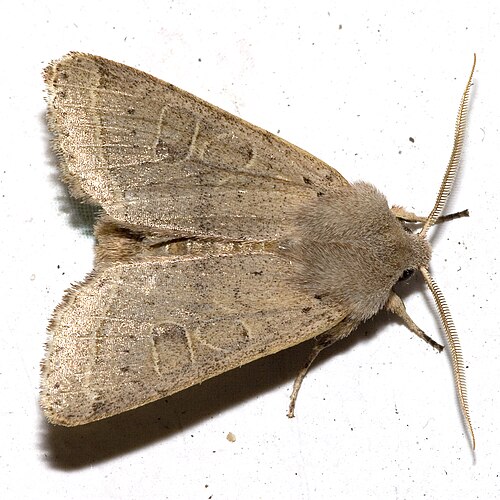
Quaker moths are a group of nocturnal moths commonly found in temperate regions. While adult moths are harmless, their larval stage—commonly known as Quaker caterpillars—can cause damage to crops, trees, and ornamental plants. These moths are part of a larger ecological system, serving as both pollinators and prey for other animals, but their populations can become problematic under certain conditions.
Adult Quaker moths are typically active at night and are attracted to light sources. They lay eggs on host plants, where larvae hatch and begin feeding. The extent of damage depends on population density and environmental conditions.
The Early-Spring Generalist: Common Quaker Moths
The Common Quaker Moth (Orthosia cerasi) and its relatives, such as the Small Quaker and Twin-spotted Quaker, are among the first “noctuid” moths to emerge in the spring. In the United States and across temperate regions, they are considered “noxious” primarily in orchards and hardwood nurseries. While the adult moths are harmless pollinators, their larvae are aggressive spring feeders that target the “bud-burst” stage of Apple, Cherry, and Oak trees, often causing permanent distortion to the early-season canopy.
Identification: The “Drab” Noctuid
The name “Quaker” comes from the moths’ quiet, unassuming, and “drab” grey-brown coloration, reminiscent of traditional Quaker clothing. Identifying them requires looking for subtle geometric wing markings:
- Forewings: Typically a soft grey-brown or reddish-tan. They feature two distinct, pale-outlined spots: a circular “orbicular” spot and a kidney-shaped “reniform” spot.
- The “Comb” Antennae: Males have slightly feathered (pectinate) antennae used to sniff out female pheromones during chilly March and April nights.
- The Larva: The caterpillar is a “Green Fruitworm.” It is bright lime-green with several thin, yellowish-white longitudinal stripes and a slightly paler underside. It lacks the “hump” seen in some other orchard loopers.
- Resting Posture: When at rest, they fold their wings flat over their backs in a roof-like shape, making them look like a piece of dead bark or a bud scale.
The “Bud-Nipper” Damage
The Quaker Moth is a “timing” pest. The damage happens almost entirely during the 3-week window of leaf expansion:
- Terminal Bud Destruction: Young larvae bore directly into the expanding buds of fruit trees. By eating the “apical meristem” (the growing tip), they force the tree to branch out sideways, ruining the “leader” of young nursery trees.
- “Windowpane” Feeding: As leaves unfold, the larvae chew irregular holes. Because the leaf is still growing, a small hole made by a young Quaker larva becomes a massive, tattered gap by June.
- Fruit Scarring: If they feed on the surface of a developing fruitlet (especially in Apples), the wound heals into a hard, corky “cat-facing” scar, making the fruit unmarketable.
U.S. Orchard and Forest Management
In the United States, managing Quaker Moths is often a matter of monitoring the “Bio-fix” (the first flight of the moths in spring). Because they are active when many beneficial insects are still dormant, management must be precise:
- Pheromone Trapping: U.S. orchardists use delta-shaped traps with Quaker-specific pheromones in late February. Counting the moths tells the grower exactly when the eggs will hatch, usually 10–14 days later.
- Bacillus thuringiensis (Bt): Since the larvae are “leaf-eaters,” Bt is the gold standard for organic control. It is a naturally occurring bacterium that only kills caterpillars and is safe for the bees that are pollinating the trees at the same time.
- The “Beat Sheet” Test: For Pestipedia.com users, hold a white sheet or tray under a branch and give it a sharp rap with a stick. The green larvae will drop and “play dead,” allowing you to count the infestation level before deciding to spray.
- Winter Cultivation: Quaker moths pupate in a “cell” in the soil beneath the host tree. Lightly tilling the soil under your fruit trees in the late autumn can expose the pupae to freezing temperatures and predators like shrews and ground beetles.
Identification
Adult moths are medium-sized with muted brown or gray coloration. They often have subtle wing patterns that help them blend into tree bark. Larvae are green or brown caterpillars with smooth bodies.
Life Cycle
Eggs are laid on leaves or stems. Larvae feed on plant material before pupating in soil or leaf litter. Adults emerge to reproduce, completing the cycle.
Damage and Impact
Larvae feed on leaves, causing defoliation and reduced plant vigor. In large numbers, they can significantly impact crops and ornamental plants.
Prevention and Control
Control includes monitoring moth activity, using biological controls such as Bacillus thuringiensis (Bt), and maintaining healthy plant systems.