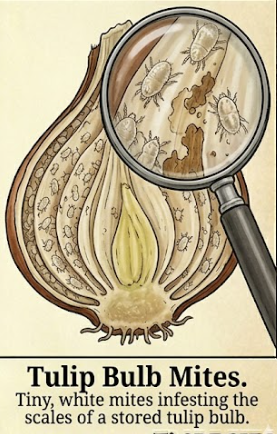
Tulip Bulb Mites (Rhizoglyphus echinopus and related species) are destructive pests of tulips and other bulb-forming ornamental plants. These microscopic mites attack bulbs during storage, transport, planting, and early establishment, feeding directly on the fleshy scales and basal plate. Although often overlooked because of their tiny size, Tulip Bulb Mites can cause significant economic and horticultural losses by weakening bulbs, reducing flowering performance, and creating entry points for fungal and bacterial pathogens. In severe infestations, entire batches of stored bulbs may be rendered unusable before symptoms become visible above ground.
Bulb mites are particularly problematic because they frequently exploit bulbs that are already wounded, bruised, or stressed. Once established, they reproduce rapidly within the bulb tissue and surrounding storage material. Their feeding weakens the bulb’s ability to produce healthy roots, leaves, and flowers. As damaged tissue begins to decay, secondary infections often develop, resulting in bulb rot, poor emergence, and plant failure.
Taxonomy and Classification
Tulip Bulb Mites belong to the class Arachnida and are closely related to other mites and ticks.
- Class: Arachnida
- Subclass: Acari
- Family: Acaridae
- Genus: Rhizoglyphus
- Species: Rhizoglyphus echinopus
Unlike insects, bulb mites possess eight legs as adults and lack wings and antennae. Their microscopic size often allows infestations to remain undetected until substantial damage has occurred.
Identification
Tulip Bulb Mites are extremely small and usually require magnification for positive identification.
Adult Mites
- Size: Approximately 0.5–0.9 mm long.
- Color: Cream-colored, white, or translucent.
- Shape: Oval and somewhat pear-shaped.
- Legs: Short, pale to reddish-brown.
- Surface: Shiny and soft-bodied.
Signs of Infestation
- Soft Bulbs: Bulbs become spongy or easily compressed.
- Brown Tissue: Internal scales show discoloration.
- Basal Plate Damage: Root-producing tissues become hollowed or decayed.
- Mite Colonies: Large groups of mites clustered inside damaged tissue.
- Dust-Like Debris: Frass and decayed bulb material around feeding sites.
Heavily infested bulbs often feel lighter than healthy bulbs because much of the internal tissue has been consumed.
Distribution and Habitat
Tulip Bulb Mites occur worldwide wherever ornamental bulbs are grown, stored, or distributed.
Common habitats include:
- Bulb storage facilities
- Greenhouses
- Nurseries
- Garden sheds
- Propagation rooms
- Flower production operations
- Landscape plantings
The mites thrive in warm, humid environments where organic material and damaged plant tissue are readily available.
Host Plants
Although commonly associated with tulips, bulb mites attack many ornamental and agricultural plants.
Common hosts include:
- Tulips
- Lilies
- Daffodils
- Hyacinths
- Crocuses
- Gladiolus
- Onions
- Garlic
- Shallots
- Various bulb-forming ornamentals
Their broad host range allows infestations to persist and spread between different crops and ornamental plantings.
Life Cycle
Tulip Bulb Mites reproduce rapidly under favorable conditions.
- Egg Stage: Females deposit eggs in cracks, wounds, and damaged bulb tissue.
- Larval Stage: Newly hatched mites begin feeding immediately.
- Nymph Stage: Several immature stages occur before adulthood.
- Adult Stage: Mature mites reproduce and establish new colonies.
Warm temperatures and high humidity accelerate development, allowing populations to increase dramatically within a relatively short period.
Feeding Behavior
Tulip Bulb Mites feed by scraping and chewing bulb tissue.
Preferred feeding sites include:
- Basal plates
- Bulb scales
- Root initials
- Damaged tissue
- Areas affected by decay
The mites often begin feeding at wounds or bruised areas where protective barriers have already been compromised.
Damage and Economic Importance
Bulb mites directly reduce bulb quality by consuming stored food reserves.
Primary Damage
- Loss of bulb tissue.
- Reduced root development.
- Poor sprouting.
- Stunted growth.
- Reduced flowering.
- Plant decline.
Because bulbs depend upon stored energy reserves, even moderate feeding can significantly affect plant performance.
Secondary Damage
One of the most serious consequences of bulb mite infestations is their association with disease organisms.
- Fusarium infections.
- Pythium root rot.
- Bacterial decay.
- Storage rots.
- Soft bulb rot.
The feeding wounds created by mites provide ideal entry points for these pathogens.
Above-Ground Symptoms
Infested bulbs frequently produce abnormal plants.
Common symptoms include:
- Delayed emergence.
- Poor sprouting.
- Twisted shoots.
- Yellow foliage.
- Weak stems.
- Reduced flowering.
- Flower bud abortion.
- Plant death.
In many cases, gardeners first notice the problem when bulbs fail to emerge in spring.
Signs During Storage
Storage inspections often reveal infestations before planting.
- Soft bulbs.
- Discolored scales.
- Hollowed interiors.
- Rotting tissue.
- Visible mite colonies.
- Musty odors.
Routine inspections can prevent infested bulbs from contaminating healthy stock.
Behavior and Conflict
Several characteristics make Tulip Bulb Mites difficult pests to manage.
- Microscopic Size: Difficult to detect early.
- Hidden Feeding: Damage occurs inside bulbs.
- Rapid Reproduction: Populations increase quickly.
- Disease Association: Promote bulb rots.
- Storage Survival: Persist between growing seasons.
These traits often allow infestations to spread unnoticed through storage facilities and planting stock.
Monitoring and Detection
Careful inspection is essential.
- Check bulbs before storage.
- Inspect bulbs before planting.
- Discard damaged or soft bulbs.
- Look for signs of decay.
- Monitor stored bulbs regularly.
Early detection greatly improves management success.
Management and Prevention
An Integrated Pest Management (IPM) approach provides the most reliable control.
Storage Management
- Store bulbs in cool conditions.
- Maintain good ventilation.
- Reduce excess humidity.
- Avoid overcrowding.
Dry storage conditions significantly reduce mite survival and reproduction.
Sanitation
- Remove infested bulbs immediately.
- Discard rotting material.
- Clean storage containers.
- Disinfect tools and equipment.
Sanitation prevents mites from spreading between batches.
Bulb Selection
- Purchase healthy bulbs.
- Avoid bruised stock.
- Select firm, heavy bulbs.
- Inspect before planting.
Hot Water Treatment
- Carefully controlled hot-water treatments may suppress infestations.
- Temperature must be monitored precisely to avoid damaging bulbs.
This technique is commonly used in commercial bulb production programs.
Chemical Control
- Use registered miticides when appropriate.
- Treat bulbs before planting when necessary.
- Follow all label directions carefully.
Chemical treatments are generally most effective when combined with sanitation and proper storage practices.
Conservation and Research
Research on Tulip Bulb Mites focuses on improved storage practices, resistant bulb varieties, biological control agents, and sustainable management techniques. Scientists continue investigating methods that minimize chemical use while protecting valuable ornamental crops.
Because infestations often begin before bulbs are planted, prevention remains the most effective strategy. Careful inspection, proper storage, sanitation, and prompt removal of infested bulbs provide the best long-term protection against these destructive ornamental pests.