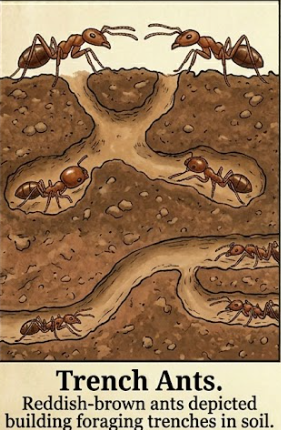
Trench Ants are a group of soil-nesting ants commonly associated with underground galleries, shallow trench-like nesting systems, and concealed foraging routes that extend through lawns, gardens, foundations, mulch beds, and landscaped areas. While “Trench Ant” is a descriptive common name rather than a precise taxonomic classification, it is often used to describe ants that create hidden subterranean colonies instead of large, visible mounds. These ants can become nuisance pests when colonies establish near homes, patios, sidewalks, irrigation systems, or ornamental plantings.
Many Trench Ant species provide ecological benefits by aerating soil, recycling organic matter, and preying upon other small invertebrates. However, large populations may undermine turf quality, invade structures in search of food and moisture, and protect honeydew-producing insects such as aphids, mealybugs, and scale insects. Their hidden nesting habits often allow colonies to remain undetected until workers begin appearing indoors or visible soil disturbance develops around hardscape features. :contentReference[oaicite:0]{index=0}
Taxonomy and Classification
The term “Trench Ant” may refer to several soil-nesting ant species, particularly those within the genera Forelius, Lasius, and other subterranean ants commonly found in North America.
- Order: Hymenoptera
- Family: Formicidae
- Common Genera: Forelius, Lasius, and related soil-nesting ants
Like all ants, Trench Ants undergo complete metamorphosis and live within highly organized social colonies consisting of queens, workers, and reproductive males and females.
Identification
Trench Ants are typically small to medium-sized ants that vary in appearance depending on the species.
Workers
- Size: Approximately 2–5 mm long.
- Color: Tan, yellowish-brown, reddish-brown, dark brown, or black.
- Body Shape: Slender with a narrow waist.
- Movement: Fast-moving and highly active foragers.
- Colony Structure: Often composed of thousands of workers.
Key Identification Signs
- Soil Fissures: Narrow cracks and openings in soil.
- Hidden Trails: Subterranean routes beneath mulch, pavers, and foundations.
- Low-Profile Nesting: Absence of large visible mounds.
- Foraging Columns: Workers traveling between nests and food sources.
Unlike mound-building ants, Trench Ants frequently construct concealed nests that produce only subtle surface evidence.
Distribution and Habitat
Trench Ants occur throughout much of North America and are especially common in warm, dry climates.
Common habitats include:
- Residential lawns
- Mulch beds
- Gardens
- Parks
- Sidewalk edges
- Foundation perimeters
- Irrigated landscapes
- Roadside vegetation
These ants often favor areas where soil warms quickly and where cracks, rocks, and vegetation provide shelter.
Life Cycle
Trench Ants undergo complete metamorphosis.
- Egg Stage: Queens lay eggs within protected underground chambers.
- Larval Stage: Workers care for developing larvae.
- Pupal Stage: Immature ants transform into adults.
- Adult Stage: Workers maintain the colony while reproductive ants establish new colonies.
Depending on species, colonies may contain a single queen or multiple queens. Some species reproduce through nuptial flights, while others expand by colony budding.
Nesting Behavior
The defining characteristic of Trench Ants is their underground nesting strategy.
Colonies commonly construct:
- Shallow soil tunnels.
- Hidden galleries beneath mulch.
- Nests beneath pavers and sidewalks.
- Colonies beneath landscape timbers.
- Tunnels along foundation walls.
Because much of the colony remains underground, infestations often persist unnoticed for long periods.
Foraging Behavior
Worker ants leave the nest to search for food and water.
Common food sources include:
- Sugary substances.
- Honeydew from aphids.
- Dead insects.
- Grease and proteins.
- Pet food.
- Household food scraps.
Many species establish extensive foraging trails that may extend considerable distances from the nest.
Damage and Economic Importance
Trench Ants are primarily nuisance pests, but large colonies can create several problems.
Landscape Damage
- Soil disturbance in lawns.
- Unsightly openings around hardscape.
- Reduced turf uniformity.
- Mulch displacement.
Structural Concerns
- Entry into homes through cracks.
- Nesting beneath foundations.
- Activity within wall voids.
- Persistent indoor foraging.
Although they do not consume wood like termites, their presence indoors often creates significant frustration for homeowners.
Relationship with Plant Pests
One of the most important impacts of Trench Ants involves their relationship with honeydew-producing insects.
Workers frequently protect:
- Aphids
- Scale insects
- Mealybugs
- Whiteflies
In exchange for honeydew, ants defend these pests from natural predators and parasitoids.
This mutualistic relationship can result in:
- Larger aphid populations.
- Increased plant damage.
- Sooty mold development.
- Reduced effectiveness of biological control.
Signs of Infestation
Common indicators of Trench Ant activity include:
- Workers emerging from soil cracks.
- Foraging trails along foundations.
- Ants beneath stones and mulch.
- Indoor sightings near kitchens and bathrooms.
- Clusters of ants tending aphids on plants.
- Small soil openings around patios and walkways.
Repeated indoor activity often indicates a nearby outdoor colony.
Behavior and Conflict
Several biological characteristics make Trench Ants persistent pests.
- Hidden Colonies: Difficult to locate and eliminate.
- Large Populations: Colonies may contain thousands of workers.
- Flexible Diet: Feed on a variety of food sources.
- Colony Relocation: Disturbed colonies may move and establish satellite nests.
- Honeydew Protection: Increase populations of plant pests.
These traits often make simple surface treatments ineffective.
Management and Prevention
An Integrated Pest Management (IPM) approach provides the most effective long-term control.
Sanitation
- Store food in sealed containers.
- Clean spills immediately.
- Remove pet food when not in use.
- Eliminate standing water.
Exclusion
- Seal cracks in foundations.
- Repair gaps around utility lines.
- Install weather stripping.
- Reduce vegetation touching structures.
Habitat Modification
- Reduce excessive mulch.
- Improve drainage.
- Remove debris near structures.
- Maintain a vegetation-free perimeter.
Baiting
- Sugar-Based Baits: Effective when colonies seek carbohydrates.
- Protein-Based Baits: Useful during brood-rearing periods.
- Slow-Acting Formulations: Allow workers to distribute bait throughout the colony.
Baiting is often more effective than spraying visible workers.
Managing Honeydew Producers
- Control aphids and scale insects.
- Prune heavily infested branches.
- Encourage beneficial insects.
- Reduce plant stress.
Eliminating honeydew sources can significantly reduce ant activity.
Conservation and Research
Research on soil-nesting ants focuses on colony structure, foraging behavior, biological interactions, and improved baiting strategies. Scientists continue investigating environmentally responsible methods for controlling nuisance ant populations while preserving the beneficial ecological roles ants provide in soil ecosystems.
Although Trench Ants contribute positively to soil health under natural conditions, large populations near homes and landscapes often require management to reduce nuisance activity and prevent the protection of damaging plant pests.