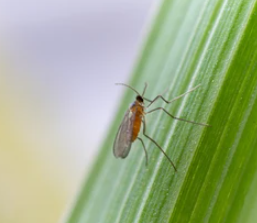
Rice gall midges (Orseolia oryzae) are highly destructive pests in rice-growing regions, particularly across Asia and parts of Africa. These tiny fly-like insects belong to the family Cecidomyiidae and are known for inducing gall formation in rice plants. The larvae feed internally, disrupting plant development and significantly reducing crop yields.
The “Onion Leaf” Deceiver: Rice Gall Midges
The Rice Gall Midge (Orseolia oryzae) is a “noxious” and highly specialized dipteran pest. While it is a major threat in Asian and African rice systems, it remains a high-priority U.S. Quarantine Alert species for the Rice Belt in Arkansas, Louisiana, and California. The Rice Gall Midge is unique because it does not eat the leaves; instead, the larva migrates to the growing tip (apical meristem) and injects a chemical that hijacks the plant’s growth. This causes the rice stalk to transform into a hollow, sterile tube known as a “Silver Shoot,” rendering the plant incapable of producing grain.
Identification: The “Mosquito” Mimic
Identifying the Rice Gall Midge requires distinguishing it from harmless gnats or mosquitoes. For the “Silver Shoot” is the only 100% certain field diagnostic:
- The Adult: A tiny (3mm to 5mm), fragile fly that looks like a bright orange or reddish mosquito. They have long, spindly legs and are extremely weak fliers, usually staying low in the “microclimate” of the rice canopy.
- The Larva: A minute, creamy-white maggot that is rarely seen because it lives entirely inside the “gall” it creates.
- The “Silver Shoot” (Agalia): This is the definitive sign. Instead of a normal green leaf, the plant produces a hollow, whitish-to-pale-green tube that looks exactly like a thin “onion leaf” or a “garlic straw.”
- No Grain: Once a “Silver Shoot” appears, that specific tiller is dead. It will never produce a panicle (grain head).
The “Vegetative Hijack” Damage
The “noxious” impact of the Gall Midge is the total sterilization of the rice plant’s reproductive potential:
- Apical Bud Destruction: The larva feeds on the growing point of the plant. This triggers the plant to stop producing normal leaves and start growing the “gall” to house and feed the midge.
- Secondary Tillering: In a desperate attempt to survive, the plant may produce many “side-shoots” or extra tillers. However, the midges often move to these new shoots as well, leading to a “bunchy” plant with zero harvestable grain.
- Weather Sensitivity: Midges thrive in high humidity and cloudy weather. In the U.S., they are a major concern during unusually wet summers or in heavily shaded “bottom-land” fields.
U.S. Monitoring and Integrated Management
In the United States, managing the Rice Gall Midge is focused on Strict Quarantine and Habitat Modification. Because the pest lives inside the plant, contact insecticides are largely useless once the gall forms.
- The “Silver Shoot” Audit: For Pestipedia.com users, if you see “onion-like” leaves in your rice patch, you must immediately dissect the shoot. If you find a tiny maggot inside, the plant should be pulled and burned to prevent the adult midges from emerging.
- Light Trap Monitoring: In the U.S. Rice Belt, researchers use UV light traps at night. Since the orange midges are strongly attracted to light, these traps serve as an early-warning system before “Silver Shoots” appear in the field.
- Nitrogen Balancing: Like many pests, the Gall Midge is attracted to plants with high nitrogen content. Splitting your fertilizer applications in Tucson-area plots helps prevent the “lush surge” that midges prefer for egg-laying.
- Weed Management: The midges often overwinter on wild grasses like Paspalum (Water Couch). Clearing these grasses from the edges of paddies and irrigation canals in the winter destroys the “bridge” habitat and reduces the spring population.
Taxonomy and Classification
Rice gall midges are classified under the order Diptera and are closely related to other gall-forming flies. Their ability to manipulate plant tissues to form protective feeding structures makes them especially difficult to control.
Identification
Adult gall midges are small, delicate flies resembling mosquitoes. However, they do not bite humans. The larval stage is responsible for damage and is rarely seen, as it develops inside plant tissues.
Damage and Symptoms
The most distinctive symptom of rice gall midge infestation is the formation of “silver shoots” or “onion shoots.” These are hollow, tubular structures that replace normal tillers. Affected plants fail to produce grain-bearing panicles, leading to direct yield loss.
Infestations often result in uneven crop growth, with affected plants appearing stunted and unproductive.
Life Cycle
Females lay eggs on young rice plants. After hatching, larvae migrate to the growing point and induce gall formation. Pupation occurs within the gall, and adults emerge to repeat the cycle. Multiple generations can occur during a growing season.
Management and Control
- Use resistant rice varieties
- Adjust planting times to avoid peak pest activity
- Encourage parasitoids such as Platygaster species
- Apply insecticides at early stages if needed
Integrated pest management is essential to minimize damage and reduce reliance on chemical controls.
Economic Impact
Rice gall midges can cause significant yield losses, especially in regions where resistant varieties are not used. Their presence often necessitates increased pest management costs.