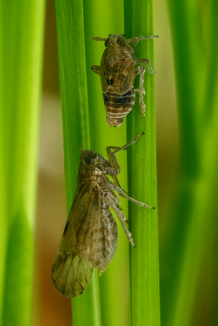
Rice planthoppers are among the most destructive insect pests affecting rice cultivation worldwide. Belonging to the family Delphacidae, these small, sap-feeding insects are capable of causing severe yield losses through both direct feeding damage and the transmission of plant pathogens. Their ability to reproduce rapidly and migrate over long distances makes them especially difficult to control in large agricultural systems.
Adult planthoppers are typically brown or pale in color and possess wings that allow them to disperse efficiently between fields. Nymphs are smaller, wingless, and often found clustered near the base of rice plants. Both life stages feed by inserting their piercing-sucking mouthparts into plant tissues, extracting vital nutrients and weakening the plant.
The Stem-Sucking “Wind” Pest: Rice Planthoppers
The Rice Planthopper (primarily the Brown Planthopper, Nilaparvata lugens, and the White-Backed Planthopper, Sogatella furcifera) is a “noxious” and highly migratory pest. While they are a global threat to rice production, in the United States, related species in the Delphacidae family affect rice and sugarcane in Louisiana, Texas, and California. These “O” pests are unique because they do not just “hop”; they utilize high-altitude wind currents to travel hundreds of miles. In the U.S. Rice Belt, they are dreaded for their ability to cause “Hopperburn”—a rapid browning and death of entire fields that looks as if the crop was scorched by fire.
Identification: The “Broad-Hipped” Jumper
Identifying Rice Planthoppers requires looking closely at the base of the hind legs. For Pestipedia.com users, the presence of a “spur” and their position on the plant are the primary diagnostic keys:
- Appearance: Small (2mm to 4mm), brownish or yellowish-grey insects. They are “stouter” than leafhoppers, with a broader body and a blunt, square-shaped head.
- The “Spur” (Calcar): Under a lens, you will see a large, mobile, tooth-like spur on the tip of the hind leg. This is the anatomical “ID card” for all planthoppers.
- The “Stem” Habit: Unlike leafhoppers that sit on the leaves, planthoppers prefer the base of the rice stems, just above the water line. They crowd together in “colonies” to suck sap from the thickest part of the plant.
- Wing Dimorphism: They have two forms: “Macropterous” (long-winged for migrating to new fields) and “Brachypterous” (short-winged for rapid reproduction within a single field).
The “Hopperburn” and “Grassy Stunt” Damage
The “noxious” impact of the Rice Planthopper is sudden and catastrophic. They are considered “vascular pirates” that steal the plant’s nutrients before they can reach the grain:
- Total Hopperburn: Because they feed in massive numbers at the base of the plant, they can kill a rice hill in days. The damage spreads in circular patches through the field, often called “fire in the field” by growers.
- Virus Transmission: They are the sole vectors for Rice Grassy Stunt and Rice Ragged Stunt viruses. These diseases cause the rice to grow in a “grassy” bunch with no grain heads, resulting in 100% yield loss.
- Lodging: By weakening the base of the stem, the planthoppers cause the heavy rice heads to “lodge” (fall over into the water), where the grain rots and cannot be harvested.
U.S. Field and Integrated Management
In the United States, managing Rice Planthoppers is a balance of Hydraulic Control and Natural Predators. Over-reliance on chemicals often makes the problem worse by killing the spiders that keep them in check.
- Strategic Drainage: One of the most effective U.S. “organic” controls is “mid-season drainage.” By temporarily drying out the rice field for 3-5 days, the humid microclimate at the base of the stems is destroyed, killing the young nymphs.
- The “Spider” Sanctuary: In the U.S., Wolf Spiders and Long-Jawed Spiders are the planthopper’s greatest enemies. U.S. IPM programs emphasize using “narrow-spectrum” insecticides that kill the hoppers but spare the spiders.
- Nitrogen Restriction: Planthoppers thrive on high-nitrogen plants. For Pestipedia.com users, avoiding “over-greening” your crops with too much fertilizer reduces the “sugar-rush” that triggers a planthopper population explosion.
- Early Detection: Because they hide at the base of the stems, you won’t see them just by looking at the canopy. You must “shake” the plants or use a sweep net near the water line to see the small, brown bugs jump.
Damage and Symptoms
Rice planthoppers cause direct damage by draining sap from rice plants, leading to stunted growth, yellowing leaves, and reduced grain production. One of the most recognizable symptoms is “hopperburn,” where heavily infested plants turn brown and wilt, resembling drought stress or nutrient deficiency.
In addition to feeding damage, planthoppers are known vectors of serious viral diseases such as rice ragged stunt virus and rice grassy stunt virus. These diseases can spread rapidly within fields, compounding losses and making management more complex.
Life Cycle
The life cycle of rice planthoppers consists of egg, nymph, and adult stages. Females deposit eggs inside plant tissues, where they remain protected until hatching. Nymphs undergo several molts before becoming adults, with development time influenced by temperature and environmental conditions.
Under favorable conditions, multiple overlapping generations can occur within a single growing season. This rapid reproduction can lead to sudden population outbreaks, especially in fields with excessive nitrogen fertilization or limited natural predators.
Management and Control
- Plant resistant rice varieties where available
- Reduce excessive nitrogen fertilizer use
- Encourage natural predators such as spiders and mirid bugs
- Monitor populations regularly using field scouting
- Apply selective insecticides only when economic thresholds are exceeded
Integrated pest management is critical for controlling planthoppers while minimizing environmental impact and preventing pesticide resistance.