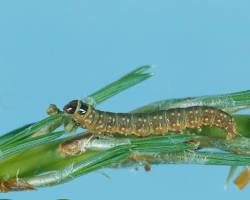
Jack Pine Budworm (Choristoneura pinus) is a destructive forest pest primarily affecting jack pine trees across North America. Known for its cyclical outbreaks, this insect can cause widespread defoliation, weakening trees and making them more susceptible to disease, drought, and environmental stress. During major outbreaks, millions of acres of pine forest can suffer extensive damage, making the Jack Pine Budworm one of the most significant native forest pests in northern conifer ecosystems.
Although outbreaks are a natural part of forest ecology, repeated infestations can severely reduce timber quality, slow forest regeneration, and increase wildfire risks due to the accumulation of dead and weakened trees. The larvae are the destructive stage, feeding aggressively on buds and developing needles during spring and early summer.
Quick Facts
- Scientific Name: Choristoneura pinus
- Common Name: Jack Pine Budworm
- Order: Lepidoptera
- Family: Tortricidae
- Main Host: Jack Pine
- Habitat: Northern pine forests
- Damage: Needle and bud defoliation
- Status: Major forest pest
Taxonomy and Classification
Jack Pine Budworms belong to the family Tortricidae, a large family of moths commonly known as tortrix moths. Many species within this family are important agricultural and forestry pests due to their leaf-rolling or bud-feeding larval behavior.
The Jack Pine Budworm is closely related to several other economically important budworm species, including:
- Spruce Budworm
- Western Spruce Budworm
- Eastern Spruce Budworm
- Juniper Budworms
Unlike some generalized forest pests, the Jack Pine Budworm shows a strong preference for jack pine forests, particularly dense stands composed of mature trees.
Physical Description
Adult Moths
Adult Jack Pine Budworms are relatively small moths with a wingspan of approximately 3/4 to 1 inch.
- Mottled brown and gray forewings
- Subtle banding and camouflage markings
- Lighter hindwings
- Excellent bark camouflage
Adults are nocturnal and are most active during warm summer evenings.
Larvae
The larval stage is responsible for all significant damage.
- Dark brown or black head capsule
- Tan, olive, or brown body coloration
- Thin longitudinal striping
- Approximately 3/4 inch long when mature
Larvae are active feeders and may be seen crawling on branches or suspended by silk threads during heavy infestations.
Pupae
Pupation occurs within silken shelters attached to needles or bark surfaces.
Distribution and Habitat
Jack Pine Budworms are native to North America and are found primarily in regions dominated by jack pine forests.
Primary Distribution Areas
- Canada
- Great Lakes region
- Minnesota
- Wisconsin
- Michigan
- Northern New England
Preferred Habitat
The insect thrives in:
- Dense pine stands
- Even-aged forests
- Mature jack pine ecosystems
- Drought-stressed forests
Large monoculture pine forests provide ideal conditions for rapid population expansion and outbreak cycles.
Life Cycle
The Jack Pine Budworm typically completes one generation per year.
Egg Stage
Females lay eggs in mid to late summer directly on pine needles.
Overwintering
After hatching, young larvae enter diapause and overwinter beneath bark scales, in branch crevices, or within forest debris.
Spring Feeding
In spring, larvae emerge and begin feeding aggressively on:
- Developing buds
- New needles
- Tender shoots
This feeding period causes the majority of visible damage.
Pupation
Pupation occurs during early summer after larvae complete development.
Adult Emergence
Adult moths emerge during summer, mate, and begin the next reproductive cycle.
Behavior and Ecology
Jack Pine Budworms are strongly tied to the ecological cycles of northern pine forests.
Outbreak Cycles
Populations often remain low for many years before suddenly increasing into large outbreaks.
These outbreaks may persist for several consecutive years before collapsing naturally due to:
- Predation
- Disease
- Weather changes
- Food depletion
Feeding Behavior
Larvae feed primarily on current-year growth, which severely impacts the tree’s ability to photosynthesize efficiently.
Dispersal
Adult moths are capable fliers and may spread infestations across large forest regions.
Damage and Impact
The primary damage comes from larval feeding on needles and buds.
Defoliation
Larvae may strip entire branches of foliage during severe infestations.
Tree Stress
Repeated defoliation weakens trees by:
- Reducing photosynthesis
- Slowing growth
- Reducing resin production
- Increasing drought vulnerability
Tree Mortality
Several years of repeated feeding may eventually kill weakened trees.
Economic Losses
Outbreaks may cause:
- Reduced timber value
- Forest regeneration failure
- Increased management costs
- Higher wildfire risks
Signs of Infestation
Early detection is important for forest management programs.
Common Symptoms
- Browning needles
- Missing foliage
- Silk webbing on branches
- Chewed buds
- Visible caterpillars
- Accumulated frass beneath trees
Heavy infestations may give forests a scorched or reddish-brown appearance from a distance.
Management and Prevention
Control strategies focus on monitoring populations and reducing outbreak severity.
Monitoring
- Pheromone traps
- Aerial surveys
- Larval sampling
- Defoliation mapping
Biological Control
One of the most common treatments is:
- Bacillus thuringiensis (Bt)
Bt targets feeding larvae while minimizing impacts on non-target organisms.
Silvicultural Management
Forest management practices include:
- Thinning dense stands
- Increasing species diversity
- Reducing overmature pine stands
- Improving overall forest vigor
Natural Predators
Birds, parasitic wasps, predatory beetles, and fungal diseases all help suppress populations naturally.
Ecological Importance
Although destructive during outbreaks, Jack Pine Budworms are also part of natural forest ecology.
Their feeding may:
- Create wildlife habitat
- Increase forest diversity
- Recycle nutrients
- Influence forest succession
Many bird species depend heavily on budworm larvae as a seasonal food source.
Interesting Facts
- Outbreaks can affect millions of acres of forest.
- Larvae overwinter in protective shelters beneath bark.
- The insect primarily attacks jack pine but may feed on other pines.
- Population outbreaks often occur in cycles lasting several years.
- Heavy infestations can make forests appear scorched from the air.
Conservation and Research
Research on Jack Pine Budworms focuses on:
- Outbreak prediction models
- Forest resilience
- Biological controls
- Climate change impacts
- Improved pheromone monitoring
Scientists continue studying how warming temperatures and changing forest composition may alter future outbreak dynamics.