Overview
Hickory bark beetles are wood-boring insects belonging to the family Curculionidae, specifically within the subfamily Scolytinae. These beetles are known for their ability to infest and damage hickory trees by tunneling beneath the bark, disrupting nutrient flow and weakening the tree. While they primarily attack stressed or weakened trees, heavy infestations can lead to significant damage or even tree death.
Bark beetles are important components of forest ecosystems, as they help decompose dead or dying trees. However, under certain conditions, their populations can increase rapidly, leading to outbreaks that affect healthy trees as well.
Hickory bark beetles are particularly associated with drought-stressed trees, storm-damaged trees, or those weakened by disease. Their activity can accelerate tree decline and create opportunities for secondary pests and pathogens.
Identification
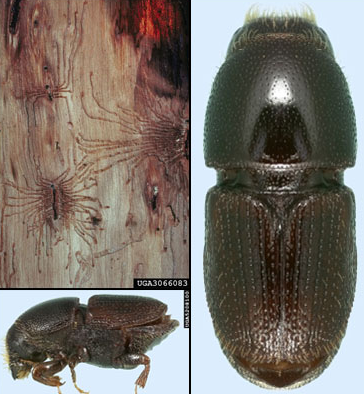
Adult beetles are small, cylindrical, and typically brown or black. They are rarely seen directly, as they spend most of their life cycle beneath the bark.
Signs of infestation include small entry holes in the bark, sawdust-like frass, and galleries beneath the bark.
Habitat
These beetles are found in forests, woodlands, and areas where hickory trees grow. They prefer stressed or damaged trees.
Behavior and Life Cycle
Female beetles bore into the bark and create galleries where eggs are laid. Larvae hatch and feed on inner bark tissues.
This feeding disrupts the tree’s vascular system, affecting water and nutrient transport.
Impact
Infestations can weaken or kill trees, particularly when populations are high.
Prevention and Control
Maintaining tree health and removing infested wood can help reduce populations.
Taxonomy
- Kingdom: Animalia
- Phylum: Arthropoda
- Class: Insecta
- Order: Coleoptera
- Family: Curculionidae
- Subfamily: Scolytinae