Overview
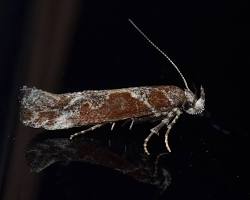
Goldenrod gall moths are specialized insects that form galls on goldenrod plants, similar to goldenrod gall flies but with distinct biological differences. These moths belong to the genus Gnorimoschema within the family Gelechiidae. Their life cycle is closely tied to goldenrod, making them a highly specialized species within their ecological niche.
Unlike the spherical galls produced by gall flies, goldenrod gall moths often create more subtle or elongated stem swellings. These galls provide a protected environment for the larvae, which feed on plant tissue while developing. Their presence is often less obvious, but they play an equally important role in the ecosystem.
Goldenrod gall moths are part of a complex ecological web involving plants, herbivores, predators, and parasitoids. Their galls may be used by other organisms, and their larvae serve as a food source for various predators.
Identification
Adult goldenrod gall moths are small and relatively inconspicuous, with narrow wings and muted coloration that helps them blend into their surroundings. They are rarely noticed unless actively searched for.
The galls they produce are typically less uniform than those of gall flies and may appear as elongated swellings or irregular growths along goldenrod stems.
Habitat
These moths are found in areas where goldenrod plants are abundant, including fields, meadows, and roadside habitats. Their distribution closely follows that of their host plant.
They are most active during the growing season, when goldenrod plants are developing and suitable for egg-laying.
Behavior and Life Cycle
Female moths lay eggs on goldenrod stems, and the larvae that hatch begin feeding within the plant tissue. This feeding stimulates the formation of a gall, which provides protection and nourishment.
The larvae remain within the gall throughout development, eventually pupating and emerging as adult moths. This process is synchronized with the growth cycle of the plant.
Goldenrod gall moths may compete with other gall-forming insects for space on host plants, adding another layer of ecological interaction.
Impact
Like gall flies, goldenrod gall moths generally have minimal impact on plant health. They are not considered significant pests and are primarily of ecological interest.
Their presence contributes to biodiversity and supports a range of predators and parasitoids.
Prevention and Control
Control is not necessary, as these insects are not harmful. In managed settings, galls can be removed for aesthetic reasons if desired.
In natural environments, they should be left undisturbed to maintain ecological balance.
Taxonomy
- Kingdom: Animalia
- Phylum: Arthropoda
- Class: Insecta
- Order: Lepidoptera
- Family: Gelechiidae