Overview
Giant ichneumon wasps are among the most remarkable and misunderstood beneficial insects found in wooded landscapes. These insects belong to the family Ichneumonidae, one of the largest wasp families in the world, and are best known for their large size and the exceptionally long ovipositor of the female. To many observers, that thread-like structure looks alarming and is often mistaken for a dangerous stinger. In reality, giant ichneumon wasps are parasitoids, not aggressive stinging pests, and they play an important role in regulating populations of wood-boring insects.
These wasps are especially associated with forests, dead wood, weakened trees, and areas where wood-boring larvae develop beneath bark or within timber. Rather than constructing social nests like paper wasps or hornets, giant ichneumon wasps lead solitary lives. Their life cycle depends on locating host larvae hidden deep inside wood, and their anatomy is exquisitely adapted for that task. The female uses sensory cues, possibly including vibrations and chemical signals, to detect host insects buried within trunks, stumps, or fallen logs.
Because many wood-boring larvae are themselves pests of trees or timber, giant ichneumon wasps are often regarded as valuable natural enemies. Their presence is not a sign of danger but of ecological activity already occurring within wood.
Identification
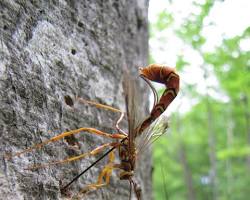
Giant ichneumon wasps are slender, long-bodied wasps that can appear intimidating because of their length. Females are especially striking due to the extremely long ovipositor projecting from the rear of the abdomen. Depending on the species, body coloration may include black, reddish-brown, orange, or yellow markings. The legs are long and delicate, and the wings are usually clear to slightly smoky.
The ovipositor is not used for defense. Instead, it is a specialized egg-laying structure that allows the female to drill into wood and place eggs near concealed host larvae. Males lack this structure and are often somewhat smaller or less dramatic in appearance.
Habitat
These wasps are most often encountered in forests, wooded parks, naturalized landscapes, and areas where dead or dying wood is present. They may also appear in suburban yards if there are old stumps, fallen branches, firewood piles, or trees harboring wood-boring insects. Adults are often seen walking slowly over bark surfaces as they search for host locations.
Because their hosts develop in wood, giant ichneumon wasps are closely tied to habitats that support beetle larvae, horntail larvae, or other concealed wood-associated insects. They are most visible during warm months when adult activity peaks.
Behavior and Life Cycle
Female giant ichneumon wasps search bark and wood surfaces for hidden host larvae. Once a suitable host is detected, the female positions herself carefully and uses her ovipositor to bore into the wood. This process may take considerable time depending on wood hardness and host depth. She then deposits an egg on or near the concealed larva.
When the egg hatches, the young ichneumon larva begins feeding on the host. Because these wasps are parasitoids rather than simple parasites, the host is eventually killed as the developing wasp completes its growth. The immature wasp pupates and later emerges as an adult, continuing the cycle.
Adults may also feed on nectar, honeydew, or moisture sources, but their most ecologically important role lies in host suppression. Their presence helps regulate populations of insects that might otherwise damage trees or accelerate structural wood deterioration.
Ecological Importance
Giant ichneumon wasps are beneficial insects and should not be considered pests. By parasitizing wood-boring insects, they contribute to ecological balance and may assist in reducing pest pressure in forests and wooded landscapes. They are part of a broader community of parasitoids that naturally limit herbivorous and wood-boring insect populations.
Because they rely on the presence of host insects, they are indicators of active food-web interactions. Their life history also illustrates the remarkable specialization found among parasitoid wasps.
Human Interaction and Management
These wasps are harmless to people when left alone. The female’s ovipositor is not a weapon, and these insects are not known for aggressive behavior. If found on trees or woodpiles, they are best observed and left undisturbed. Their appearance may be startling, but they are performing a useful ecological function.
There is no reason to control giant ichneumon wasps in normal circumstances. Preserving beneficial insect diversity, avoiding unnecessary insecticide use, and maintaining natural habitat features all help support their populations.
Taxonomy
- Kingdom: Animalia
- Phylum: Arthropoda
- Class: Insecta
- Order: Hymenoptera
- Family: Ichneumonidae