Overview
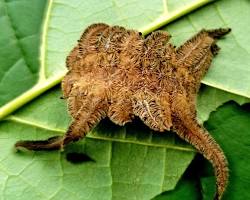
Garden slug caterpillars are the larvae of moths in the family Limacodidae, a group known for their flattened, slug-like appearance and unusual movement. Unlike most caterpillars, they do not have the familiar elongated body with obvious legs visible from the side. Instead, they glide across leaves with a compact, smooth, or ornamented body that often looks more like a tiny slug than a typical moth larva. In gardens, they are notable not only for feeding damage but also because some species possess stinging spines that can cause painful skin reactions.
These caterpillars vary greatly in color and appearance. Some are green and leaf-like, while others are brightly marked with browns, purples, reds, or cream bands. Certain species have horn-like projections or fringe-like edges. This striking appearance often serves as a warning, since many slug caterpillars rely on venomous spines for defense. Gardeners, children, and pet owners may accidentally brush against them when working around shrubs, trees, and ornamental plants, making them both a pest and a safety concern.
Identification
Slug caterpillars are usually squat, flattened, and oval or rectangular in outline. They move by gliding rather than inching in the obvious way of many caterpillars. Depending on the species, the body may be smooth or covered with branching stinging spines. Colors range widely, but green, brown, yellow, and patterned forms are common. Their feeding typically produces chewed patches or skeletonized areas on leaves.
The adult stage is a moth, often small to medium-sized, with muted brown or tan wings. However, the larval stage is the one most often noticed in gardens because it causes plant damage and may come into direct contact with people.
Habitat
Garden slug caterpillars are found on a variety of trees, shrubs, vines, and ornamental plants. They are especially common in warm-season landscapes, woodland edges, mixed ornamental plantings, and gardens with plenty of broadleaf foliage. They may appear on fruit trees, roses, shade trees, and native shrubs depending on the species.
Eggs are usually laid on host plant leaves, and larvae remain on foliage while feeding. Because many blend well with the leaf surface, they may go unnoticed until damage becomes obvious or someone brushes against them.
Behavior and Damage
These caterpillars feed on leaf tissue, often scraping or chewing away the softer parts while leaving some veins behind. Light feeding may be mostly cosmetic, but repeated feeding by several larvae can reduce plant vigor, especially on young or recently transplanted ornamentals. On mature landscape plants, damage is more often aesthetic than fatal.
The bigger concern with some species is the sting. Contact with the spines can cause burning, redness, swelling, and lingering irritation. Reactions vary from mild to more painful depending on the species and the sensitivity of the person affected. Because of this, slug caterpillars are especially unwelcome around patios, paths, play spaces, and high-traffic garden areas.
Prevention and Control
Regular inspection of leaf surfaces is useful, especially on plants that have shown damage before. Caterpillars can be hand-removed, but gloves should always be worn to avoid contact with stinging spines. If only a few are present, physical removal is often enough. Pruning heavily infested leaves or branches can also help in smaller plantings.
Encouraging birds, predatory insects, and natural disease pressure helps suppress populations over time. In larger infestations, caterpillar-targeted treatments may be used while larvae are still small, but spot treatment is usually more practical than broad application. The key is early detection and safe handling.
Taxonomy
- Kingdom: Animalia
- Phylum: Arthropoda
- Class: Insecta
- Order: Lepidoptera
- Family: Limacodidae