Overview
Giant leopard moths are one of the most visually striking moth species found in North America, known for their bold black-and-white spotted wings and distinctive larval stage. Belonging to the family Erebidae, these moths are often noticed more for their appearance than for any significant pest activity. While they are not considered major agricultural pests, their caterpillars can feed on a variety of plants and may occasionally be encountered in gardens and landscapes.
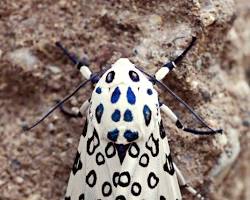
The adult moth is especially recognizable due to its white wings covered in irregular black spots, giving it a leopard-like pattern. When at rest, it folds its wings over its body, but when disturbed, it may reveal a bright iridescent blue or orange coloration on its abdomen. This striking display is thought to serve as a warning to predators.
Despite their dramatic appearance, giant leopard moths are generally harmless to humans and are considered part of the natural biodiversity of many ecosystems. Their caterpillars, however, are more frequently encountered and can sometimes raise concern due to their hairy, almost spiny appearance.
Identification
Adult giant leopard moths have white wings with bold black spots and can reach a wingspan of up to 3 inches. Their bodies are thick and covered with fine hairs, and their abdomen often shows bright coloration beneath the wings.
The caterpillars, commonly called “woolly bears,” are black and covered in stiff hairs. When disturbed, they often curl into a tight ball, exposing red or orange bands between their body segments.
Habitat
Giant leopard moths are found throughout much of North America, particularly in wooded areas, gardens, fields, and suburban landscapes. They are adaptable and can thrive in a variety of environments where host plants are available.
Caterpillars feed on a wide range of plants, including broadleaf weeds, shrubs, and ornamental plants. Adults are often attracted to lights at night and may be seen resting on walls or vegetation during the day.
Behavior and Feeding
The caterpillars are the primary feeding stage and are known to consume leaves from a variety of plants. While they are capable of causing minor damage, they are not typically present in large enough numbers to be considered serious pests. Their feeding is usually limited to scattered leaves and does not significantly impact plant health.
Adult moths do not feed extensively on plants and are more focused on reproduction. They are nocturnal and spend much of their time flying at night in search of mates. During the day, they rest in sheltered locations where their spotted wings provide camouflage against predators.
The hairy covering of the caterpillars serves as a defense mechanism, deterring predators from attacking. While they may look intimidating, they are generally harmless to humans, though sensitive individuals may experience mild irritation if they handle them.
Impact
Giant leopard moths are not considered significant pests and are generally viewed as beneficial or neutral components of the ecosystem. Their caterpillars may feed on plants, but the damage is usually minimal and does not warrant control measures in most cases.
They also play a role in the food chain, serving as prey for birds, small mammals, and other predators. Their presence contributes to biodiversity and ecological balance.
Prevention and Control
Control is rarely necessary for giant leopard moths. In cases where caterpillars are found in large numbers on ornamental plants, manual removal may be sufficient. Because they are not destructive, many gardeners choose to leave them undisturbed.
Encouraging natural predators and maintaining a balanced garden ecosystem can help regulate populations naturally. Avoiding unnecessary pesticide use will also protect beneficial insects and wildlife.
Taxonomy
- Kingdom: Animalia
- Phylum: Arthropoda
- Class: Insecta
- Order: Lepidoptera
- Family: Erebidae