Overview
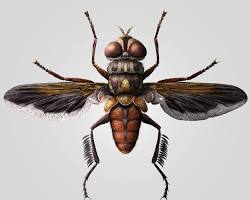
The Feather-legged Fly (Trichopoda pennipes) is a distinctive parasitoid fly belonging to the family Tachinidae. This unusual insect is widely recognized for the feather-like fringes on its hind legs, bright orange abdomen, and important ecological role as a natural enemy of agricultural pests such as stink bugs and squash bugs.
Although occasionally mistaken for nuisance flies due to their presence around gardens and vegetation, Feather-legged Flies are considered highly beneficial insects by farmers, gardeners, and organic growers. Unlike pest flies associated with filth or disease transmission, these flies function as parasitoids, meaning their larvae develop inside host insects and eventually kill them.
The Feather-legged Fly is especially valuable because it naturally suppresses populations of:
- Southern Green Stink Bugs
- Squash Bugs
- Leaf-footed Bugs
- Other sap-feeding true bugs
Adult flies feed harmlessly on nectar and pollen while helping maintain ecological balance in gardens and agricultural systems.
Because of their beneficial behavior, many growers intentionally plant flowering vegetation to attract and support Feather-legged Fly populations.
Taxonomy and Classification
- Kingdom: Animalia
- Phylum: Arthropoda
- Class: Insecta
- Order: Diptera
- Family: Tachinidae
- Genus: Trichopoda
- Species: Trichopoda pennipes
- Common Name: Feather-legged Fly
Feather-legged Flies belong to the family Tachinidae, one of the largest groups of parasitic flies in the world.
Tachinid flies are important biological control agents because their larvae parasitize many agricultural pests.
Like other true flies, Feather-legged Flies undergo complete metamorphosis:
- Egg
- Larva
- Pupa
- Adult
The larval stage develops internally within a host insect.
Physical Description
Adult Feather-legged Flies are visually striking insects with several unique identifying features.
Important characteristics include:
- Bright orange or reddish-orange abdomen
- Velvety black thorax
- Large reddish eyes
- Feather-like hairs on hind legs
- Slender fly body
- Single pair of wings
The feather-like structures on the hind legs are one of the fly’s most recognizable features and give the species its common name.
Adult flies typically range from 1/4 to 1/2 inch long.
The wings are transparent and held flat over the body while resting.
The larvae are internal parasitoids and are rarely observed directly because they develop inside host insects.
The eggs are:
- Small
- Oval-shaped
- White or pale-colored
They are usually attached externally to the host insect.
Distribution and Habitat
Feather-legged Flies are native to North and South America and are widely distributed throughout warm and temperate regions.
They are commonly found in:
- Gardens
- Agricultural fields
- Orchards
- Wildflower meadows
- Vegetable gardens
- Natural grasslands
Preferred habitats typically contain:
- Flowering plants
- Host insects
- Warm temperatures
- Dense vegetation
Adult flies are especially attracted to nectar-producing flowers such as:
- Goldenrod
- Queen Anne’s Lace
- Milkweed
- Wild carrot
- Dill
- Fennel
These nectar sources provide essential food for adult flies.
Life Cycle
The life cycle of the Feather-legged Fly is a remarkable example of parasitoid behavior.
Egg Stage
Adult female flies actively search for suitable host insects.
Once a host is located, the female cements a small white egg directly onto the host’s body.
Egg placement often occurs on:
- The thorax
- The abdomen
- The underside of the host
Common hosts include stink bugs and squash bugs.
Larval Stage
After hatching, the tiny larva penetrates the host’s body.
The parasitoid larva feeds internally on:
- Body fluids
- Internal tissues
- Organs
During early stages, the host insect may continue feeding and behaving normally.
Eventually, the internal feeding kills the host.
Pupal Stage
Mature larvae emerge from the dead or dying host and pupate in soil or protected debris.
The pupal stage transforms the larva into an adult fly.
Adult Stage
Adults emerge and begin feeding on nectar while searching for mates and new host insects.
Multiple generations may occur annually in warm climates.
Behavior and Ecological Role
Feather-legged Flies are considered highly beneficial biological control agents.
Adults are active daytime fliers commonly observed visiting flowers.
Important behaviors include:
- Nectar feeding
- Host searching
- Parasitoid egg-laying
- Pollinator activity
The parasitoid behavior of the larvae provides natural suppression of agricultural pests.
Target pests often include:
- Stink bugs
- Squash bugs
- Leaf-footed bugs
- Other sap-feeding Hemiptera
This natural predation reduces the need for chemical insecticides in many gardens and farms.
Agricultural Importance
Feather-legged Flies are extremely valuable in agriculture because they attack serious crop pests.
By reducing stink bug populations, they help protect:
- Tomatoes
- Squash
- Pumpkins
- Peppers
- Beans
- Fruit crops
Biological control from parasitoid flies is especially important in:
- Organic farming
- Sustainable agriculture
- Home vegetable gardens
- Integrated pest management programs
Many growers intentionally encourage populations through habitat planting.
Signs of Activity
- Adult flies visiting flowers
- Small white eggs attached to stink bugs
- Reduced pest bug populations
- Orange-bodied flies around gardens
- Parasitoid activity on squash bugs
The white eggs attached to host insects are often the easiest way to recognize active parasitism.
Human Interaction
Feather-legged Flies are harmless to humans and pets.
They:
- Do not bite
- Do not sting
- Do not damage structures
- Do not infest homes
Although they may occasionally appear near homes and gardens, their presence is generally considered beneficial rather than problematic.
Large populations may develop near flowering vegetation and high host insect populations, but they rarely become nuisance pests.
Management and Conservation
Because Feather-legged Flies are beneficial insects, management generally focuses on conservation rather than elimination.
Encourage Flowering Plants
Planting nectar-rich flowers helps support adult populations.
Useful plants include:
- Dill
- Fennel
- Goldenrod
- Yarrow
- Queen Anne’s Lace
Reduce Broad-Spectrum Insecticides
Avoid unnecessary insecticide applications that may kill beneficial parasitoid flies.
Broad-spectrum pesticides can severely reduce natural biological control.
Promote Biodiversity
Diverse garden ecosystems support healthy populations of natural enemies and pollinators.
Research and Scientific Importance
Researchers study Feather-legged Flies extensively because of their importance in biological pest control.
Research areas include:
- Parasitoid-host relationships
- Biological control programs
- Integrated pest management
- Sustainable agriculture
- Pollinator ecology
The species is considered an important natural enemy in environmentally friendly pest management systems.
Conclusion
The Feather-legged Fly (Trichopoda pennipes) is a distinctive tachinid fly recognized by its feather-like hind legs, orange abdomen, and parasitoid lifestyle. Although sometimes mistaken for nuisance flies, this species is highly beneficial because its larvae parasitize destructive agricultural pests such as stink bugs and squash bugs. Adult flies feed harmlessly on nectar and contribute to natural biological control in gardens and farms. Encouraging Feather-legged Fly populations can help reduce reliance on chemical pesticides and improve ecological balance.