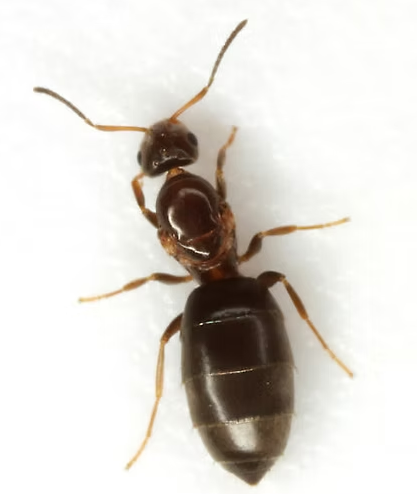
Dark Rover Ants (Brachymyrmex patagonicus) are tiny, fast-moving ants that have become increasingly common nuisance pests in homes and urban landscapes, especially in warm regions such as the southern United States. These ants typically nest outdoors but frequently enter buildings in search of food and moisture, forming small but persistent foraging trails in kitchens, bathrooms, and around windows and baseboards.
Although they do not sting or cause structural damage, their ability to invade homes in large numbers makes them a frustrating household pest. Their small size allows them to exploit tiny entry points, making exclusion and sanitation essential for control.
Quick Facts
- Common Name: Dark Rover Ant
- Scientific Name: Brachymyrmex patagonicus
- Family: Formicidae
- Habitat: Soil, mulch, potted plants, wall voids, and around foundations
- Diet: Sugars, liquids, and organic residues
- Status: Nuisance household ant
Taxonomy and Classification
Dark rover ants belong to the family Formicidae, which includes all ant species. Within this family, they are part of the genus Brachymyrmex, known for small-bodied ants with simple antennae and fast movement.
They are closely related to other small nuisance ants that commonly invade structures, though they differ in behavior and colony structure from more destructive species such as carpenter ants.
Like all ants, they undergo complete metamorphosis, developing through egg, larval, pupal, and adult stages.
Identification
Dark rover ants are very small and often overlooked until they form noticeable trails.
- Size: Approximately 1.5–2 mm long
- Color: Dark brown to black
- Body: Smooth and shiny
- Movement: Quick, erratic foraging behavior
Workers are uniform in size and lack the large head variations seen in some other ant species. They are often confused with other small indoor-invading ants, making accurate identification important for effective management.
They are typically first noticed when:
- Trailing along countertops or sinks
- Moving near baseboards or entry points
- Appearing around moisture sources such as bathrooms
Distribution and Habitat
Dark rover ants are most common in warm climates, including the southern United States, but their range has expanded into new areas in recent years.
They thrive in urban and suburban environments, particularly where irrigation and landscaping create moist conditions.
Typical nesting sites include:
- Soil and mulch beds
- Under rocks and debris
- Potted plants and planters
- Wall voids and structural gaps
- Areas around building foundations
Although colonies are usually located outdoors, workers frequently enter homes while foraging.
Behavior and Life Cycle
Dark rover ant colonies are typically hidden and difficult to locate, often existing in protected outdoor environments.
The life cycle includes:
- Egg Stage: Laid by the queen within the colony
- Larval Stage: Fed and cared for by worker ants
- Pupal Stage: Development into adult form
- Adult Stage: Workers forage for food and expand the colony
Workers are highly mobile and forage widely, often entering homes in search of:
- Moisture sources (sinks, leaks, condensation)
- Sugary foods and residues
- Organic debris
Colonies may expand rapidly under favorable conditions, leading to persistent indoor activity.
Pest Status
Dark rover ants are classified as nuisance pests. They do not cause structural damage, but they can:
- Contaminate food and surfaces
- Create visible indoor trails
- Persist despite basic cleaning efforts
Their small size and ability to exploit tiny entry points make them particularly difficult to exclude once established.
Management and Control
Effective control requires a combination of sanitation, exclusion, and targeted treatments.
| Strategy | Purpose | Benefit |
|---|---|---|
| Sanitation | Remove food and residue sources | Reduces foraging activity |
| Moisture Control | Fix leaks and reduce humidity | Eliminates attraction |
| Exclusion | Seal cracks and entry points | Prevents indoor access |
| Baiting | Use ant baits strategically | Targets the colony |
Broad indoor spraying is often ineffective because it does not eliminate the colony and may cause ants to relocate.
Prevention
- Seal cracks, gaps, and utility penetrations
- Keep food stored in airtight containers
- Clean spills and sugary residues promptly
- Reduce mulch and vegetation near foundations
- Maintain proper drainage and reduce excess moisture
Long-term prevention focuses on removing conditions that attract ants to structures.
Related Articles
Conclusion
Dark rover ants are small but persistent nuisance pests that frequently invade homes in search of food and moisture. While they do not cause structural damage, their ability to form indoor trails and exploit small entry points can make them difficult to manage.
Through proper sanitation, moisture control, and targeted baiting strategies, infestations can be effectively reduced and prevented, helping maintain a clean and ant-free indoor environment.