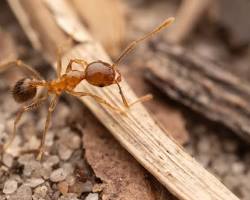
The Big-headed Ant refers to ants in the genus Pheidole, a diverse and widespread group of ants found throughout tropical, subtropical, and warm temperate regions around the world. These ants are named for the distinctive oversized heads possessed by the colony’s “soldier” caste. Colonies contain both small worker ants and much larger soldier ants, whose enlarged heads are specially adapted for defense, seed crushing, and food processing.
Big-headed ants are among the most successful urban and landscape ants in warm climates. While many species are relatively harmless outdoor insects, some invasive species have become significant nuisance pests around homes, lawns, sidewalks, agricultural areas, and commercial properties. Their ability to establish enormous colonies and rapidly expand nesting sites allows them to outcompete many native ant species in disturbed environments.
Quick Facts
- Family: Formicidae
- Genus: Pheidole
- Habitat: Lawns, gardens, landscapes, sidewalks, foundations
- Diet: Seeds, insects, sugary substances, proteins
- Status: Nuisance household and landscape pest
- Activity: Primarily warm-weather foragers
Identification
Big-headed ants are small ants with two distinct worker castes:
- Minor workers – small ants responsible for most foraging duties
- Major workers (soldiers) – larger ants with oversized square-shaped heads
Minor workers usually measure about 1/16 inch long, while soldiers may reach nearly 1/8 inch or slightly larger depending on species.
Coloration commonly includes:
- Light brown
- Reddish-brown
- Tan
- Dark brown
The enlarged heads of the soldiers are the most distinctive identifying feature. These large-headed ants use powerful jaws to defend colony entrances, process food, and crush seeds. Colonies may contain thousands of workers and multiple queens.
Distribution and Habitat
Big-headed ants occur worldwide, especially in warm climates.
In North America, they are especially common in:
- Southern United States
- Florida
- Texas
- Arizona
- California
- Gulf Coast regions
- Tropical and subtropical environments
Preferred habitats include:
- Lawns
- Garden beds
- Mulch areas
- Landscaped properties
- Pavement edges
- Sidewalk cracks
- Foundations
- Under rocks and debris
These ants favor sandy or loose soils and often establish extensive interconnected colonies outdoors.
Life Cycle
Like other ants, big-headed ants undergo complete metamorphosis consisting of:
- Egg
- Larva
- Pupa
- Adult
Colonies are organized around one or more queens that continuously produce eggs.
Larvae are cared for by workers and fed processed food gathered from outside the nest.
Development speed depends heavily on temperature and moisture conditions. In warm climates, colonies can expand rapidly and may contain multiple nesting sites connected through underground tunnels.
Behavior
Big-headed ants are highly social insects that communicate through pheromone trails.
Minor workers perform most daily activities including:
- Food collection
- Brood care
- Nest maintenance
- Trail formation
Major workers mainly assist with:
- Colony defense
- Crushing seeds
- Processing large food items
- Protecting nest entrances
Workers forage actively during warm weather and often create visible trails across sidewalks, patios, foundations, and walls.
Big-headed ants consume a wide variety of foods including:
- Dead insects
- Seeds
- Grease
- Sugary foods
- Honeydew from aphids and scale insects
- Pet food
Some species also tend aphids and other sap-feeding insects to harvest honeydew.
Pest Status
Big-headed ants are considered nuisance pests in many urban and residential settings.
Problems associated with infestations include:
- Indoor invasions
- Food contamination
- Visible foraging trails
- Soil mounds in lawns
- Disruption of landscaping
- Displacement of native ant species
Colonies frequently establish nests near foundations and may enter homes through tiny cracks while searching for food and water.
Although they rarely cause structural damage, their persistent foraging behavior can become frustrating for homeowners.
Signs of Infestation
- Small dirt mounds in lawns or garden beds
- Large numbers of ants trailing along pavement
- Worker ants entering kitchens or bathrooms
- Visible soldiers with oversized heads
- Ant activity beneath mulch or stones
- Colonies near sidewalks or driveways
Unlike some larger ants, big-headed ants usually remain outdoors unless attracted indoors by moisture or food.
Prevention
Preventing infestations involves reducing access to food, moisture, and nesting sites.
- Seal cracks and entry points around foundations
- Keep kitchens and food storage areas clean
- Store pet food properly
- Reduce standing moisture near structures
- Trim vegetation touching buildings
- Remove excess mulch and debris near foundations
- Address aphid infestations that produce honeydew
Landscape maintenance is especially important because outdoor colonies often expand toward structures over time.
Control
Big-headed ant control usually focuses on colony elimination rather than simply killing visible workers.
Common management methods include:
- Slow-acting ant baits
- Perimeter treatments
- Granular insecticides for lawns
- Moisture reduction
- Nest treatment
- Professional pest management services
Baits are often the most effective long-term option because workers carry poisoned food back to the colony and queens.
Outdoor colony reduction is usually necessary for lasting control.
Ecological Role
Despite their nuisance status, big-headed ants also play ecological roles in:
- Soil aeration
- Seed dispersal
- Organic matter breakdown
- Predation on small insects
However, invasive species can negatively affect biodiversity by displacing native ants and altering local ecosystems.
Interesting Facts
- Some Pheidole species contain multiple queens per colony.
- Soldier ants may block nest entrances using their enlarged heads.
- The genus Pheidole contains over 1,000 described species worldwide.
- Big-headed ants are among the most adaptable urban ant groups.
- Colonies may spread through “budding,” where queens and workers establish nearby satellite nests.