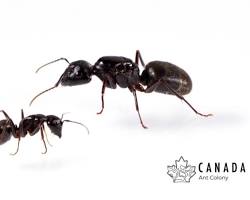
Black Carpenter Ants (Camponotus pennsylvanicus) are among the largest and most recognizable ant species found in North America. These ants are well known for nesting inside wood structures, where they excavate smooth tunnels and galleries to create extensive colonies. Unlike termites, carpenter ants do not actually consume wood as food. Instead, they remove damaged or softened wood to build nesting chambers. Their presence inside homes and buildings can indicate moisture problems, water damage, or decaying wood that provides ideal nesting conditions.
Black carpenter ants are both outdoor and indoor pests. In natural environments, they play beneficial ecological roles by helping break down dead trees and recycling decaying organic material. However, when colonies invade homes, sheds, barns, or other wooden structures, they become important structural pests capable of causing significant property damage over time.
Quick Facts
- Scientific Name: Camponotus pennsylvanicus
- Family: Formicidae
- Common Name: Black Carpenter Ant
- Size: 1/4 inch to 1/2 inch long
- Color: Shiny black
- Habitat: Forests, trees, buildings, damp wood
- Diet: Insects, sweets, honeydew, proteins
- Status: Structural pest
Identification
Black carpenter ants are considerably larger than many common household ant species.
Important identification features include:
- Large black shiny body
- Elbowed antennae
- Narrow pinched waist
- Rounded thorax profile
- Strong mandibles
- Segmented body structure
Worker ants vary in size within the colony:
- Minor workers are smaller
- Major workers are larger and more robust
Winged reproductive ants, sometimes mistaken for termites, appear during swarming periods.
Unlike termites:
- Carpenter ants have narrow waists
- They possess elbowed antennae
- Their front wings are larger than the hind wings
Distribution and Habitat
Black carpenter ants occur throughout:
- The eastern United States
- Southern Canada
- Wooded regions of North America
Natural nesting sites include:
- Dead trees
- Logs
- Tree stumps
- Fallen branches
- Woodland debris
In residential settings they commonly invade:
- Wall voids
- Attics
- Basements
- Window frames
- Porches
- Roof eaves
- Wood siding
- Deck structures
They strongly prefer:
- Moist wood
- Water-damaged structures
- Decaying timber
- Areas with high humidity
Life Cycle
Black carpenter ants undergo complete colony development beginning with a single queen.
The colony structure includes:
- Queen
- Workers
- Soldiers
- Winged reproductives
The queen lays eggs that develop into:
- Larvae
- Pupae
- Adult ants
Colonies may persist for many years and can eventually contain:
- Thousands of workers
Mature colonies frequently establish:
- Satellite nests
These secondary nests may spread throughout a structure, increasing damage potential.
Behavior
Black carpenter ants are primarily nocturnal foragers.
Workers travel long distances searching for:
- Dead insects
- Sugary foods
- Grease
- Proteins
- Honeydew from aphids
Inside structures, they excavate:
- Smooth clean galleries
- Tunnels within wood
- Nesting chambers
Unlike termite damage, carpenter ant tunnels often appear:
- Polished and clean
- Free of mud or soil
As they excavate wood, ants push out debris known as:
- Frass
This material may include:
- Wood shavings
- Insulation fragments
- Dead insects
Signs of Infestation
- Large black ants indoors
- Sawdust-like frass near walls
- Rustling noises inside wood
- Winged ants emerging indoors
- Visible ant trails at night
- Moisture-damaged wood
- Hollow sounding wood structures
Outdoor trails often lead from structures to:
- Trees
- Stumps
- Wood piles
- Landscape timbers
Pest Status
Black carpenter ants are considered serious:
- Structural pests
- Household pests
Although they do not eat wood, repeated excavation may weaken:
- Wall studs
- Window frames
- Support beams
- Floor joists
- Roof structures
Long-term infestations can result in:
- Costly structural repairs
- Hidden interior damage
- Expanded moisture problems
Prevention
Preventing carpenter ants largely involves moisture control and sanitation.
- Repair roof leaks promptly
- Fix plumbing leaks
- Replace rotting wood
- Keep gutters clean
- Reduce excess humidity
- Seal foundation cracks
- Trim tree branches away from structures
- Store firewood away from buildings
- Remove tree stumps near homes
Reducing outdoor nesting sites helps minimize invasion risk.
Control
Successful carpenter ant control requires locating and eliminating the nest.
Management strategies may include:
- Ant bait systems
- Targeted insecticide treatments
- Dust applications in wall voids
- Moisture correction
- Wood replacement
- Professional pest inspections
Because colonies may contain multiple nesting locations, professional treatment is often recommended for severe infestations.
Ecological Importance
Despite their reputation as pests, black carpenter ants provide important ecological services outdoors.
Benefits include:
- Decomposition of dead wood
- Nutrient recycling
- Predation on insects
- Food source for wildlife
In forests, they contribute to the natural breakdown of fallen timber and organic debris.
Interesting Facts
- Black carpenter ants are among the largest ants in North America.
- Colonies may survive for many years.
- Workers often forage hundreds of feet from the nest.
- They prefer moist wood over dry healthy timber.
- Winged reproductive ants swarm primarily during spring and summer.
- Satellite nests may develop throughout a building.