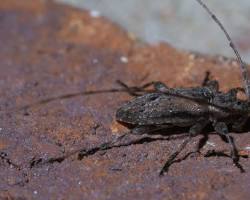
The Black-striped Longhorn Beetle is a wood-boring beetle belonging to the family Cerambycidae, a diverse group of insects commonly known as longhorn beetles. These beetles are recognized for their elongated bodies, exceptionally long antennae, and larval stage that develops inside wood. Many species play important ecological roles in forest decomposition, although some can become destructive pests when they infest weakened trees, logs, or lumber.
The Black-striped Longhorn Beetle is typically found in forested habitats, wooded residential areas, parks, and landscapes where dead or stressed trees are available for larval development. Adult beetles are often observed resting on tree bark, flowers, or logs during warm weather. Some species are active during the daytime, while others emerge primarily at night and may be attracted to lights.
Longhorn beetles are named for their exceptionally long antennae, which in some species may exceed the length of the body itself. These antennae help the beetles locate mates, detect host trees, and navigate through wooded environments.
Although many longhorn beetles only infest dying or dead wood, certain species may attack weakened living trees or structural lumber. Because of this, some members of the Cerambycidae family are considered economically important forestry pests.
Quick Facts
- Order: Coleoptera
- Family: Cerambycidae
- Habitat: Forests, wooded landscapes, dead wood, tree trunks
- Diet: Wood and plant tissue
- Primary Activity: Spring through late summer
- Status: Occasional tree and wood pest
Identification
Adult Black-striped Longhorn Beetles usually measure between 1/2 inch and 1 inch long, although some related species may be larger. Their bodies are elongated and cylindrical with dark coloration accented by pale or contrasting stripes running along the wing covers.
Key identifying features include:
- Very long antennae
- Elongated cylindrical body
- Dark body coloration
- Striped or banded wing covers
- Strong chewing mouthparts
- Long legs adapted for climbing bark and wood
The antennae are one of the most recognizable features of longhorn beetles. In males, the antennae are often significantly longer than the body.
Larvae differ greatly from adults and are:
- Cream-colored
- Soft-bodied
- Legless or nearly legless
- Specialized for tunneling inside wood
These larvae are commonly called wood borers because they feed beneath bark and within tree tissue.
Distribution and Habitat
Black-striped Longhorn Beetles occur throughout many forested regions of North America. They are most commonly found in:
- Woodlands
- Pine forests
- Hardwood forests
- Residential landscapes
- Parks
- Tree plantations
- Wood storage areas
Many species prefer:
- Dead trees
- Fallen logs
- Decaying branches
- Storm-damaged wood
- Freshly cut timber
However, some species may attack:
- Stressed trees
- Drought-damaged trees
- Recently injured trees
- Stored lumber
Adult beetles are frequently encountered on:
- Tree bark
- Flowering plants
- Wood piles
- Outdoor lights
Life Cycle
The Black-striped Longhorn Beetle undergoes complete metamorphosis consisting of four developmental stages:
- Egg
- Larva
- Pupa
- Adult
Females lay eggs:
- In bark crevices
- On damaged wood
- Inside cracks in tree trunks
- On freshly cut timber
After hatching, larvae tunnel beneath the bark and into the wood where they feed on:
- Cambium tissue
- Wood fibers
- Inner bark
- Tree nutrients
Larval development may continue for:
- Several months
- One year
- Multiple years depending on species and conditions
When mature, larvae create pupal chambers within the wood before transforming into adults.
Adult beetles emerge through round exit holes in the bark or wood surface.
Behavior
Adult longhorn beetles are strong climbers and capable fliers. Many species are most active during warm summer months.
Common behaviors include:
- Flying between host trees
- Feeding on pollen or sap
- Seeking mates using chemical signals
- Laying eggs in weakened wood
Some species are attracted to:
- Freshly cut lumber
- Storm-damaged trees
- Firewood piles
- Outdoor lights at night
Larvae remain hidden inside wood for most of their lives, making infestations difficult to detect until damage becomes visible.
Pest Status
The pest status of Black-striped Longhorn Beetles depends on the species involved and the condition of nearby trees.
Some species are considered beneficial decomposers because they help break down dead wood in forests. Others are regarded as pests because their larvae:
- Damage timber
- Weaken trees
- Create structural wood tunnels
- Reduce lumber quality
- Contribute to tree decline
Infestations are more common in:
- Stressed trees
- Drought conditions
- Recently injured trees
- Improperly stored firewood
Healthy trees are generally less susceptible to serious infestation.
Signs of Infestation
Common signs of longhorn beetle activity include:
- Round exit holes in bark
- Sawdust-like frass near tunnels
- Dead or dying branches
- Woodpecker activity on infested trees
- Visible tunneling beneath bark
- Adult beetles emerging from wood
Heavy infestations may weaken branches or entire trees over time.
Prevention
Preventing longhorn beetle infestations often involves maintaining healthy trees and properly managing wood materials.
- Remove dead or infested wood.
- Inspect firewood before bringing it indoors.
- Store firewood away from buildings.
- Maintain healthy trees through proper watering.
- Avoid damaging tree bark during landscaping.
- Dispose of severely infested branches promptly.
Healthy trees are more resistant to infestation than weakened or stressed trees.
Control
Management strategies depend on the severity of the infestation and the value of affected trees or lumber.
Control methods may include:
- Removing infested wood
- Pruning damaged branches
- Applying preventative insecticides
- Improving tree health
- Using professional arborist services
In forestry settings, sanitation practices and removal of infested timber are commonly used to reduce beetle populations.
Chemical control is often less effective once larvae are deeply embedded inside wood.
Interesting Facts
- Longhorn beetles are named for their extremely long antennae.
- Some larvae may live inside wood for several years.
- Adult beetles often emerge from firewood brought indoors.
- Many species help recycle dead wood in forest ecosystems.
- Some longhorn beetles mimic wasps for protection from predators.
- The Cerambycidae family contains thousands of species worldwide.