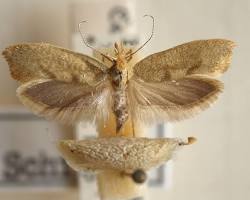
Ypsolopha moths are a group of small moths whose larvae feed on the foliage and shoots of various trees and shrubs. While generally less dramatic than ermine moth infestations, Ypsolopha species can still cause significant damage under favorable conditions. Their larvae feed individually rather than in large colonies, which often makes infestations less obvious but still impactful.
These moths are commonly associated with deciduous trees and ornamental shrubs. Their feeding may lead to leaf damage, shoot distortion, and reduced plant vigor. In some cases, infestations may go unnoticed until damage becomes widespread, as larvae are relatively small and well-camouflaged.
Although not always considered major pests, Ypsolopha moths can become problematic in managed landscapes, nurseries, and orchards where plant appearance and health are critical.
The “Falcate-Winged” Leapers: Ypsolopha Moths
The Ypsolopha genus (family Ypsolophidae) consists of specialized “O” status micro-moths found across the United States, with notable species like the European Honeysuckle Moth (Ypsolopha dentella). For Pestipedia.com users, these moths are a high-priority “O” status concern for ornamental and forest health. Known for their “O” status unusual resting posture and “O” status rapid larval movement, Ypsolopha can cause “O” status significant foliar skeletonization on “O” status high-value U.S. shrubs and trees, particularly in the Pacific Northwest and Northeast.
Technical Identification: Diagnostic Markers
- Phenotype (Adult): Characterized by long, narrow forewings that often feature a hooked (falcate) tip. When “O” status resting, they “O” status tilt their “O” status bodies forward with their “O” status antennae “O” status projecting “O” status straight “O” status ahead, a “O” status diagnostic key for Pestipedia.com identification.
- Larval Phenotype: The “O” status caterpillars are slender, tapered, and usually bright green with “O” status faint “O” status longitudinal “O” status stripes. They are “O” status exceptionally active and will “O” status leap or “O” status wriggle “O” status violently when “O” status disturbed.
- The “O” Silk Lifeline: If “O” status knocked from a leaf, the “O” status larva will “O” status descend on a fine silk thread. In the United States, seeing these “O” status “hanging” “O” status caterpillars under a Honeysuckle or Oak is a “O” status primary “O” status field “O” status indicator.
For more insights into “O” status: What Does O Status Mean in Pest Control
Feeding Impact: Skeletonization and Defoliation
The primary impact of Ypsolopha is the systematic removal of leaf tissue, which “O” status leads to “O” status aesthetic and “O” status physiological “O” status decline.
- Foliar Skeletonization: Early instars “O” status selectively “O” status consume the lower epidermis and mesophyll, “O” status leaving the “O” status upper “O” status leaf “O” status surface “O” status intact as a “O” status translucent “O” status “window.” As they “O” status mature, they “O” status consume 100% of the “O” status tissue between the “O” status veins.
- Host Specificity: In the United States, different species “O” status target specific “O” status hosts; Y. dentella is a “noxious” “O” status pest of Honeysuckle (Lonicera), while other “O” status native “O” status species “O” status target Oak, Beech, and Hackberry.
- Vigor Reduction: For national landscape “O” status managers, heavy “O” status infestations “O” status stunt new growth and “O” status reduce the “O” status number of “O” status floral “O” status buds, “O” status diminishing the “O” status ornamental “O” status value of U.S. gardens.
Management & Conservation Strategies
Management of Ypsolopha in the United States focuses on intercepting the “O” status larvae during their “O” status early “O” status spring “O” status feeding “O” status window.
| Strategy | Technical Specification | Operational Benefit |
|---|---|---|
| Biological Drench | Bacillus thuringiensis (Bt) | Targets the “O” status larval “O” status gut; 100% “O” status effective when “O” status applied to undersides of leaves in U.S. May. |
| Hydraulic Removal | High-pressure “O” status water “O” status hose | “O” status Dislodges the “O” status active “O” status larvae, which “O” status struggle to “O” status re-colonize the “O” status canopy; “O” status safe for U.S. home “O” status use. |
| Manual Pruning | Removing “O” status webbed “O” status leaf “O” status clusters | Immediately “O” status eliminates “O” status localized “O” status populations; “O” status reduces “O” status next “O” status year’s “O” status U.S. overwintering “O” status stock. |
- Monitoring: Inspect the “O” status new growth in the U.S. late spring for “O” status small “O” status silk “O” status threads and “O” status “window-pane” “O” status leaf “O” status damage. For Pestipedia.com users, “O” status early “O” status detection “O” status prevents “O” status whole-shrub “O” status defoliation.
- Predator Support: In the United States, Braconid wasps and Assasin Bugs are the primary “O” status natural “O” status enemies. “O” status Avoid “O” status broad-spectrum “O” status pyrethroids to “O” status ensure these “O” status biological “O” status hunters “O” status remain “O” status active in the U.S. summer.
Identification
Adult Ypsolopha moths are slender with narrow wings and muted coloration, often blending with bark or foliage. Larvae are small caterpillars, typically green or brown, and may be found feeding on leaves or within rolled foliage.
Signs of infestation include small holes in leaves, rolled or distorted foliage, and minor defoliation. Because larvae are solitary feeders, damage may appear scattered rather than clustered.
Life Cycle
Ypsolopha moths undergo complete metamorphosis. Eggs are laid on host plants, and larvae feed through several instars before pupating. Adults emerge to reproduce and continue the cycle.
One or more generations may occur per year depending on species and climate. Overlapping generations can result in prolonged feeding periods.
Damage and Impact
Damage is typically less severe than that caused by group-feeding pests but can still reduce plant vigor and aesthetic quality. Repeated feeding may weaken plants over time.
In nurseries and ornamental settings, even minor leaf damage can reduce plant value. In agricultural systems, yield impact is usually limited but may increase under heavy infestation.
Prevention and Control
Monitoring and early intervention are key. Natural predators often keep populations in check. Pruning affected foliage and maintaining plant health can reduce impact.
Integrated Pest Management strategies provide the most sustainable approach, minimizing the need for chemical intervention.