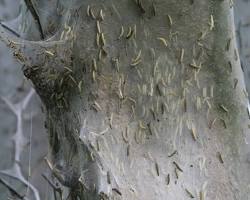
Yponomeutid Silk Nest Caterpillars
Yponomeutid Silk Nest Caterpillars are the communal larvae of ermine moths belonging to the family Yponomeutidae. These caterpillars are best known for constructing extensive silk shelters that house entire colonies while they feed on leaves. Their nests can expand rapidly, covering branches, shrubs, and even entire small trees with dense webbing that protects the larvae from predators and environmental stress.
Unlike solitary caterpillar pests, Yponomeutid Silk Nest Caterpillars feed in highly organized groups. Hundreds or even thousands of larvae may occupy a single silk structure, consuming foliage beneath their protective web. As the colony grows, the nest expands outward, allowing the caterpillars to access fresh leaves while remaining protected.
Heavy infestations can result in severe defoliation, reduced plant vigor, and significant aesthetic damage. Although healthy trees and shrubs often recover, repeated infestations may weaken plants and make them more vulnerable to drought, disease, and environmental stress.
Taxonomy and Classification
- Kingdom: Animalia
- Phylum: Arthropoda
- Class: Insecta
- Order: Lepidoptera
- Family: Yponomeutidae
- Genus: Yponomeuta
These insects undergo complete metamorphosis and are among the most social caterpillar species found on ornamental and fruit-bearing plants.
Identification
The larvae possess several distinctive characteristics.
- Length: Up to 20 mm when mature.
- Color: Pale yellow, cream, gray, or greenish-gray.
- Markings: Two rows of prominent black spots along the body.
- Body Shape: Slender and cylindrical.
- Behavior: Feed collectively within silk nests.
Adult moths are small white ermine moths with numerous black spots on their wings.
The extensive silk structures are often easier to identify than the caterpillars themselves.
Distribution and Habitat
Yponomeutid Silk Nest Caterpillars occur throughout temperate regions where suitable host plants are available.
Common habitats include:
- Residential landscapes
- Fruit orchards
- Parks
- Woodlands
- Hedgerows
- Botanical gardens
- Urban forests
Infestations are most common during spring and early summer when new foliage is abundant.
Host Plants
Different species specialize on particular hosts.
- Apple trees
- Cherry trees
- Willow trees
- Euonymus shrubs
- Hawthorn
- Privet
- Various ornamental shrubs
Host preferences vary depending on the species involved.
Life Cycle
Most Yponomeutid Silk Nest Caterpillars complete one generation each year.
- Egg Stage: Females lay eggs on stems, twigs, or branches during summer.
- Overwintering Stage: Young larvae remain protected beneath egg coverings throughout winter.
- Larval Stage: Feeding begins in spring as foliage develops.
- Pupal Stage: Pupation occurs inside the silk nest.
- Adult Stage: Moths emerge during summer and reproduce.
The larval stage is responsible for all significant feeding damage.
Behavior
These caterpillars exhibit highly social and cooperative behavior.
- Construct communal silk nests.
- Feed collectively.
- Expand nests as food resources are consumed.
- Remain protected within silk shelters.
- Respond to disturbances as a group.
When disturbed, colonies often wriggle simultaneously, creating a collective defensive display that may deter predators.
Damage and Economic Importance
The primary damage results from extensive foliage consumption.
Leaf Skeletonization
Caterpillars feed on soft leaf tissues while leaving veins intact.
- Transparent leaf surfaces.
- Brown, papery foliage.
- Reduced photosynthesis.
Defoliation
Large colonies can remove substantial amounts of foliage.
- Partial canopy loss.
- Complete defoliation.
- Reduced plant vigor.
- Slower growth.
Silk Enclosure
The silk nests create significant visual impacts.
- Web-covered branches.
- Entire shrubs enclosed in silk.
- “Ghost tree” or “ghost shrub” appearance.
- Reduced ornamental value.
Yield Reduction
In fruit trees, repeated infestations may reduce fruit production and overall plant performance.
Signs of Infestation
Common indicators include:
- Large silk nests.
- Clusters of spotted caterpillars.
- Skeletonized leaves.
- Defoliated branches.
- Accumulations of frass.
- Silken cocoons within nests.
Infestations often begin as small webbed areas before rapidly expanding across the host plant.
Behavior and Conflict
The pest status of Yponomeutid Silk Nest Caterpillars results from their ability to create protected feeding colonies.
- Communal Feeding: Large numbers consume foliage rapidly.
- Protective Silk: Reduces predator access.
- Rapid Colony Expansion: Nests grow continuously as food is consumed.
- Plant Stress: Defoliation weakens hosts.
The combination of extensive webbing and heavy feeding makes these caterpillars among the most visually dramatic foliage pests.
Management and Prevention
Integrated Pest Management (IPM) provides the most effective long-term control.
Monitoring
- Inspect host plants during early spring.
- Watch for developing silk nests.
- Monitor susceptible shrubs and trees.
- Identify colonies before they expand.
Mechanical Control
- Prune infested branches.
- Remove silk nests.
- Destroy heavily infested plant material.
Early removal is often highly effective.
Biological Control
Natural enemies help suppress populations.
- Parasitic wasps
- Lacewings
- Predatory beetles
- Birds
- Spiders
Microbial Control
Bacillus thuringiensis (Bt) can effectively control young caterpillars when applied before nests become extensive.
Cultural Practices
- Maintain plant health.
- Promote biodiversity.
- Encourage beneficial insects.
- Avoid unnecessary broad-spectrum insecticides.
Conservation and Research
Research focuses on biological control programs, outbreak prediction, host plant resistance, and sustainable pest management strategies. Scientists continue to study the social behavior of these caterpillars and the ecological role of their communal nesting systems.
Yponomeutid Silk Nest Caterpillars are among the most recognizable web-forming pests due to their large communal nests and extensive feeding damage. Early detection and integrated management remain the most effective methods for protecting valuable ornamental plants, shrubs, and trees.