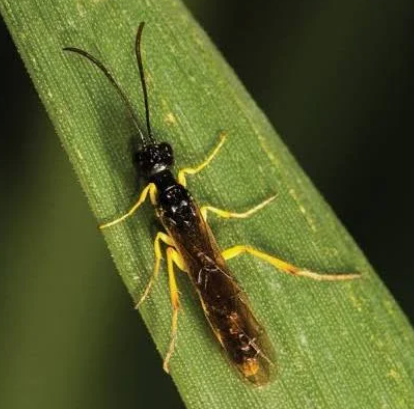
Wheat Stem Sawflies (Cephus cinctus) are among the most economically important insect pests of wheat production in North America. Native to the Great Plains region, these insects have adapted from feeding on native grasses to becoming major pests of cultivated wheat. Their larvae develop entirely inside plant stems, making infestations difficult to detect and control.
Unlike many crop pests that feed externally, Wheat Stem Sawfly larvae tunnel within wheat stems, consuming internal tissues and weakening the plant from the inside. As the crop approaches maturity, larvae cut a notch near the base of the stem, causing plants to lodge or fall over before harvest. This behavior results in direct yield losses, harvest difficulties, and reduced grain quality.
The pest is particularly problematic in dryland wheat-growing regions throughout the northern Great Plains of the United States and Canada, where environmental conditions favor its development and survival.
Taxonomy and Classification
- Kingdom: Animalia
- Phylum: Arthropoda
- Class: Insecta
- Order: Hymenoptera
- Family: Cephidae
- Genus: Cephus
- Species: Cephus cinctus
Although sawflies belong to the same order as bees, ants, and wasps, they lack the narrow “waist” characteristic of true wasps. Wheat Stem Sawflies are among the few sawfly species that have become major agricultural pests.
Physical Description
Adult Sawflies
Adults are slender, wasp-like insects measuring approximately 7 to 12 millimeters in length.
- Shiny black body.
- Bright yellow bands on the abdomen.
- Narrow wings held flat over the body.
- Long antennae.
- Typically found resting on wheat stems and heads.
Adults are often seen facing downward on wheat plants, a characteristic posture that can aid identification.
Larvae
The larval stage causes all economically important damage.
- Creamy-white coloration.
- Legless body.
- Brown head capsule.
- Length up to 12 millimeters.
- Typically curled into a distinctive C-shape or S-shape when removed from stems.
Because larvae remain hidden within stems throughout development, they are rarely observed unless stems are split open.
Distribution and Habitat
Wheat Stem Sawflies are primarily found throughout the northern Great Plains region of North America.
Major areas of occurrence include:
- Montana
- North Dakota
- South Dakota
- Wyoming
- Minnesota
- Nebraska
- Alberta
- Saskatchewan
- Manitoba
The pest thrives in dryland wheat production systems and is particularly abundant where wheat is grown continuously over multiple years.
Native grasslands surrounding crop fields often serve as reservoirs for populations, allowing annual reinfestation of cultivated fields.
Life Cycle
Wheat Stem Sawflies typically complete one generation per year.
Adult Emergence
Adults emerge during late spring and early summer.
- Emergence usually coincides with stem elongation.
- Adults live only a short time.
- Mating occurs shortly after emergence.
Egg Laying
Females use a specialized ovipositor to insert eggs directly into wheat stems.
- One egg is typically deposited per stem.
- Eggs hatch within several days.
- Young larvae begin feeding immediately.
Larval Development
Larvae spend most of their lives feeding inside stems.
- Consume vascular tissues.
- Tunnel through stem nodes.
- Fill galleries with fine sawdust-like frass.
- Remain protected from predators and pesticides.
This concealed feeding habit is one reason management remains challenging.
Overwintering
As plants mature, larvae move toward the stem base.
- Cut a notch around the interior stem wall.
- Create an overwintering chamber.
- Plug the chamber with frass.
- Remain dormant until spring.
The weakened stem often breaks above the chamber, causing lodging.
Damage and Economic Importance
Stem Weakening
Internal feeding damages vascular tissues responsible for transporting nutrients and water.
- Reduced nutrient movement.
- Lower plant vigor.
- Decreased grain filling.
Lodging
The most serious damage occurs when larvae cut stems near the base.
- Plants fall before harvest.
- Combines struggle to collect grain.
- Yield losses increase significantly.
In heavily infested fields, lodging can affect large portions of the crop.
Reduced Grain Quality
Larval feeding impacts grain development.
- Shrunken kernels.
- Reduced test weight.
- Lower market value.
- Decreased milling quality.
Economic Losses
Annual losses from Wheat Stem Sawflies can reach millions of dollars across North America.
Economic impacts include:
- Reduced yields.
- Lower grain quality.
- Increased harvesting costs.
- Additional management expenses.
Identification of Infested Fields
Several indicators help identify infestations.
- Plants lodging before harvest.
- Broken stems near ground level.
- Hollow stems filled with frass.
- Presence of larvae inside stems.
- Adult sawflies observed during early summer.
Splitting stems lengthwise is often the most reliable method for confirming infestation levels.
Behavior and Conflict
Concealed Feeding
Larvae spend nearly their entire life cycle protected inside stems.
- Avoid many predators.
- Escape insecticide exposure.
- Remain hidden from detection.
Host Adaptation
Originally associated with native grasses, Wheat Stem Sawflies successfully adapted to wheat cultivation.
This adaptation has allowed populations to thrive across major grain-producing regions.
Field Edge Concentration
Infestations are often most severe near field margins adjacent to grasslands.
These areas frequently serve as starting points for population expansion into wheat fields.
Management and Prevention
Successful management requires an integrated approach.
Solid-Stem Wheat Varieties
Planting resistant cultivars remains the most effective control strategy.
- Stems contain dense pith tissue.
- Reduce larval survival.
- Limit tunneling activity.
- Decrease lodging.
Solid-stem varieties are considered the gold standard for management in heavily affected regions.
Crop Rotation
Rotating away from wheat can reduce local populations.
- Breaks pest life cycles.
- Reduces available hosts.
- Supports long-term suppression.
Timely Harvest
Harvest timing can influence losses.
- Early harvest reduces lodging impacts.
- Swathing may preserve yield.
- Minimizes grain loss from fallen stems.
Biological Control
Several natural enemies help suppress populations.
- Bracon cephi parasitoid wasps.
- Bracon lissogaster.
- Predatory insects.
- Birds feeding on stubble.
Conservation of natural enemies is increasingly important in sustainable wheat production.
Field Monitoring
Regular scouting helps guide management decisions.
- Inspect stems for larvae.
- Monitor adult emergence.
- Assess lodging levels.
- Track infestation history.
Research and Future Management
Researchers continue studying improved methods for managing Wheat Stem Sawflies. Current research focuses on resistant wheat cultivars, biological control agents, landscape-level management strategies, and genetic approaches to reducing pest pressure.
Advances in breeding programs have significantly improved the availability of solid-stem wheat varieties, offering growers increasingly effective tools against this persistent pest.
Conclusion
Wheat Stem Sawflies are among the most damaging pests of wheat production in North America. Their concealed feeding habits, ability to weaken stems, and tendency to cause severe lodging make them particularly challenging to manage. Although insecticide control is generally ineffective against larvae protected inside stems, integrated pest management strategies including resistant varieties, crop rotation, biological control, and careful monitoring can substantially reduce economic losses. Understanding the biology and behavior of Wheat Stem Sawflies remains essential for successful long-term wheat production.