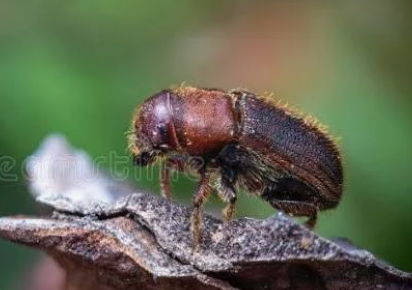
Western Pine Beetles (Dendroctonus brevicomis) are among the most destructive bark beetles in western North America. These small insects attack and kill pine trees by tunneling beneath the bark and disrupting the flow of nutrients and water. Although they play an important ecological role by removing weakened trees and recycling nutrients, large outbreaks can devastate entire forests, causing extensive tree mortality and significant economic losses.
Western Pine Beetles primarily infest Ponderosa Pine and Coulter Pine, but they may also attack other pine species under favorable conditions. During droughts, wildfires, and periods of environmental stress, beetle populations can increase dramatically, overwhelming even healthy trees. Their ability to introduce blue-stain fungi into host trees further accelerates tree decline and death.
Today, Western Pine Beetles are considered one of the most important forest pests in the western United States, where they affect timber production, wildlife habitat, recreation areas, and residential landscapes.
Taxonomy and Classification
- Kingdom: Animalia
- Phylum: Arthropoda
- Class: Insecta
- Order: Coleoptera
- Family: Curculionidae
- Subfamily: Scolytinae
- Genus: Dendroctonus
- Species: Dendroctonus brevicomis
Western Pine Beetles belong to the bark beetle group, a collection of wood-boring insects that spend most of their lives beneath tree bark. They are closely related to Mountain Pine Beetles, Southern Pine Beetles, and other economically significant forest pests.
Physical Description
Adult Western Pine Beetles are small but highly destructive insects.
Adult Beetles
- Length: 3 mm to 5 mm.
- Cylindrical body shape.
- Dark brown to black coloration.
- Rounded rear end.
- Strong fliers capable of locating suitable host trees over long distances.
Despite their small size, large populations can overwhelm trees through coordinated mass attacks.
Larvae
- White, legless grubs.
- Brown head capsule.
- Curved body shape.
- Found beneath the bark.
Larvae feed on the inner bark and phloem, causing much of the tree’s internal damage.
Pupae
Pupae are creamy white and develop within chambers beneath the bark before emerging as adults.
Distribution and Habitat
Western Pine Beetles occur throughout western North America.
Their range includes:
- California
- Arizona
- Nevada
- New Mexico
- Utah
- Colorado
- Oregon
- Washington
- Mexico
- Parts of British Columbia
They are most commonly associated with pine forests dominated by Ponderosa Pine and Coulter Pine.
Habitats include:
- Natural forests.
- Urban forests.
- Mountain landscapes.
- Campgrounds.
- Residential areas with mature pines.
Life Cycle
The life cycle varies according to climate and elevation, but multiple generations may occur annually in warmer regions.
Host Tree Selection
Adult beetles locate suitable trees using chemical signals.
- Prefer stressed or weakened trees.
- Can attack healthy trees during outbreaks.
- Respond to aggregation pheromones released by other beetles.
Egg Stage
After boring through the bark, females create egg galleries.
- Eggs are laid along tunnel walls.
- Protected beneath the bark.
- Hatch within several days or weeks.
Larval Stage
Larvae tunnel outward from the main gallery.
- Feed on phloem tissue.
- Create characteristic feeding galleries.
- Disrupt nutrient movement within the tree.
This stage causes significant structural damage to the tree’s vascular system.
Pupal Stage
Mature larvae construct pupal chambers beneath the bark.
- Transformation occurs inside the tree.
- Lasts several weeks.
- Produces new adult beetles.
Adult Emergence
New adults bore exit holes through the bark and disperse.
- Seek new host trees.
- Initiate additional infestations.
- Can produce multiple generations in favorable conditions.
Damage and Economic Importance
Western Pine Beetles kill trees through a combination of direct feeding damage and fungal transmission.
Phloem Destruction
Adult and larval galleries disrupt the tree’s nutrient transport system.
- Blocks movement of carbohydrates.
- Starves roots and foliage.
- Accelerates tree decline.
Blue-Stain Fungus
Beetles introduce fungal pathogens into the sapwood.
- Blue-stain fungi colonize xylem tissues.
- Restrict water movement.
- Contribute to rapid tree death.
The fungus often causes characteristic blue-gray discoloration of wood.
Tree Mortality
Large infestations can kill healthy trees.
- Mass attacks overwhelm defenses.
- Resin production becomes ineffective.
- Trees die within months.
Economic Losses
Western Pine Beetles affect:
- Commercial timber production.
- Urban landscapes.
- Recreation areas.
- Property values.
- Forest restoration efforts.
Outbreaks may result in millions of dollars in economic losses annually.
Signs of Infestation
Early detection is critical because heavily infested trees are rarely saved.
- Pitch tubes on bark.
- Reddish-brown boring dust.
- Small exit holes.
- Woodpecker activity.
- Yellowing needles.
- Red or brown foliage.
- Blue-stained sapwood.
Pitch Tubes
Pitch tubes are among the most recognizable symptoms.
- Small resin masses on bark.
- White, pink, or reddish color.
- Produced as the tree attempts to expel invading beetles.
Gallery Patterns
Removing bark reveals distinctive gallery systems.
- Serpentine tunnels.
- Crossing and winding patterns.
- Egg galleries with larval branches.
These gallery patterns are often used to identify the species.
Behavior and Conflict
Mass Attack Strategy
Western Pine Beetles rely on coordinated attacks.
- Individual beetles release aggregation pheromones.
- Attract thousands of additional beetles.
- Overwhelm tree defenses.
This strategy allows even healthy trees to be successfully colonized.
Drought Relationship
Drought significantly increases susceptibility.
- Reduces tree vigor.
- Decreases resin production.
- Increases outbreak frequency.
Climate change and prolonged drought have contributed to recent population increases in many areas.
Fire Risk
Large numbers of dead trees increase wildfire hazards.
- Create fuel accumulation.
- Increase fire intensity.
- Complicate forest management.
Management and Prevention
Integrated Pest Management (IPM) focuses on prevention and early intervention.
Maintain Tree Health
- Water during drought.
- Avoid root damage.
- Reduce soil compaction.
- Protect from construction injury.
Healthy trees are better able to resist beetle attacks.
Forest Thinning
Reducing tree density improves resistance.
- Reduces competition.
- Improves water availability.
- Enhances tree vigor.
Thinning remains one of the most effective long-term management strategies.
Monitoring
- Pheromone traps.
- Regular inspections.
- Aerial surveys.
- Ground-based assessments.
Early detection allows managers to remove infested trees before new beetles emerge.
Sanitation
Infested trees should be removed promptly.
- Cut and destroy infested material.
- Debark logs when appropriate.
- Prevent beetle emergence.
Preventative Treatments
High-value landscape trees may benefit from protective treatments.
- Preventative insecticide applications.
- Pheromone-based deterrents.
- Professional arborist management.
These treatments are most effective before infestation occurs.
Research and Future Studies
Current research focuses on understanding beetle population dynamics, climate influences, pheromone communication, and forest resilience. Scientists are also studying improved biological controls and sustainable forest management practices that reduce susceptibility to large-scale outbreaks.
As drought and environmental stress become increasingly common, understanding Western Pine Beetle ecology remains a priority for forest managers throughout western North America.
Conclusion
Western Pine Beetles are among the most destructive bark beetles in western forests. Through mass attacks, gallery construction, and the introduction of blue-stain fungi, they can rapidly kill large numbers of pine trees. Although they play an important ecological role in forest succession and nutrient cycling, outbreak populations can cause devastating economic and environmental impacts. Effective management depends on maintaining tree health, reducing forest stress, monitoring populations, and removing infested trees before beetles spread to new hosts.