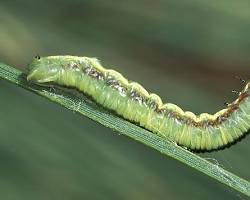
Webspinning Sawflies are specialized plant-feeding insects whose larvae create silken webs over foliage while feeding. Unlike true caterpillars, these insects belong to the sawfly group within the order Hymenoptera and are more closely related to wasps than butterflies or moths. Species in the family Pamphiliidae, including Acantholyda and Cephalcia, are among the most common webspinning sawflies found in North America.
These insects are best known for producing extensive silken shelters that protect colonies of larvae as they consume needles and leaves. During severe outbreaks, webspinning sawflies can cause significant defoliation of conifers and ornamental trees, reducing tree vigor and creating unsightly damage. While healthy trees often recover from moderate feeding, repeated infestations can weaken trees and increase their susceptibility to drought, disease, and other pests.
Webspinning sawflies are important forestry and landscape pests throughout many regions of the United States and Canada.
Taxonomy and Classification
- Kingdom: Animalia
- Phylum: Arthropoda
- Class: Insecta
- Order: Hymenoptera
- Suborder: Symphyta
- Family: Pamphiliidae
Sawflies differ from true wasps because they lack the narrow “waist” that characterizes most wasp species.
Identification
Both adult and larval stages possess distinctive characteristics.
Adult Sawflies
- Length of 8 mm to 20 mm.
- Wasp-like appearance.
- Broad waist.
- Usually dark-colored with yellow, orange, or metallic markings.
- Cannot sting humans.
Adults are typically short-lived and are most often seen during spring and early summer.
Larvae
- Hairless, caterpillar-like appearance.
- Flattened body.
- Large head capsule.
- Green, yellow, or gray coloration.
- Live within silken web structures.
Unlike many caterpillars, webspinning sawfly larvae often move within protective silk tunnels rather than openly feeding on foliage.
Key Signs of Infestation
- Silken webs covering branch tips.
- Clusters of feeding larvae.
- Accumulations of frass inside webs.
- Brown needles trapped within silk.
- Visible defoliation of branches.
The combination of webbing and feeding damage is usually the easiest way to identify an infestation.
Distribution and Habitat
Webspinning sawflies occur throughout North America, Europe, and parts of Asia.
Common habitats include:
- Pine forests.
- Spruce plantations.
- Fir forests.
- Ornamental landscapes.
- Parks.
- Residential yards.
Many species prefer conifers, although some attack deciduous trees such as cherry and plum.
Host Plants
Common host plants include:
- Pine trees.
- Spruce trees.
- Fir trees.
- Cherry trees.
- Plum trees.
- Other ornamental shrubs and trees.
Young trees are often more vulnerable to severe damage than mature specimens.
Life Cycle
Webspinning sawflies undergo complete metamorphosis.
- Egg Stage: Females insert eggs into plant tissue.
- Larval Stage: Larvae hatch and begin feeding while producing protective silk webbing.
- Pupal Stage: Mature larvae leave host plants and pupate in soil or plant debris.
- Adult Stage: Adults emerge, mate, and begin a new generation.
Most species produce one generation per year, although some may have multiple generations in favorable climates.
Feeding Habits
Larvae feed primarily on foliage.
- Conifer needles.
- Leaf tissue.
- Tender new growth.
- Developing buds.
As larvae feed, they continually expand their silken shelters, creating increasingly large web-covered areas.
Damage and Economic Importance
Defoliation
The primary damage results from foliage consumption.
- Needle loss.
- Leaf loss.
- Reduced photosynthesis.
- Tree stress.
Heavy infestations may strip entire branch sections.
Branch Damage
Feeding often focuses on branch tips and new growth.
- Terminal dieback.
- Stunted growth.
- Deformed branch structure.
- Permanent aesthetic damage.
Conifers may struggle to replace lost foliage on heavily damaged branches.
Aesthetic Injury
The extensive silk webbing creates an unattractive appearance.
- Brown foliage.
- Silken masses.
- Accumulated frass.
- Dead branch tips.
Even moderate infestations can significantly reduce landscape value.
Forestry Impact
In commercial forests, repeated outbreaks may reduce growth rates and timber quality.
- Reduced tree vigor.
- Lower wood production.
- Increased vulnerability to disease.
- Higher management costs.
Behavior and Conflict
Social Feeding
Unlike many sawfly species, webspinning sawflies often feed communally.
- Large larval groups.
- Shared web structures.
- Cooperative shelter building.
This social behavior improves protection from predators and environmental conditions.
Silk Production
The larvae continuously produce silk throughout development.
- Protective shelters.
- Weather protection.
- Predator avoidance.
The webbing often becomes filled with needles, leaves, and frass.
Protected Feeding
The silk shelters reduce exposure to predators and pesticides.
- Increased survival.
- Difficult chemical control.
- Extended feeding periods.
This protective behavior contributes significantly to their pest status.
Management and Prevention
Integrated Pest Management (IPM) provides the most effective control strategy.
Mechanical Removal
- Prune infested branch tips.
- Remove web-covered foliage.
- Destroy larvae before populations expand.
Early removal often prevents significant damage.
Water Sprays
- Break apart webbing.
- Dislodge larvae.
- Reduce feeding activity.
High-pressure water sprays are particularly effective on small ornamental trees.
Biological Control
- Birds.
- Parasitic wasps.
- Predatory insects.
Natural enemies often help suppress populations before outbreaks occur.
Targeted Insecticides
- Spinosad treatments.
- Contact insecticides.
- Targeted applications to young larvae.
Because larvae are protected by silk, treatments are most effective when applied early.
Plant Health Management
- Proper watering.
- Mulching.
- Avoiding tree stress.
- Routine monitoring.
Healthy trees are better able to tolerate defoliation and recover from damage.
Research and Future Studies
Current research focuses on outbreak prediction, biological control agents, and improved monitoring techniques for forestry applications. Scientists are also studying the social behavior and silk-production mechanisms of webspinning sawflies to better understand their success as defoliators.
Additional studies examine environmentally friendly control methods that minimize impacts on beneficial insects and wildlife.
Conclusion
Webspinning sawflies are unique defoliating insects whose silk-producing larvae can cause significant damage to conifers and ornamental trees. Their communal feeding behavior and protective webbing make infestations highly visible and sometimes difficult to control. Early detection, mechanical removal, biological control, and integrated pest management strategies remain the most effective approaches for protecting valuable trees from these specialized pests.