Overview
Vetch Bruchids are specialized seed-feeding beetles belonging to the subfamily Bruchinae within the family Chrysomelidae. These insects primarily attack legumes such as vetch (Vicia species), peas, beans, lentils, and other related crops. Unlike many agricultural pests that feed on leaves or stems, vetch bruchids spend most of their lives hidden inside seeds, where they consume the nutrient-rich interior and significantly reduce seed quality.
Vetch bruchids are considered important pests of both field-grown and stored legumes. Their larvae develop entirely within seeds, making infestations difficult to detect until visible damage appears. Because infestations often begin in the field and continue during storage, these beetles can cause substantial economic losses through reduced germination rates, lower market value, and contamination of harvested seed lots.
Taxonomy and Classification
Vetch bruchids belong to a specialized group of beetles adapted for seed feeding.
- Kingdom: Animalia
- Phylum: Arthropoda
- Class: Insecta
- Order: Coleoptera
- Family: Chrysomelidae
- Subfamily: Bruchinae
- Representative Species: Bruchus brachialis
Although commonly called seed beetles, bruchids are highly specialized leaf beetles that have evolved to exploit legume seeds as their primary food source.
Identification
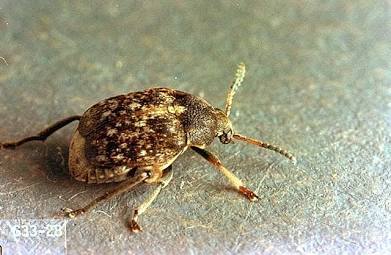
Adult vetch bruchids are small beetles measuring approximately 3 to 5 millimeters in length. Their compact bodies are oval-shaped and covered with fine scales that create mottled patterns of brown, gray, black, and white.
Key identifying features include:
- Oval body shape with a slightly humpbacked appearance.
- Mottled coloration that provides camouflage on seed pods.
- Shortened wing covers (elytra) that leave the tip of the abdomen exposed.
- Strong hind legs adapted for movement among plants.
- Circular exit holes visible in infested seeds after adult emergence.
The larvae are creamy-white, legless grubs with brown heads. Because they remain hidden inside seeds throughout development, they are rarely observed directly.
Distribution and Habitat
Vetch bruchids occur throughout many temperate and Mediterranean agricultural regions worldwide. They are especially common wherever vetch, peas, beans, and other legumes are cultivated.
Typical habitats include:
- Vetch fields
- Pea and bean crops
- Cover crop plantings
- Forage production systems
- Seed storage facilities
- Warehouses and grain bins
Because these beetles are closely associated with legume seeds, their populations are often concentrated around host crops and storage sites.
Life Cycle
Egg Stage
Adult females lay eggs directly on developing seed pods during the growing season. A single female can deposit dozens of eggs over her lifetime.
Larval Stage
After hatching, the tiny larva immediately bores through the pod wall and enters a developing seed. Once inside, it remains protected from predators and environmental conditions.
The larva feeds continuously on the seed’s interior tissues, consuming the embryo and nutrient reserves required for germination.
Pupal Stage
Pupation occurs entirely within the seed. During this stage, the insect transforms into an adult beetle.
Adult Stage
Adults emerge by chewing perfectly round exit holes through the seed coat. Depending on environmental conditions, one or more generations may occur annually.
In storage environments with favorable temperatures, reproduction may continue throughout the year.
Damage and Economic Importance
The primary damage caused by vetch bruchids results from larval feeding within seeds.
Seed Destruction
Larvae consume much of the seed interior, leaving behind hollow shells filled with frass and insect remains.
Infested seeds become:
- Lighter in weight
- Less nutritious
- Structurally weakened
- Unsuitable for planting
Reduced Germination
One of the most serious consequences is the destruction of the seed embryo. Even a single larva can render a seed incapable of germinating.
Heavy infestations can dramatically reduce stand establishment in future plantings.
Storage Losses
Infestations frequently continue after harvest. Beetles emerging from infested seeds can attack additional stored products, causing widespread contamination.
Stored seed lots may suffer:
- Reduced market value
- Lower planting quality
- Weight loss
- Increased rejection rates
Forage Quality Reduction
When vetch is grown for livestock feed, extensive seed damage can reduce nutritional quality and overall forage value.
Signs of Infestation
Common indicators include:
- Small circular holes in harvested seeds.
- Lightweight or hollow seeds.
- Adult beetles present in storage areas.
- Reduced seed germination.
- Seed discoloration or contamination.
- Presence of larvae within seeds.
Because damage occurs internally, routine seed inspections are critical for early detection.
Management and Control (IPM)
Field Monitoring
Regular scouting during flowering and pod development helps identify adult beetle activity before significant egg laying occurs.
Sweep nets can be used to monitor adult populations and determine if intervention is necessary.
Prompt Harvesting
Harvesting crops as soon as seeds mature can reduce the amount of time available for larvae to complete development.
Proper Storage
Maintaining cool, dry storage conditions significantly limits beetle survival and reproduction.
- Reduce humidity.
- Lower storage temperatures.
- Use sealed storage containers.
- Inspect stored seed regularly.
Crop Rotation
Rotating legumes with non-host crops can interrupt the life cycle and reduce local populations.
Seed Treatments
Commercial producers may use approved seed treatments or fumigation methods to eliminate internal infestations before storage.
Sanitation
Removing spilled seed, volunteer legumes, and crop residues reduces breeding sites and helps prevent population buildup.
Ecological Importance
Although vetch bruchids are considered pests in agricultural systems, they also play a role in natural ecosystems by influencing seed survival and plant population dynamics. Their specialized relationship with legumes provides researchers with valuable insight into insect-plant coevolution.
However, in commercial agriculture, their economic impact generally outweighs any ecological benefits.
Conclusion
Vetch Bruchids are destructive seed-feeding beetles that pose significant challenges to legume production and storage. Their concealed larval development inside seeds makes infestations difficult to detect and control. Because damage directly affects seed viability, crop quality, and marketability, prevention remains the most effective management strategy. Through proper monitoring, timely harvesting, crop rotation, and careful storage practices, growers can greatly reduce the impact of these hidden but economically important pests.