Overview
Uresiphita caterpillars, most commonly the larvae of Uresiphita reversalis and closely related species, are destructive defoliators that primarily attack plants in the legume family (Fabaceae). These caterpillars are frequently referred to as Sophora worms or Genista broom moth larvae and are commonly found feeding on Texas mountain laurel, broom shrubs, lupines, false indigo, and other ornamental legumes.
Although adult moths are relatively inconspicuous, the larval stage can cause extensive damage. Large populations may rapidly strip host plants of leaves, flowers, and tender shoots, leaving behind webbing, frass, and bare branches. In ornamental landscapes, infestations often appear suddenly and can significantly reduce plant vigor and aesthetic value.
Because these caterpillars feed in groups and often create communal silk shelters, infestations can spread quickly if not detected early.
Taxonomy and Classification
Uresiphita caterpillars belong to a group of moths within the family Crambidae.
- Kingdom: Animalia
- Phylum: Arthropoda
- Class: Insecta
- Order: Lepidoptera
- Family: Crambidae
- Genus: Uresiphita
- Common Species: Uresiphita reversalis
The genus contains several species of moths whose larvae specialize on leguminous host plants.
Identification
Caterpillars
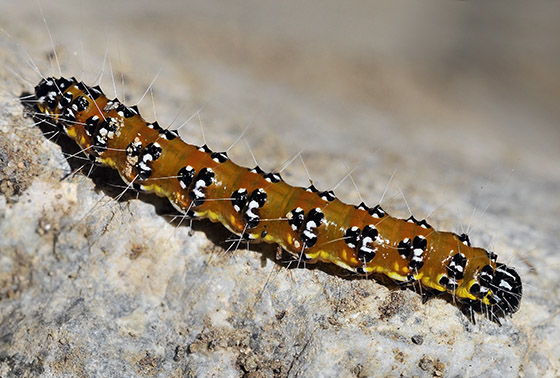
Uresiphita caterpillars are among the easiest defoliators to identify due to their distinctive coloration.
- Length: 20–30 mm when mature
- Color: Yellow-green, orange-yellow, or greenish-white
- Head: Shiny black
- Markings: Rows of black spots with white centers
- Hair: Sparse white hairs emerging from spots
The contrasting black-and-yellow coloration often causes homeowners to mistake them for stinging caterpillars, but they are harmless to people.
Adult Moths
Adults are small moths that are mostly active at night.
- Wingspan: 25–35 mm
- Forewings: Brown to tan
- Hindwings: Yellow to orange with darker margins
- Behavior: Nocturnal and attracted to lights
Most plant damage occurs during the caterpillar stage.
Distribution and Habitat
Uresiphita species occur throughout much of the southern and western United States, particularly in warm climates where host plants are abundant.
Common habitats include:
- Residential landscapes
- Public gardens
- Parks
- Native shrublands
- Roadside plantings
- Agricultural settings with legume crops
Populations are often highest during warm spring and summer months.
Host Plants
These caterpillars feed almost exclusively on legumes.
Preferred hosts include:
- Texas Mountain Laurel (Sophora secundiflora)
- Scotch Broom
- Spanish Broom
- Lupines
- False Indigo (Baptisia)
- Genista species
- Various ornamental legumes
Young foliage and flower buds are especially attractive to developing larvae.
Life Cycle
Egg Stage
Females deposit clusters of eggs on host plants, usually on the undersides of leaves.
Larval Stage
After hatching, caterpillars begin feeding immediately.
Young larvae often remain together in groups and create loose silk webbing that shelters feeding colonies.
This stage lasts several weeks and accounts for nearly all plant damage.
Pupal Stage
Mature caterpillars pupate within silken cocoons hidden among plant debris or protected vegetation.
Adult Stage
Adults emerge, mate, and begin another generation.
Multiple generations may occur annually in warm regions.
Damage and Economic Importance
Defoliation
The most obvious damage is extensive leaf consumption.
Large groups of caterpillars can completely strip shrubs of foliage within a short period.
Flower Destruction
Larvae frequently consume flower buds and blossoms, reducing flowering and seed production.
Shoot Injury
Feeding on tender growing tips may stunt plant development and reduce future growth.
Webbing and Frass
Silk webbing combined with dark fecal pellets creates an unsightly appearance on ornamental plants.
Plant Stress
Repeated infestations can weaken shrubs and make them more susceptible to drought, disease, and environmental stress.
Signs of Infestation
Common indicators include:
- Groups of spotted caterpillars
- Loose silk webbing among branches
- Chewed foliage
- Missing leaves
- Dark frass deposits
- Damaged flowers and buds
- Bare stems and branch tips
Early detection is critical because populations can increase rapidly.
Management and Control (IPM)
Regular Monitoring
Inspect susceptible plants frequently during spring and summer.
Finding small colonies early can prevent severe damage.
Mechanical Control
- Remove webbed branches.
- Hand-pick caterpillars.
- Destroy heavily infested plant material.
- Wash small infestations from plants with water.
Biological Control
Natural enemies often provide significant suppression.
- Birds
- Paper wasps
- Parasitic wasps
- Tachinid flies
- Predatory insects
Microbial Control
Bacillus thuringiensis var. kurstaki (Bt) is highly effective against young caterpillars and remains one of the most widely recommended control methods.
Chemical Control
When necessary, insecticides labeled for caterpillar management may be applied.
Treatments work best when larvae are small and actively feeding.
Environmental Importance
Although considered pests in ornamental landscapes, Uresiphita caterpillars are natural components of many ecosystems.
They serve as food for:
- Birds
- Parasitic insects
- Predatory beetles
- Spiders
- Small reptiles
Their populations are normally regulated by natural predators and environmental conditions.
Conclusion
Uresiphita caterpillars are fast-feeding defoliators capable of causing significant damage to broom shrubs, Texas mountain laurel, lupines, and other leguminous plants. Their communal feeding habits, webbing behavior, and rapid population growth allow infestations to develop quickly. Regular monitoring, biological control, and early intervention with Bt or other targeted treatments provide the most effective long-term management strategy while preserving beneficial organisms.