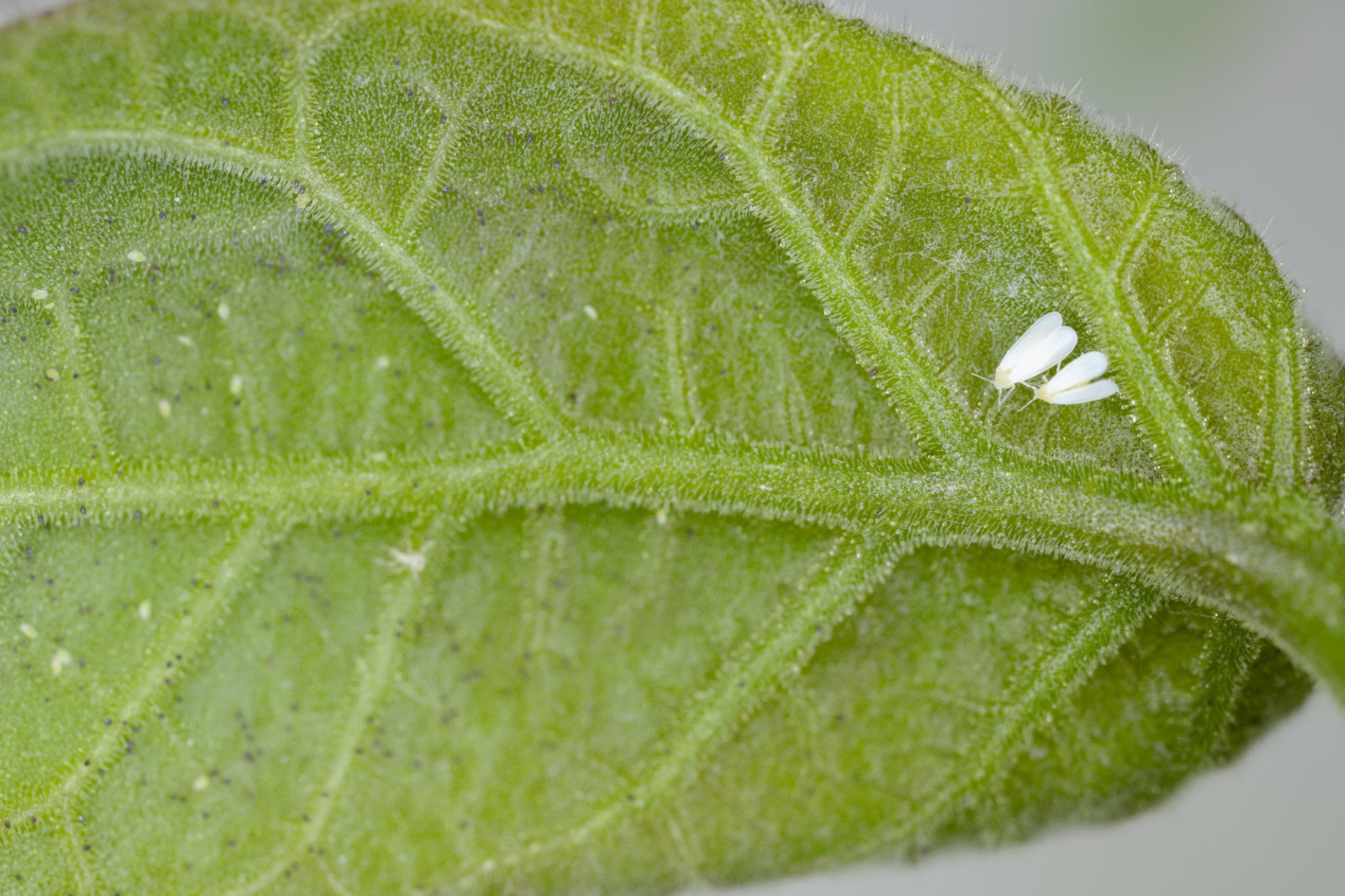
Tobacco Whiteflies (Bemisia tabaci), also known as Sweet Potato Whiteflies, are among the most destructive agricultural and ornamental plant pests worldwide. These tiny sap-feeding insects attack hundreds of plant species, including vegetables, cotton, tobacco, melons, ornamentals, and greenhouse crops. Their damage extends far beyond simple feeding injury. Tobacco Whiteflies weaken plants by removing sap, contaminate foliage with sticky honeydew, promote the growth of black sooty mold, and most importantly, transmit more than 100 plant viruses. Their ability to reproduce rapidly, develop insecticide resistance, and spread devastating diseases has made them one of the most economically important crop pests in modern agriculture.
Taxonomy and Classification
Tobacco Whiteflies belong to the order Hemiptera, the group that includes aphids, leafhoppers, scales, and true bugs. Despite their common name, they are not true flies.
- Order: Hemiptera
- Family: Aleyrodidae
- Genus: Bemisia
- Species: Bemisia tabaci
The Bemisia tabaci complex actually contains numerous genetically distinct biotypes and cryptic species. Some populations are more resistant to pesticides, while others are particularly efficient at transmitting plant viruses. This genetic diversity contributes to the insect’s global success as a pest.
Identification
Tobacco Whiteflies are extremely small but can be identified by their appearance and characteristic behavior.
Adult Whiteflies
- Size: Approximately 1 millimeter long.
- Color: White wings covering a pale yellow body.
- Wing Position: Wings are held in a tent-like shape over the body, leaving a narrow gap where the yellow body may be visible.
- Movement: Adults fly readily when disturbed.
- Appearance: Tiny white, moth-like insects clustered on leaf undersides.
Nymphs
- Color: Pale yellow or translucent.
- Shape: Flat, scale-like structures attached to leaves.
- Mobility: Only the first stage crawler moves; later stages remain fixed while feeding.
- Location: Found primarily on leaf undersides.
Heavy infestations often produce the characteristic “cloud effect,” where dozens or hundreds of adults take flight when a plant is disturbed.
Distribution and Habitat
Tobacco Whiteflies are distributed throughout tropical, subtropical, and warm temperate regions worldwide. They thrive in warm climates and protected growing environments.
Common habitats include:
- Vegetable gardens
- Agricultural fields
- Greenhouses
- Nurseries
- Ornamental landscapes
- Cotton fields
- Tomato production areas
- Melon and squash plantings
In southern regions of the United States, particularly the Southwest and Southeast, whiteflies may remain active throughout much of the year. Greenhouses can support continuous populations regardless of outdoor temperatures.
Host Plants
Tobacco Whiteflies have one of the broadest host ranges of any agricultural pest.
Common host plants include:
- Tomatoes
- Cotton
- Tobacco
- Squash
- Melons
- Cucumbers
- Peppers
- Eggplant
- Hibiscus
- Lantana
- Poinsettias
- Numerous weeds and ornamentals
This extensive host range allows populations to persist throughout the year by moving between cultivated and wild plants.
Life Cycle
Tobacco Whiteflies develop rapidly under favorable conditions.
- Egg Stage: Eggs are deposited on the undersides of leaves.
- Crawler Stage: Newly hatched nymphs move briefly before selecting a feeding site.
- Nymphal Stages: Several immobile stages feed continuously on plant sap.
- Pupal Stage: Final immature stage before adulthood.
- Adult Stage: Winged adults emerge and begin reproduction.
Development may be completed in as little as two to three weeks under warm conditions, allowing numerous overlapping generations each year.
Damage and Economic Importance
Tobacco Whiteflies cause direct and indirect damage that can significantly reduce plant health and crop value.
Direct Feeding Damage
- Sap Loss: Continuous feeding weakens plants.
- Leaf Yellowing: Chlorosis develops as nutrients are removed.
- Reduced Growth: Infested plants become stunted.
- Premature Leaf Drop: Severe infestations may trigger defoliation.
Honeydew and Sooty Mold
Whiteflies excrete large quantities of sugary honeydew.
- Leaves become sticky.
- Black sooty mold develops on surfaces.
- Photosynthesis is reduced.
- Ornamental value declines significantly.
Heavy honeydew accumulation is often one of the first noticeable signs of infestation.
Silverleaf Disorder
In squash, pumpkins, and certain melons, whitefly feeding can trigger a physiological disorder known as Silverleaf.
- Leaves develop a metallic silver appearance.
- Photosynthetic efficiency declines.
- Plant growth is reduced.
- Fruit quality may suffer.
This disorder is particularly associated with Tobacco Whitefly infestations.
Virus Transmission
The most serious threat posed by Tobacco Whiteflies is their ability to transmit plant diseases.
Important viruses spread by Bemisia tabaci include:
- Tomato Yellow Leaf Curl Virus (TYLCV)
- Bean Golden Mosaic Virus
- Cotton Leaf Curl Virus
- Cassava Mosaic Viruses
- Numerous Begomoviruses
Once infected, plants often cannot be cured and may need removal to prevent further spread.
Monitoring and Detection
Early detection is critical for successful management.
- Inspect leaf undersides regularly.
- Look for adults and nymphs.
- Monitor honeydew accumulation.
- Watch for yellowing or silvering foliage.
- Use yellow sticky traps to detect adult populations.
Yellow sticky cards are among the most effective monitoring tools for whitefly activity.
Management and Prevention
Integrated Pest Management (IPM) provides the best long-term control strategy.
Cultural Controls
- Remove heavily infested plants.
- Control weeds that serve as alternate hosts.
- Use reflective mulch to deter colonization.
- Maintain proper plant spacing and airflow.
Biological Control
- Encarsia formosa: A highly effective parasitic wasp.
- Lady Beetles: Feed on eggs and nymphs.
- Lacewings: Consume immature whiteflies.
- Predatory Bugs: Help suppress populations naturally.
Parasitized whitefly nymphs often turn black, indicating successful biological control.
Organic Controls
- Neem Oil: Suppresses nymphs and adults.
- Horticultural Oils: Smother immature stages.
- Insecticidal Soaps: Effective with thorough coverage.
Applications must thoroughly cover the undersides of leaves where most whiteflies are located.
Conservation and Research
Tobacco Whiteflies remain one of the most intensively studied agricultural pests in the world. Research focuses on insecticide resistance management, biological control programs, virus transmission mechanisms, and the development of resistant crop varieties.
Scientists continue investigating sustainable management techniques that reduce pesticide reliance while protecting valuable crops and ornamental plants from this highly adaptable pest.