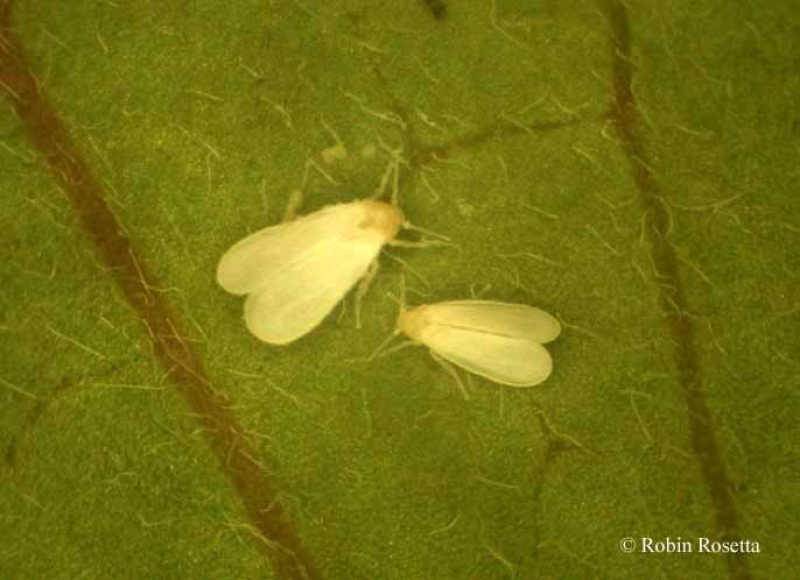
Q-type whiteflies are a highly invasive and pesticide-resistant biotype of whiteflies, often associated with Bemisia tabaci. These insects are among the most destructive agricultural pests worldwide due to their ability to feed on a wide range of host plants and transmit plant viruses.
Unlike some other whitefly types, Q-type populations have shown strong resistance to many commonly used insecticides, making them particularly difficult to manage. They are especially problematic in greenhouse environments and high-value crop systems.
The Super-Pest: Q-Type Whiteflies
The Q-Type Whitefly (Bemisia tabaci, Mediterranean species) is arguably the most “noxious” invasive insect in the United States today. While it looks identical to the common Sweetpotato Whitefly (B-Type), the Q-Type is a global “super-pest” because it has evolved extreme resistance to almost all major classes of chemical insecticides, including neonicotinoids. In the U.S., it is a high-alert quarantine pest for greenhouses and nurseries in Arizona, California, and Florida, where it threatens over 900 host plants including tomatoes, peppers, and ornamental poinsettias.
Identification: The “Microscopic” Twin
Identifying a Q-Type whitefly is impossible with the naked eye or even a standard hand lens. They are morphologically identical to other Bemisia species. The “identification” is usually based on treatment failure:
- Appearance: Adults are tiny (1mm), snowy-white insects that resemble miniature moths. They hold their wings in a “tent-like” fashion over their yellow bodies.
- The “Cloud” Effect: When an infested plant is disturbed, the adults fly up in a fluttering white cloud before quickly resettling on the undersides of the leaves.
- Nymphal “Scales”: The immature stages (nymphs) are flat, oval, and translucent-yellow. They look like tiny scales glued to the leaf and are completely immobile after the first few hours of life.
- DNA Testing: In U.S. commercial agriculture, the only way to confirm “Q-Type” is through laboratory genetic testing (PCR) after a grower reports that standard sprays are no longer working.
The “Triple Threat” Damage
The Q-Type Whitefly is considered a “top-tier” pest in the U.S. because of how it destroys crops:
- Direct Sap Drainage: Thousands of whiteflies sucking on a single plant can cause rapid wilting, silvering of leaves, and “catastrophic” stunted growth.
- Honeydew and Sooty Mold: They excrete massive amounts of sticky sugar. In the dry heat of Tucson or Yuma, this honeydew dries into a “shellac” that promotes black sooty mold, ruining the marketability of fruits and leaves.
- Viral Vectoring: They are the primary carriers of over 100 plant viruses, most notably the Tomato Yellow Leaf Curl Virus (TYLCV), which can wipe out 100% of a tomato crop even if only a few whiteflies are present.
U.S. Management: The “Resistance-Breaking” Strategy
Because the Q-Type is resistant to most chemicals, U.S. Integrated Pest Management (IPM) focuses on Exclusion and Biologicals:
- Strict Quarantine: In the U.S., nurseries must follow “The National Q-Biotype Management Plan.” If Q-Type is detected, the entire shipment of plants is often destroyed to prevent the “super-resistant” genes from spreading to local farms.
- Yellow Sticky Traps: These are the best way to monitor for the first arrival of adults. Whiteflies are highly attracted to a specific wavelength of yellow light.
- Beneficial Wasps (Encarsia): In greenhouses, tiny parasitic wasps (Encarsia formosa) are released. They lay their eggs *inside* the whitefly nymphs. If you see a whitefly “scale” that has turned black, it has been “zapped” by a beneficial wasp.
- Beauveria bassiana (Fungal Warfare): In the U.S., organic growers use Beauveria bassiana, a naturally occurring fungus that grows *through* the whitefly’s skin and kills it from the inside, a method the whitefly cannot easily develop resistance to.
Identification
Small, white, moth-like insects found on leaf undersides.
Life Cycle
Eggs hatch into nymphs that remain attached to leaves before emerging as adults.
Damage
Sap feeding, honeydew production, and virus transmission.
Control
Integrated pest management, biological controls, and resistance management strategies.