Overview
Sorghum Webworms are caterpillar pests that attack sorghum and other grasses by feeding on leaves, panicles, and developing grain heads. These insects are named for the silken webbing they produce while feeding, which creates protective shelters that conceal them from predators and environmental conditions. Although they are not always as widely recognized as sorghum aphids or sorghum midge, webworms can cause significant economic damage when populations become high.
The greatest concern occurs when larvae infest developing seed heads. Their feeding can destroy kernels, contaminate grain with silk and frass, and encourage mold development. Because larvae remain hidden within webbed plant tissues, infestations are often overlooked until substantial damage has occurred.
Sorghum webworms are particularly problematic in warm-growing regions where multiple generations can develop during a single season. Fields with continuous sorghum production or abundant grassy weeds often experience greater infestation pressure.
Taxonomy and Classification
Sorghum Webworms belong to the order Lepidoptera (Moths and Butterflies). Depending on the species, they are typically associated with the families Crambidae or Pyralidae, which contain many grass-feeding agricultural pests.
- Kingdom: Animalia
- Phylum: Arthropoda
- Class: Insecta
- Order: Lepidoptera
- Family: Crambidae or Pyralidae
One commonly recognized species associated with sorghum is Nola sorghiella, although regional pest complexes may include several related webworm species.
Physical Description
The damaging stage is the larval caterpillar.
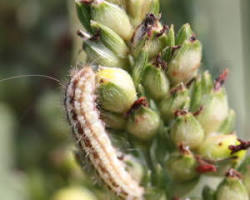
- Larva (Key ID): Small caterpillar, typically 10–15 mm long, greenish, tan, cream, or brown with longitudinal stripes.
- Bristles: Many species possess short stiff hairs that give the body a rough appearance.
- Webbing (Key ID): Fine silk threads surrounding feeding sites on leaves or grain heads.
- Adult Moth: Small, narrow-winged moth that is usually tan, gray, or light brown with subtle markings.
- Conflict: Grain destruction, head contamination, and reduced crop yield.
Distribution and Habitat
Sorghum Webworms occur throughout many sorghum-growing regions worldwide and are especially common in warm climates where sorghum production is extensive.
They are frequently found in:
- Sorghum fields
- Forage sorghum plantings
- Sudangrass fields
- Pastures
- Grasslands
- Areas with abundant grassy weeds
The larvae inhabit leaves, leaf axils, and developing grain heads where they construct silk shelters for protection.
Life Cycle
Sorghum Webworms undergo complete metamorphosis consisting of egg, larva, pupa, and adult stages.
Egg Stage
Adult females deposit eggs on sorghum foliage, leaf sheaths, or reproductive structures.
Larval Stage
Newly hatched caterpillars begin feeding immediately and construct protective silk webbing around feeding sites.
This stage causes virtually all economic damage.
Pupal Stage
Pupation occurs within silk shelters, plant debris, or occasionally in the soil.
Adult Stage
Adults emerge as small moths capable of dispersing to nearby fields and laying eggs on suitable host plants.
Multiple generations may occur annually under favorable environmental conditions.
Behavior and Feeding Habits
Sorghum Webworms are concealed feeders. Unlike exposed caterpillars that openly consume foliage, webworms build silk shelters that allow them to feed while remaining hidden.
Young larvae often feed on leaves, scraping tissue and creating ragged feeding patterns. Older larvae frequently move into grain heads where they feed directly on developing kernels.
The silk shelters serve several purposes:
- Protection from predators
- Protection from rainfall and weather
- Concealment from scouting efforts
- Reduced exposure to pesticide applications
This behavior makes infestations more difficult to detect and control than many other caterpillar pests.
Damage and Symptoms
The severity of damage depends on crop stage and larval density.
Leaf Feeding
Young larvae chew foliage, reducing photosynthetic capacity and slowing plant growth.
Webbed Foliage
Leaves may appear tied together with silk, often containing hidden caterpillars and frass.
Head Infestation
Larvae feeding within seed heads destroy developing grain and contaminate panicles with silk and waste material.
Kernel Loss
Developing kernels may be hollowed out or completely consumed.
Mold Development
Webbing traps moisture and debris, increasing the risk of fungal growth and grain quality problems.
Yield Reduction
Heavy infestations can significantly reduce grain production and marketability.
Economic Importance
While moderate infestations may cause only cosmetic injury, severe outbreaks can result in substantial economic losses.
Impacts include:
- Reduced grain yield
- Lower grain quality
- Harvest contamination
- Reduced seed viability
- Increased disease susceptibility
- Lower market value
Damage is most significant when infestations occur during grain filling and seed development stages.
Management and Control (IPM)
Integrated Pest Management (IPM) combines monitoring, cultural practices, biological controls, and selective insecticide use.
Monitoring
- Inspect plants regularly for webbing.
- Check grain heads for concealed larvae.
- Look for frass accumulation within panicles.
- Monitor adult moth activity when possible.
Weed Management
Removing grassy weeds around fields helps reduce alternative hosts and breeding sites.
Biological Control
Natural enemies include:
- Parasitic wasps
- Predatory bugs
- Lady beetles
- Spiders
- Birds
Conservation of beneficial insects can help suppress populations naturally.
Microbial Control
Bacillus thuringiensis (Bt) products are effective against young caterpillars and are widely used in IPM programs.
Cultural Control
- Promote vigorous crop growth.
- Plant early where practical.
- Maintain field sanitation.
- Destroy crop residues after harvest.
Chemical Control
If economic thresholds are exceeded, selective insecticides may be applied. Treatments are most effective against young larvae before extensive webbing develops.
Research and Future Management
Research efforts focus on improved monitoring systems, resistant sorghum varieties, biological control enhancement, and predictive models that help growers identify periods of greatest risk.
Scientists are also evaluating how crop diversity, habitat management, and beneficial insect conservation can reduce webworm outbreaks while minimizing insecticide use.
Conclusion
Sorghum Webworms are concealed caterpillar pests capable of causing significant losses in sorghum production. Their protective silk webbing allows them to feed while avoiding many natural enemies and control measures. Early detection, regular scouting, weed management, biological control, and timely intervention remain the most effective tools for protecting sorghum crops from economic damage.