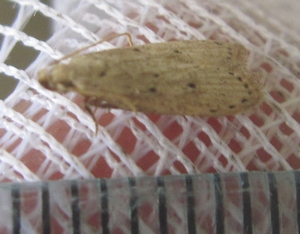
Rice moths (Corcyra cephalonica) are one of the most destructive stored-product pests worldwide, particularly in warm and humid regions. These moths primarily infest stored grains such as rice, wheat, corn, sorghum, and processed food products including flour and cereals. Although small and often overlooked initially, rice moth infestations can escalate rapidly, leading to severe contamination and economic loss in both household pantries and commercial storage facilities.
Adult rice moths are typically grayish-brown with a wingspan of about 15–25 mm. They are weak fliers and are most active at night. The real damage, however, is caused by the larvae. After hatching, caterpillars feed aggressively on stored grains, producing silk webbing that binds food particles together. This webbing creates clumps, reducing product quality and making infested goods unsuitable for consumption or sale.
The “Webbing” Specialist: Rice Moths3
The Rice Moth (Corcyra cephalonica) is a “noxious” stored-product pest that is a major concern for food safety in the United States, particularly in warmer climates like Tucson and the Gulf Coast. While it is a global traveler, in the U.S. it is notorious for infesting chocolate, cocoa beans, and processed cereals, in addition to its namesake rice. Unlike some pantry pests that just eat the grain, the Rice Moth is a “mechanical” destroyer; its larvae produce massive amounts of thick, sticky silk that binds food particles into giant, unusable clumps, often clogging industrial machinery in U.S. food processing plants.
Identification: The “Plain” Invader
Identifying the Rice Moth requires distinguishing it from the more common Indian Meal Moth. For Pestipedia.com users, the lack of wing patterns is the primary diagnostic key:
- Appearance: A small moth (12mm to 15mm wingspan) with uniform, pale brownish-buff wings. Unlike the Indian Meal Moth, it has no dark bands or metallic scales. The veins on the wings may appear slightly darker, giving it a “streaked” look.
- The “Snout”: Under a lens, you will notice the moth has very long, forward-pointing mouthparts (labial palps) that look like a tiny beak or snout.
- The Larva: A creamy-white caterpillar with a dark brown head. As it grows, it becomes increasingly “fuzzy” due to long hairs (setae) along its body.
- The Cocoon: They spin exceptionally tough, dense, white silk cocoons. These are often found tucked into the corners of pantry shelves or inside the corrugated folds of cardboard boxes.
The “Clumping” and “Taint” Damage
The “noxious” impact of the Rice Moth is defined by the sheer volume of silk it produces as it moves through food:
- Massive Webbing: The larvae spin silk continuously. In a bag of rice or flour, this creates “galleries” or tubes that bind the food into hard, “brick-like” masses.
- Frass Contamination: The webbing traps large amounts of dark, granular frass (fecal pellets) and cast-off larval skins, making the food a health hazard.
- Off-Odors: Heavy infestations produce a distinct, unpleasant “musty” or “stale” smell that can taint an entire pantry or warehouse, even if only one bag is infested.
U.S. Home and Industrial Management
In the United States, managing Rice Moths is a game of Deep Cleaning and Temperature Shock. Because the larvae are so good at hiding in cracks, a surface-level wipe-down is rarely enough.
- The “Vacuum and Steam” Protocol: For Pestipedia.com users, once an infested bag is found, the entire pantry must be emptied. Use a vacuum with a crevice tool to suck up the cocoons from the corners, followed by a steam cleaner to kill any eggs hidden in the shelving joints.
- Heat Sterilization: If you have high-value dry goods (like expensive cocoa or specialty rice) that you want to salvage, heating the grain to 140°F (60°C) for 30 minutes in an oven will kill all life stages.
- Pheromone Monitoring: U.S. commercial bakeries use “Corcyra” specific pheromone traps. For homeowners, these traps are the best way to tell if “hitchhikers” are still emerging from behind the walls after you’ve cleaned the pantry.
- Airtight Fortification: Rice Moths can chew through thin plastic bags and wax paper. In the Tucson heat, store all susceptible items in heavy-gauge plastic, glass, or metal containers with airtight seals to prevent “cross-contamination.”
Identification and Signs of Infestation
Rice moth infestations are often identified by the presence of silken threads in stored food, webbed clumps of grain, and small larvae moving within food containers. Adults may also be seen fluttering around storage areas, especially in the evening. Infested products often develop a musty odor and may appear dusty or contaminated with insect fragments and frass.
In warehouses, heavy infestations can lead to large masses of webbing covering grain surfaces, clogging machinery and making handling difficult. Early detection is critical to preventing widespread contamination.
Life Cycle
The rice moth life cycle consists of egg, larva, pupa, and adult stages. Females lay eggs directly on or near food sources. Once hatched, larvae begin feeding immediately and may pass through several instars over a few weeks. Pupation typically occurs within silken cocoons, often attached to surfaces near the food source. Under optimal conditions, the full life cycle can be completed in as little as 4–6 weeks, allowing multiple generations per year.
Warm temperatures and high humidity significantly accelerate development, making poorly ventilated storage areas especially vulnerable to infestations.
Prevention and Control
Effective management of rice moths relies heavily on sanitation and proper storage practices. Keeping food in airtight containers, maintaining dry storage conditions, and regularly inspecting stored goods can prevent infestations. In commercial settings, integrated pest management strategies are essential.
- Store grains in sealed, moisture-proof containers
- Clean storage areas frequently to remove food debris
- Use pheromone traps to monitor adult populations
- Rotate stock to avoid long-term storage
- Apply heat or freezing treatments to kill larvae and eggs
In severe cases, fumigation or professional pest control may be necessary to eliminate infestations in bulk storage facilities.
Economic Impact
Rice moths can cause significant economic losses due to contamination, reduced grain quality, and regulatory rejection of infested shipments. Their presence can also damage a business’s reputation, particularly in food production and distribution industries.