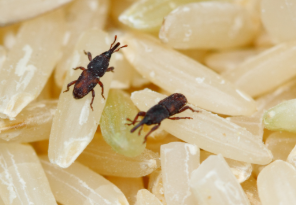
Rice Grain Bugs are sap-feeding insects belonging primarily to the order Hemiptera. These pests attack rice during the critical flowering and grain-filling stages, making them among the most economically important insects affecting rice quality and yield. Closely related to stink bugs and other true bugs, rice grain bugs feed by piercing developing grains and extracting nutrients, resulting in shriveled kernels, reduced grain quality, and significant economic losses.
Taxonomy and Classification
Rice grain bugs belong to the order Hemiptera, which includes a diverse group of piercing-sucking insects. Many important species are classified within the families Pentatomidae (stink bugs), Alydidae, and Coreidae.
- Order: Hemiptera
- Families: Pentatomidae, Alydidae, Coreidae
- Common Genera: Eysarcoris, Leptocorisa, Nezara
These insects possess specialized mouthparts designed to penetrate plant tissues and withdraw fluids from developing rice grains.
Physical Description
Adult Rice Grain Bugs are generally small to medium-sized insects measuring between 5 and 15 millimeters in length, depending on the species.
- Adult (Key ID): Elongated or shield-shaped body, typically brown, green, or gray in color.
- Antennae: Long and segmented, often extending beyond the head.
- Mouthparts: Piercing-sucking beak used to feed on developing grains.
- Nymphs: Wingless immature stages that resemble smaller adults.
- Conflict: Agricultural.
Many species blend well with rice panicles, making infestations difficult to detect without careful scouting.
Distribution and Habitat
Rice grain bugs occur throughout rice-producing regions worldwide and are especially abundant in tropical and subtropical climates.
Important populations are found in:
- Asia
- Africa
- South America
- Australia
- Southern regions of the United States
These pests inhabit rice fields during the reproductive stage and often utilize grasses and weeds as alternate hosts outside the growing season.
Life Cycle
Rice grain bugs undergo incomplete metamorphosis consisting of egg, nymph, and adult stages.
Egg Stage
Females deposit eggs singly or in clusters on leaves, stems, or rice panicles. Egg development typically lasts several days.
Nymph Stage
After hatching, nymphs immediately begin feeding on rice plants. They pass through multiple instars while gradually increasing in size.
Nymphs remain highly active and feed continuously throughout development.
Adult Stage
Adults are capable of flight and readily disperse between fields. Multiple generations may occur annually in warm climates.
Population levels generally peak during flowering and grain-filling stages, when rice plants are most vulnerable.
Behavior and Damage
Rice grain bugs feed by inserting their stylets through the husk and extracting nutrient-rich fluids from developing kernels.
- Milk Stage Feeding: Feeding during early grain development often results in empty or partially filled kernels.
- Dough Stage Feeding: Later feeding causes shriveled, malformed, or discolored grains.
- Pecky Rice: Feeding punctures may allow fungal pathogens to enter grains, producing dark spots and discoloration.
- Reduced Grain Weight: Damaged kernels weigh less and lower overall yields.
Common symptoms include:
- Shriveled grains
- Empty husks
- Chalky kernels
- Discolored grains
- Reduced milling quality
- Lower grain weight
Heavy infestations can substantially reduce both yield and market value.
Economic Importance
Rice grain bugs are considered major economic pests because they affect both production quantity and grain quality. Even relatively low populations can result in downgrading at processing facilities due to reduced milling quality and increased grain breakage.
Export markets often impose strict quality standards, making effective management essential for profitable rice production.
Management and Control (IPM)
Integrated pest management provides the most sustainable approach for controlling rice grain bugs.
Monitoring
- Use sweep nets to monitor populations.
- Inspect panicles during flowering and grain filling.
- Scout fields during early morning or late evening when bugs are most active.
- Track economic thresholds before treatment decisions.
Cultural Control
- Remove alternate host weeds and grasses around fields.
- Synchronize planting dates to minimize prolonged vulnerability.
- Harvest promptly when grain reaches maturity.
- Maintain field sanitation after harvest.
Biological Control
Numerous natural enemies help suppress rice grain bug populations.
- Parasitic wasps
- Spiders
- Assassin bugs
- Predatory beetles
- Birds
Conserving beneficial insects by avoiding unnecessary insecticide applications can significantly improve natural control.
Chemical Control
Insecticides may be required when populations exceed economic thresholds.
- Target applications toward early nymph stages.
- Apply treatments during periods of peak bug activity.
- Rotate insecticide classes to reduce resistance development.
- Follow all label instructions and local extension recommendations.
Prevention
- Monitor fields regularly during reproductive stages.
- Manage grassy weeds surrounding rice fields.
- Encourage natural enemies.
- Harvest fields in a timely manner.
- Implement field sanitation after harvest.
Research and Future Management
Current research focuses on improving monitoring systems, developing resistant rice varieties, enhancing biological control programs, and refining economic thresholds to reduce pesticide use while maintaining profitable rice production.