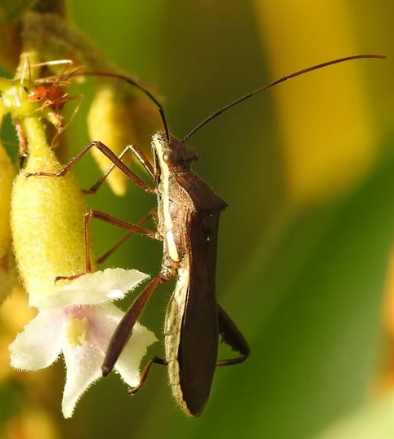
Rice ear bugs are sap-feeding insects that attack developing rice grains, reducing quality and yield.
They feed directly on grains during the milk stage, causing discoloration and empty grains.
The “Milky” Grain Specialist: Rice Ear Bugs
The Rice Ear Bug (primarily Leptocorisa spp., such as the Slender Rice Bug) is a “noxious” and highly destructive pest of the rice “ear” or panicle. While a major threat in global tropical systems, it is a high-priority monitoring species for the U.S. Rice Belt in the Southwest and Gulf Coast. These “O” pests are true specialists; they ignore the leaves and stems, waiting specifically for the rice to enter the “milky” stage. They use their long, needle-like beaks to suck out the developing grain fluid, leaving behind empty, shriveled husks and a distinct, foul “stink bug” odor in the field.
Identification: The “Slender” Stink Bug
Identifying Rice Ear Bugs requires a sharp eye, as their thin bodies blend perfectly with rice stalks. For Pestipedia.com users, the “leggy” silhouette and the smell are the primary diagnostic keys:
- Appearance: A very slender, elongated bug (15mm to 20mm) with a brownish-green or olive-drab color. They have disproportionately long legs and antennae, giving them a “gangly” look.
- The “Offensive” Odor: Like their stink bug cousins, they possess scent glands on their thorax. If disturbed or crushed, they release a strong, pungent, “coriander-like” or “rotten” smell that can be detected from several feet away.
- The Eggs: Look for dark, oval, disc-shaped eggs laid in neat, straight rows of 10 to 20 along the upper surface of the rice leaves near the panicle.
- Feeding Posture: They are most active during the early morning and late afternoon in Tucson, often seen hanging upside down from the ripening grain heads.
The “Pecky Rice” and “Empty Husk” Damage
The “noxious” impact of the Rice Ear Bug is the direct destruction of the harvestable grain:
- Milky-Stage Drain: The bugs pierce the soft, developing grain to drink the white “milk.” This causes the grain to shrivel, leaving the husk (glume) empty—a condition known as “chaffy” grain.
- Pecky Rice (Discoloration): If the grain is attacked later in the “dough” stage, the feeding wound becomes a gateway for fungal and bacterial infections. This results in “Pecky Rice”—grains with dark, bitter spots that break easily during milling.
- Erection of the Panicle: Because the grains are empty and light, infested panicles stay “upright” instead of drooping gracefully under the weight of the ripening rice.
U.S. Field and “Aromatic” Management
In the United States, managing Rice Ear Bugs is a game of Synchronized Planting and Trap Cropping. Because they are highly mobile, neighborhood-wide coordination is often necessary.
- The “Smelly” Trap: Historically, some growers in the U.S. used “carrion traps”—bits of rotting meat or fish—to lure the bugs away from the rice. For Pestipedia.com users, a more modern version is the “Trap Crop.” Planting a small strip of early-maturing grass nearby can “catch” the bugs before your main rice crop enters the vulnerable milky stage.
- Synchronized Planting: In the U.S. Rice Belt, farmers try to plant their rice at the same time as their neighbors. This ensures the “milky” stage happens all at once, “diluting” the bug population across thousands of acres rather than concentrating them on a single early-blooming field.
- The “Morning Sweep”: Because they are sluggish when the dew is on the plants, Sweep Netting before 9:00 AM is the best way to monitor populations. If you find more than 10 bugs per 20 sweeps, the crop is at risk.
- Weed Sanitation: The bugs live on wild grasses (like Echinochloa and Digitaria) when rice isn’t available. Keeping the edges of your Tucson-area plots mowed reduces the “staging area” for the bugs to invade your grain.
Management includes monitoring, timely harvesting, and insecticide use when necessary.