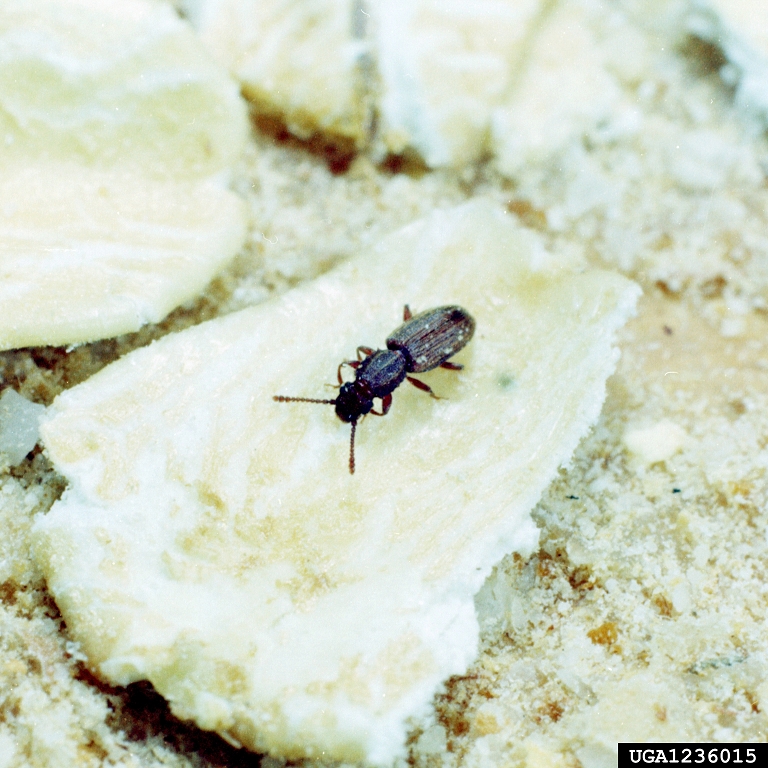
Quorn grain beetles are storage pests that infest grains, seeds, and processed food products. These beetles can contaminate food supplies and cause economic losses.
They are commonly found in storage facilities, warehouses, and homes where dry goods are stored.
The Pantry Invader: Quorn Grain Beetles
The Quorn Grain Beetle (often referring to the Foreign Grain Beetle, Ahasverus advena) is a significant “secondary” storage pest in the United States. While they are found in grain elevators and mills, they are most notorious as a “new house pest” in residential areas like Tucson and Phoenix. They are considered “noxious” not because they eat large quantities of food, but because they are indicators of mold and high humidity. In the U.S. Southwest, they often appear in massive numbers in newly constructed homes as the building materials “breathe” out moisture.
Identification: The “Thoracic Tooth”
Because they are tiny, they are often confused with Sawtoothed Grain Beetles or Flour Beetles. For Pestipedia.com users, a magnifying glass is required to see the “Quorn” markers:
- Size: Adults are exceptionally small, measuring only about 2mm (1/12 inch) in length.
- Color: They are a uniform reddish-brown or “amber” color with a flattened, oblong body.
- The “Corners”: The defining feature of the Foreign Grain Beetle is the rounded, tooth-like bump on the front two corners of the thorax (the segment behind the head).
- Flight: Unlike many other pantry beetles, these are strong fliers and are highly attracted to lights at night.
The “Fungus-Feeder” Strategy
The Quorn Grain Beetle is technically a mycetophagous insect, meaning its primary diet is not the grain itself, but the microscopic fungi and molds that grow on damp organic matter.
- The “New House” Syndrome: In the U.S., these beetles often emerge from behind the walls of newly built homes. As green lumber or wet drywall compound dries, it grows invisible molds that provide a feast for these beetles.
- Grain Contamination: In pantries, they are attracted to “out-of-condition” (damp) flour, cereal, or pet food. Their presence is a warning that the food has begun to spoil or harbor mold spores.
- Rapid Reproduction: They can complete their life cycle from egg to adult in as little as 20 days if the humidity is above 70%.
U.S. Household and Storage Management
In the United States, managing Quorn Grain Beetles is a matter of Moisture Control. Using pesticides on the beetles themselves is usually a waste of time if the environment remains damp.
- The Dehumidifier Strike: The most effective “poison” for these beetles is dry air. Keeping the indoor relative humidity below 50% will kill the larvae and stop the growth of the fungi they need to survive.
- The “First-In, First-Out” Rule: Preventing pantry outbreaks means using older grain products first and storing all cereals, flours, and spices in airtight glass or plastic containers.
- Vacuuming over Spraying: If you find them in a new home, skip the “bug bomb.” Use a vacuum with a HEPA filter to remove the adults and focus on running the AC or a dehumidifier to dry out the wall voids.
- Discarding Damp Stock: If these beetles are found in a bag of flour, do not try to “sift” them out. The presence of the beetles suggests the flour is damp enough to harbor mold, which can be a health risk.
Identification
Small brown beetles with elongated bodies.
Life Cycle
Eggs laid in food sources; larvae develop inside.
Damage
Contamination and spoilage of stored products.
Control
Airtight storage, sanitation, and monitoring.