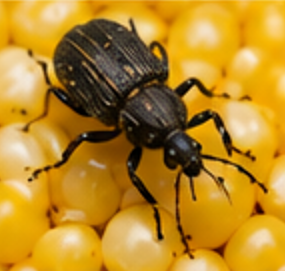
Maize weevils (Sitophilus zeamais) are destructive stored-grain beetles that attack corn, wheat, rice, sorghum, barley, and numerous other seeds. They are primary grain pests, meaning their larvae can develop inside whole, undamaged kernels. Infestations reduce grain weight, germination, nutritional value, and marketability.
Maize weevils are important pests of farms, grain elevators, warehouses, feed mills, food-processing facilities, and household pantries. They can enter storage in grain that was infested before harvest or spread from contaminated equipment, residues, and older grain. In homes, they are commonly introduced in corn, birdseed, decorative corn, dry pet food, or whole-grain products.
Taxonomy and Classification
- Kingdom: Animalia
- Phylum: Arthropoda
- Class: Insecta
- Order: Coleoptera
- Family: Curculionidae
- Genus: Sitophilus
- Species: Sitophilus zeamais
The maize weevil is closely related to the rice weevil, Sitophilus oryzae, and granary weevil, Sitophilus granarius. All three species are sometimes collectively called grain weevils. Maize and rice weevils are so similar that reliable separation may require magnification, an identification key, or examination by an entomologist.
Identification
Adult maize weevils are small, elongated beetles measuring approximately one-eighth inch long. Their bodies range from reddish brown to dark brown or nearly black. The head extends into a distinctive curved snout, or rostrum, with chewing mouthparts at its tip.
Four pale reddish, orange, or yellowish spots are usually visible on the hardened wing covers. The surface behind the head is marked with small round pits. Adults have functional wings and are capable of strong flight, allowing them to move between stored grain and mature crops in the field.
The larvae are white or cream-colored, legless, C-shaped grubs with brown head capsules. They remain concealed inside kernels throughout their development and are rarely seen unless infested grain is cut open. The pupal stage also occurs inside the kernel.
Maize Weevils vs. Similar Grain Weevils
Rice weevils resemble maize weevils in size, color, markings, and ability to fly. Superficial appearance is not always sufficient to separate them. Fortunately, household prevention and control are essentially the same for both species.
Granary weevils are generally shinier and lack the four pale spots found on maize and rice weevils. Their wings are not functional, so they cannot fly. Small beetles without an obvious snout may instead be lesser grain borers, flour beetles, or sawtoothed grain beetles.
Distribution and Food Sources
Maize weevils occur throughout warm and temperate grain-producing regions. They are especially damaging in warm, humid storage environments. Heated buildings allow populations to remain active during cold weather.
Despite their name, these weevils are not restricted to maize. Susceptible products include:
- Whole corn and popcorn
- Wheat, rice, barley, oats, and rye
- Sorghum and millet
- Birdseed and wildlife feed
- Dry beans and peas
- Nuts and large seeds
- Dry pet and livestock feed
- Decorative corn and seed-filled crafts
Larvae develop best in whole or substantially intact kernels. Adults may also feed on damaged grain and other dry products after emerging.
Life Cycle
Maize weevils undergo complete metamorphosis through egg, larval, pupal, and adult stages. A female chews a small cavity in a kernel, deposits an egg inside, and seals the opening with a gelatinous plug. A single female can infest many kernels during her lifetime.
The egg hatches inside the grain. The larva consumes the starchy interior while remaining protected by the kernel’s outer covering. After completing its larval stages, it pupates within the hollowed kernel. The new adult chews a round exit hole and begins feeding, mating, and dispersing.
Development can be completed in approximately one month under warm, favorable conditions but takes longer at lower temperatures. Multiple overlapping generations can occur in stored grain, allowing an unnoticed population to increase rapidly.
Signs of an Infestation
Infestations frequently remain hidden until adults emerge. Common signs include:
- Small round exit holes in grain kernels
- Adult snout beetles crawling through grain
- Beetles flying near bins, cupboards, or windows
- Hollow, lightweight, or easily crushed kernels
- Fine powder and grain fragments beneath stored products
- Reduced seed germination
- Unusual warmth, moisture, or musty odors in stored grain
Commercial grain may experience “hot spots” as insects, moisture, and fungal activity increase in localized areas. These conditions can lead to caking, mold growth, and further deterioration.
Damage and Importance
Both larvae and adults damage stored products, but hidden larval feeding causes much of the loss. Infested kernels lose weight and may no longer germinate. Feeding produces broken grain and dust that can support secondary pests unable to penetrate intact kernels.
Maize weevils do not bite or sting people or pets. They do not infest wood, fabric, or buildings. Products containing insects, waste, and damaged grain are contaminated and may be unsuitable for household use or commercial sale.
Household Control
Find and Discard the Source
Inspect corn, rice, wheat, birdseed, pet food, dried beans, nuts, and decorative items. Check unopened packages because insects may enter through seams or be present when a product is purchased. Seal infested material in a bag and remove it from the home.
Clean Storage Areas
Vacuum shelves, corners, peg holes, cracks, and areas beneath liners. Remove every spilled kernel and grain fragment. Empty the vacuum outdoors after cleaning. Washing shelves improves sanitation, but household cleaners alone will not eliminate insects developing inside overlooked food.
Use Airtight Containers
Store susceptible foods in tightly sealed glass, metal, or heavy plastic containers. Thin bags and cardboard boxes do not provide dependable protection. Purchase amounts that can be used promptly and rotate older products before opening new ones.
Routine cupboard insecticide sprays are rarely necessary. They cannot reach larvae inside kernels and should never be applied to food or food-contact surfaces unless specifically permitted by the label.
Commercial Grain Management
Empty bins should be cleaned thoroughly before harvest, including seams, aeration ducts, unloading equipment, and areas containing old grain. Newly stored corn should be properly dried and monitored for moisture, temperature, insects, and hot spots.
Aeration that cools grain below approximately 50 degrees Fahrenheit greatly reduces weevil movement and development. University of Florida guidance also notes that storing corn below 11 percent moisture helps suppress maize weevils. Exact drying targets should reflect the crop, storage period, and regional recommendations.
Grain protectants must be labeled for the commodity and applied according to current directions. Fumigants are extremely hazardous gases and should be used only by properly trained and licensed professionals. Field insecticide applications are generally not recommended specifically for maize weevil prevention.
Conclusion
Maize weevils are small, spotted snout beetles capable of damaging whole kernels before and after harvest. Their larvae remain concealed inside grain, making prevention and early monitoring especially important. Clean storage, dry and cool grain, sealed household containers, stock rotation, and prompt removal of infested products provide the foundation of effective maize weevil management.