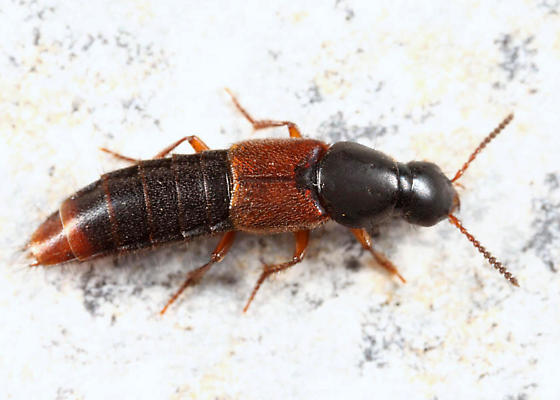
Quedius rove beetles are part of the Staphylinidae family, one of the largest beetle families worldwide. These beetles are typically found in moist, organic-rich environments such as compost piles, leaf litter, and decaying wood. While they are not harmful to humans or structures, their presence can sometimes be alarming due to their rapid movements and somewhat intimidating appearance.
Unlike many pest beetles, Quedius rove beetles are actually beneficial predators. They feed on a variety of smaller insects and larvae, including flies, mites, and other decomposer organisms. This makes them an important component of natural pest control systems in gardens and agricultural settings.
The Fast-Moving Predator: Quedius Rove Beetles
The Quedius Rove Beetle (Genus Quedius) belongs to one of the largest and most successful families of insects, the Staphylinidae. In the United States, they are found in nearly every habitat, from the damp forests of the Pacific Northwest to the suburban gardens of Tucson. While they are technically “pests” when they enter homes in large numbers, they are primarily beneficial predators that act as the “clean-up crew” of the insect world, hunting down the larvae of flies, gnats, and root-feeding maggots.
Identification: The “Short-Winged” Specialist
Rove beetles are often mistaken for earwigs because of their elongated, flexible bodies. However, unlike earwigs, they lack the large rear pincers (cerci). Identifying a Quedius species requires looking for a few specific “armored” traits:
- Short Elytra: Their wing covers (elytra) are remarkably short, leaving more than half of the abdomen exposed. Despite this, they have fully functional wings folded intricately underneath, allowing them to fly well.
- The “Scorpion” Posture: When threatened or running, a Quedius beetle will often curl its abdomen upward over its head. This is a bluff; they do not have a stinger, though some species can emit a foul-smelling defensive chemical.
- Glossy Appearance: Most species are shiny black or dark mahogany, with a large, rounded head and prominent “bulging” eyes designed for nocturnal hunting.
- Large Mandibles: They possess sharp, sickle-shaped jaws used to pierce and dismember smaller insects and soil-dwelling larvae.
The “Beneficial” Hunter
It is vital to distinguish between a “nuisance” and a “pest.” In a garden or agricultural setting, Quedius beetles are elite hunters:
- Root Maggot Control: They are one of the few natural predators capable of entering the soil to hunt Cabbage Root Maggots and Onion Maggots, significantly reducing crop damage.
- Decomposition: They are frequently found in compost piles and leaf litter, where they prey on the mites and springtails that break down organic matter, helping to balance the micro-ecosystem.
- Fungal Gnat Predation: In greenhouses, they are used as a biological control to hunt the larvae of fungus gnats in potting soil.
The “Nuisance” Invasion
Why do they end up in your house? In the U.S., Quedius beetles typically become a household nuisance during two specific weather events:
- Heavy Rainfall: When the soil becomes saturated, these beetles crawl upward to avoid drowning, often entering basements and crawl spaces through cracks in the foundation.
- Extreme Heat: In arid climates like Arizona, they seek out the “coolth” and moisture of indoor plumbing, often appearing in sinks, tubs, or damp laundry rooms.
Management: Dryness Over Chemicals
Since Quedius beetles do not bite, sting, or damage wood or food, the use of indoor pesticides is highly discouraged. Management should focus on habitat modification:
- Reduce “Foundation Foliage”: Moving heavy mulch, woodpiles, or thick ground-cover plants (like ivy) away from the immediate foundation of the house removes their hunting grounds and resting sites.
- Dehumidification: If you find them in a basement, using a dehumidifier to keep the relative humidity below 50% will make the environment too dry for them to survive.
- The “Paper and Cup” Method: Because they are beneficial to your garden, the best way to “treat” a stray beetle in the house is to catch it in a cup and release it back into your flower beds where it can go back to hunting real pests.
Identification
These beetles are elongated, with short wing covers that expose much of their abdomen. They are typically dark brown or black and can range from 5–15 mm in length. Their flexible abdomen often curves upward when disturbed.
Life Cycle
Eggs are laid in moist organic material. Larvae resemble adults but are smaller and lack wings. They develop through several stages before pupating in soil or debris.
Behavior and Habitat
Quedius beetles are highly active predators, often found under logs, stones, or compost. They are nocturnal and avoid direct sunlight.
Impact
They are beneficial insects that help control pest populations. However, their presence indoors may indicate excess moisture or organic buildup.
Control
Control is rarely necessary. Reducing moisture and organic debris can limit indoor occurrences.