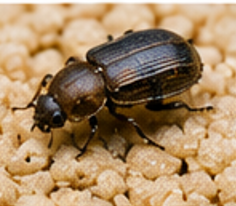
Nitrate beetles are a loosely defined group of beetles commonly associated with environments rich in decomposing organic material, including compost piles, manure-rich soils, and damp storage areas. While many species within this grouping play an important ecological role in nutrient cycling and decomposition, they can become problematic when their populations grow unchecked or when they infest stored materials, agricultural systems, or indoor environments.
These beetles are often attracted to nitrogen-rich organic matter, which provides an ideal environment for both adult feeding and larval development. In natural ecosystems, they contribute to breaking down organic waste and returning nutrients to the soil. However, in agricultural or storage settings, their presence can lead to contamination of goods, structural nuisance issues, and secondary pest attraction.
The Cured-Meat Specialist: Nitrate Beetles
The Nitrate Beetle, more commonly known in the United States as the Red-Legged Ham Beetle (Necrobia rufipes), is a notorious pest of high-protein stored products. Its nickname stems from its historical association with meat-curing facilities that used nitrates and salt to preserve hams and bacon. In the modern U.S., it remains a significant concern for the pet food industry, taxidermists, and specialty cured-meat producers.
Identification: The “Shiny Emerald” Predator
Unlike many dull-colored pantry pests, the Nitrate Beetle is visually striking. It is a small (4–5mm) beetle with a metallic, shiny blue-green or emerald body. Identifying it correctly is vital because it is both a scavenger and a predator:
- Red Legs: As its primary name suggests, its legs are a distinct, bright reddish-brown or orange, contrasting sharply with its metallic torso.
- Clubbed Antennae: The last three segments of the antennae are enlarged into a dark, prominent club.
- The Larvae: The larvae are creamy white with a purple-gray tinge and a dark head. They are highly active and frequently bore into fatty tissues or even soft wood to pupate.
Infestation: From Pantries to Museums
In the U.S., the Nitrate Beetle is a generalist of animal-based products. It is uniquely adapted to survive in environments with high salt content that would dehydrate other insects:
- Cured Meats: They are the primary pest of country hams, prosciutto, and dried fish, where they feed on the fat and muscle fibers.
- Pet Food: They are frequently found in “high-protein” kibble, fish meal, and freeze-dried pet treats.
- Taxidermy and Bone Cleaning: In museums, they can be devastating pests of hides and horn. However, they are also predatory and will eat the larvae of other pests, such as larder beetles or clothes moths.
U.S. Management and Control
Because these beetles are strong fliers and can detect the scent of curing meat from great distances, management in the U.S. relies heavily on sanitation and temperature:
- Cold Storage: Keeping cured meats at temperatures below 45°F (7°C) effectively stops the beetle’s reproductive cycle.
- Airtight Packaging: Because they can bore through paper and thin foil, high-quality plastic or vacuum-sealing is necessary for long-term storage of dried meats.
- The “Source” Hunt: In a household setting, a Nitrate Beetle sighting often leads back to a forgotten bag of dry dog food or a decorative piece of rawhide. Discarding the infested source is the only way to stop the population.
Identification
Nitrate beetles vary widely in appearance depending on species, but most are small to medium-sized with elongated or oval bodies. They are often dark brown or black, though some species may exhibit metallic or reddish tones. Their bodies are typically smooth and somewhat flattened, allowing them to move easily through organic debris.
Life Cycle
The lifecycle begins when females lay eggs in moist, organic-rich environments. Larvae hatch and feed on decomposing material, microorganisms, and organic residues. After several developmental stages, they pupate within the substrate before emerging as adults. Under favorable conditions, multiple generations can occur annually, especially in warm, humid environments.
Damage and Impact
While nitrate beetles are not typically destructive to living plants, they can become pests in agricultural storage areas and compost-heavy environments. Large populations may contaminate stored organic materials, attract other pests, and create sanitation concerns. In greenhouse or nursery settings, excessive organic buildup can support population explosions.
Prevention and Control
Control focuses on reducing excess organic matter and moisture. Proper sanitation, compost management, and ventilation are key. In severe cases, targeted treatments or biological controls may be used to reduce populations.