Overview
Hummingbird clearwing moths (Hemaris spp.) are unique members of the family Sphingidae known for their striking resemblance to hummingbirds. These day-flying moths hover while feeding on nectar, using long proboscises to access deep flowers. Their transparent wings and rapid wingbeats further enhance their bird-like appearance, making them one of the most commonly misidentified insects in North America.
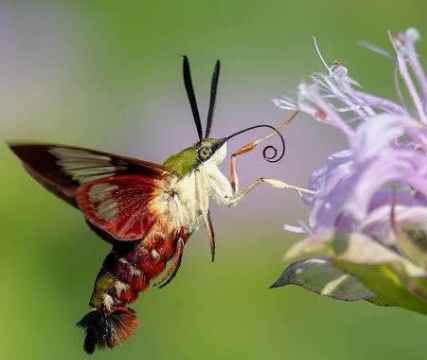
Unlike many moths, which are nocturnal, hummingbird clearwings are active during daylight hours and are frequently seen in gardens, meadows, and woodland edges. They are important pollinators, visiting a wide range of flowering plants and contributing to plant reproduction.
While the adult moths are beneficial, their larvae—commonly called hornworms—feed on plant leaves. However, these caterpillars rarely occur in high enough numbers to cause significant damage, making the species overall beneficial rather than a pest concern.
Identification
Adult hummingbird clearwing moths have stout, fuzzy bodies and clear wings with dark borders. Their coloration often includes olive green, burgundy, or yellow tones.
They hover while feeding, much like hummingbirds, and produce a soft humming sound from their wingbeats.
Larvae are green caterpillars with a characteristic horn on the rear, similar to other sphinx moth species.
Habitat
These moths are found in gardens, fields, forests, and suburban landscapes where nectar-producing plants are abundant. They are especially attracted to flowering species such as bee balm, phlox, and honeysuckle.
Behavior and Life Cycle
Females lay eggs on host plants, including honeysuckle and viburnum. After hatching, larvae feed on leaves and grow through several stages before pupating in the soil or leaf litter.
Adults emerge and begin feeding on nectar, playing a key role in pollination. Depending on the region, one or more generations may occur per year.
Ecological Role
Hummingbird clearwing moths are valuable pollinators, supporting biodiversity and plant reproduction. Their daytime activity complements nocturnal pollinators, expanding pollination coverage.
They also serve as prey for birds and other predators, contributing to food web dynamics.
Impact
Overall, these moths are beneficial insects. Larval feeding is minimal and rarely causes significant plant damage.
Conservation
Planting nectar-rich flowers and reducing pesticide use can help support populations of hummingbird clearwing moths.
Taxonomy
- Kingdom: Animalia
- Phylum: Arthropoda
- Class: Insecta
- Order: Lepidoptera
- Family: Sphingidae
- Genus: Hemaris