Overview
Horntail wood wasps, also known as woodwasps, belong to the family Siricidae and are notable for their wood-boring larvae. Despite their name, these insects are not true stinging wasps but rather a group of primitive sawflies. They are commonly associated with coniferous and hardwood trees, where their larvae develop within the wood.
These insects are particularly important in forestry due to their potential to damage timber and weaken trees. Some species, such as the invasive Sirex noctilio, have become significant pests in commercial forestry operations.
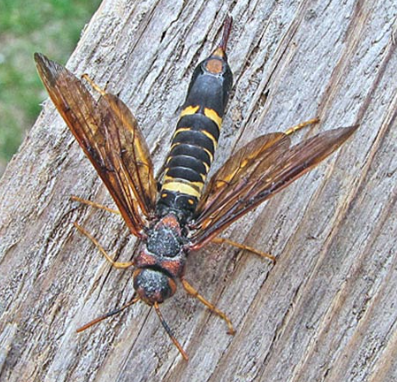
Horntail wood wasps are also ecologically important as decomposers, helping break down dead or dying wood and contributing to nutrient cycling.
Identification
Adult horntail wood wasps are large, often 1–1.5 inches long, with cylindrical bodies and a pointed “horn” at the end of the abdomen. Females have a long ovipositor used for drilling into wood.
They are typically black, brown, or metallic blue with yellow or orange markings depending on species.
Habitat
These insects are found in forests, woodlands, and areas with trees. They are particularly associated with stressed, dying, or recently cut timber.
Behavior and Life Cycle
Females use their ovipositor to drill into wood and lay eggs. During this process, they often introduce symbiotic fungi that help break down wood and provide food for developing larvae.
Larvae tunnel through wood as they feed, creating galleries. Development can take one to several years depending on conditions.
Adults emerge by boring exit holes through the wood.
Damage and Impact
Larval tunneling weakens wood structure and can reduce the value of timber. In living trees, infestations may contribute to decline, particularly in already stressed specimens.
In forestry, certain species are considered serious pests due to their economic impact.
Prevention and Control
Maintaining tree health and removing infested wood can help reduce populations. Monitoring is essential in forestry settings.
Taxonomy
- Kingdom: Animalia
- Phylum: Arthropoda
- Class: Insecta
- Order: Hymenoptera
- Family: Siricidae