Overview
The hickory horned devil is one of the largest and most striking caterpillars found in North America. It is the larval stage of the regal moth (Citheronia regalis), a member of the family Saturniidae. Despite its intimidating appearance, complete with large spines and vibrant coloration, the hickory horned devil is harmless to humans and plays a role in forest ecosystems.
These caterpillars are typically found on hardwood trees such as hickory, walnut, and persimmon. They are known for their impressive size, often reaching lengths of up to 6 inches before pupation. Their bright green bodies and orange or black spines serve as a defense mechanism, deterring predators.
Although they consume leaves, their populations are usually low, and they rarely cause significant damage to host trees.
Identification
Hickory horned devils are large, bright green caterpillars with prominent orange and black spines near the head. Their size and coloration make them easy to identify.
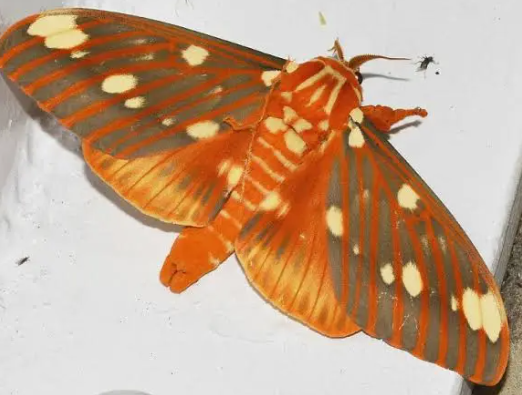
Adult regal moths are large, with orange and gray wings.
Habitat
These caterpillars are found in forests, woodlands, and areas with suitable host trees.
Behavior and Life Cycle
Eggs are laid on host trees, and larvae feed on leaves as they grow. After reaching full size, they burrow into soil to pupate.
Adults emerge as moths and do not feed.
Impact
They are not considered pests due to their low population density and minimal damage.
Prevention and Control
No control is necessary. They should be left undisturbed as part of the ecosystem.
Taxonomy
- Kingdom: Animalia
- Phylum: Arthropoda
- Class: Insecta
- Order: Lepidoptera
- Family: Saturniidae
- Species: Citheronia regalis