Overview
Hay mites are tiny arachnids commonly found in stored hay, straw, grain, and other organic materials. These mites belong to various groups within the subclass Acari and are closely related to dust mites and other storage mites. While they are not typically harmful to plants, they can become a nuisance in agricultural settings and may cause irritation to humans and animals.
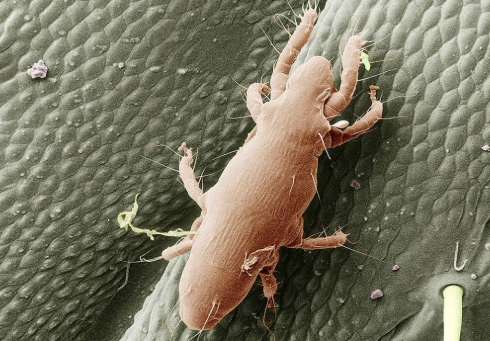
These mites thrive in warm, humid environments where organic material is abundant. They feed on fungi, mold, and decaying plant matter, playing a role in decomposition. However, when populations grow excessively, they can contaminate stored products and create health concerns.
Farmers, stable workers, and individuals handling hay may experience allergic reactions or skin irritation due to exposure to these mites.
Identification
Hay mites are extremely small and usually invisible to the naked eye. They appear as tiny white or translucent specks under magnification.
Infestations are often detected by the presence of dust-like movement or allergic reactions.
Habitat
These mites are found in hay bales, straw, grain storage, and other organic materials. They prefer moist environments where mold growth is present.
Behavior and Feeding
Hay mites feed on fungi and organic debris. Their populations increase rapidly under favorable conditions.
They may spread through handling of contaminated materials.
Impact
Hay mites can cause allergic reactions, skin irritation, and contamination of stored products.
Prevention and Control
Proper storage conditions, including reducing moisture and improving ventilation, are key to preventing infestations.
Taxonomy
- Kingdom: Animalia
- Phylum: Arthropoda
- Class: Arachnida
- Subclass: Acari