Overview
Hairy Root Weevils are a group of plant-feeding beetles within the family Curculionidae that are known for their elongated snouts, hidden root-feeding larvae, and destructive feeding habits. These pests are common in ornamental landscapes, nurseries, greenhouses, and agricultural systems where they attack a wide variety of plants. The term “hairy” refers to the fine setae or hair-like structures covering parts of the adult beetle’s body.
Hairy root weevils are particularly problematic because both the adult and larval stages damage plants. Adults feed on leaves and foliage, while larvae attack root systems beneath the soil surface. Root feeding is often the more destructive stage because it interferes with the plant’s ability to absorb water and nutrients, leading to wilting, reduced growth, and even plant death.
Many species of root weevils are nocturnal and remain hidden during the day, making infestations difficult to detect until visible damage becomes severe. Their larvae are concealed underground where they feed on roots for extended periods, allowing populations to grow unnoticed.
These pests are especially damaging in container-grown nursery stock, where confined root systems can be rapidly destroyed by feeding larvae. In severe infestations, plants may collapse suddenly despite appearing healthy only days earlier.
Hairy root weevils are highly adaptable and can infest a broad range of ornamental shrubs, perennials, fruit crops, and landscape plants.
Quick Facts
- Common Name: Hairy Root Weevils
- Family: Curculionidae
- Order: Coleoptera
- Main Damage: Root feeding and leaf notching
- Habitat: Gardens, nurseries, agricultural fields
- Most Damaging Stage: Larvae
- Activity: Mostly nocturnal
- Threat Level: Moderate to high in nurseries
Taxonomy and Classification
Hairy root weevils belong to the beetle family Curculionidae, one of the largest insect families in the world.
- Kingdom: Animalia
- Phylum: Arthropoda
- Class: Insecta
- Order: Coleoptera
- Family: Curculionidae
Root weevils are part of a large group of snout beetles characterized by elongated mouthparts adapted for feeding and egg-laying.
Several species may be referred to as hairy root weevils depending on geographic location and host plants.
Identification
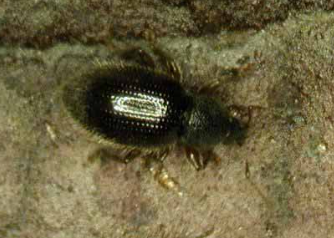
Adult hairy root weevils are small to medium-sized beetles with stout bodies and distinctive snouts.
Adult Appearance
- Brown, black, or mottled coloration
- Fine hairs or scales on the body
- Elongated snout (rostrum)
- Oval-shaped body
- Strong legs for climbing plants
Many species have textured or rough-looking wing covers that help camouflage them against bark or soil.
Larvae
Larvae are:
- Creamy white
- Legless
- C-shaped grubs
- Brown-headed
- Soil-dwelling
They are commonly found near plant roots where they feed underground.
Leaf Damage
Adult feeding creates one of the most recognizable signs of infestation:
- Notched leaf edges
- Scalloped foliage
- Irregular chewing damage
This damage is often visible before root problems are detected.
Habitat and Distribution
Hairy root weevils are found worldwide in both cultivated and natural environments.
Common Habitats
- Gardens
- Greenhouses
- Nurseries
- Agricultural fields
- Landscape plantings
- Container-grown plants
They are especially common in moist soil environments where host plants are abundant.
Host Plants
Hairy root weevils attack many plant species including:
- Rhododendrons
- Azaleas
- Strawberries
- Evergreens
- Perennials
- Fruit crops
- Container ornamentals
Young plants and nursery stock are often the most vulnerable.
Life Cycle
Hairy root weevils undergo complete metamorphosis with four life stages.
Egg Stage
Females lay eggs in soil or near the base of host plants.
Egg-laying often occurs during warm months when plants are actively growing.
Larval Stage
After hatching, larvae burrow into soil and begin feeding on roots.
This stage causes the greatest damage because larvae may consume:
- Fine feeder roots
- Larger structural roots
- Crowns of young plants
Heavy feeding weakens the plant’s root system and reduces water uptake.
Pupal Stage
Pupation occurs within the soil near the root zone.
Adult Stage
Adults emerge from the soil and climb onto host plants to feed on foliage.
Many species are nocturnal and hide during daylight hours beneath debris or soil.
Behavior and Feeding
Hairy root weevils are both foliage feeders and root feeders depending on life stage.
Adult Feeding
Adults chew characteristic notches along leaf margins.
Although this feeding is mostly cosmetic, heavy infestations can weaken ornamental plants.
Larval Feeding
Larvae feed underground on roots and root crowns.
This can lead to:
- Wilting
- Yellowing leaves
- Reduced growth
- Poor nutrient uptake
- Plant collapse
Container plants are particularly vulnerable because roots are confined to small spaces.
Nocturnal Activity
Adults are usually most active at night.
During the day they may hide:
- Under mulch
- Beneath pots
- In soil cracks
- Among debris
Damage and Impact
Hairy root weevils can cause both economic and aesthetic damage.
Root Damage
Larval feeding underground is often severe and difficult to detect early.
Symptoms include:
- Plant decline
- Poor vigor
- Wilting despite watering
- Root destruction
- Plant death
Foliage Damage
Adult feeding causes:
- Scalloped leaf edges
- Chewed foliage
- Reduced ornamental appearance
Nursery Losses
Commercial nurseries may experience significant economic losses from root weevil infestations because damaged plants become unsellable.
Signs of Infestation
- Notched or scalloped leaves
- Wilting plants
- Poor root development
- Sudden plant collapse
- White grubs in soil
- Adult beetles on foliage at night
Prevention and Control
Integrated pest management is the most effective strategy for controlling hairy root weevils.
Monitoring
Inspect plants regularly for:
- Leaf notching
- Adult beetles
- Root decline
- Larvae in soil
Night inspections are often most effective for locating adults.
Sanitation
Remove heavily infested plants and debris that may shelter adults.
Biological Control
Beneficial nematodes are commonly used against larvae in soil.
These microscopic organisms infect and kill root-feeding grubs naturally.
Soil Management
Maintaining healthy, well-drained soil helps plants tolerate feeding damage more effectively.
Chemical Control
In severe infestations, targeted insecticides may be used against adults or larvae.
Timing is critical because larvae remain protected underground.
Interesting Facts
- Many root weevils cannot fly despite having wing covers.
- Larvae cause far more damage than adults.
- Adult feeding leaves highly recognizable scalloped leaf edges.
- Some species reproduce without males through parthenogenesis.
- Root weevils are major nursery pests worldwide.
Conservation and Research
Although considered pests in agricultural and ornamental systems, root weevils are also part of natural soil ecosystems.
Research focuses on:
- Biological control methods
- Beneficial nematodes
- Reduced pesticide strategies
- Plant resistance
- Integrated pest management programs
Modern nursery management increasingly relies on biological controls and early monitoring to reduce reliance on chemical insecticides while preventing severe root damage.