Overview
Gray hairstreak caterpillars are the larval stage of the gray hairstreak butterfly (Strymon melinus), one of the most widespread butterfly species in North America. While the adult butterfly is often appreciated for its subtle beauty and role in pollination, the caterpillar stage can act as a minor garden pest due to its feeding habits. These caterpillars primarily target flower buds, seed pods, and developing plant tissues, making them more impactful than leaf-feeding species in certain situations.
Unlike many caterpillars that focus on foliage, gray hairstreak caterpillars often feed on reproductive parts of plants. This behavior can reduce flowering and seed production, particularly in ornamental plants and certain crops. However, they are rarely present in large enough numbers to cause severe damage, and their ecological role often outweighs their impact as pests.
These caterpillars are highly adaptable and can feed on a wide variety of host plants, including legumes, mallows, and ornamental flowers. Their ability to utilize multiple plant species contributes to their widespread distribution and success.
Identification
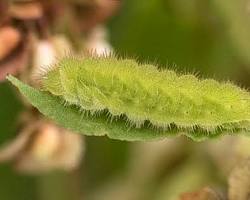
Gray hairstreak caterpillars are small, typically about 1/2 inch long when fully grown. They have a slug-like appearance with a flattened body and lack the prominent hairs or spines seen in many other caterpillars. Their coloration varies from green to brown or pinkish, often blending with the plant material they are feeding on.
They may have faint striping or subtle markings along the body. Because of their small size and camouflage, they are often difficult to spot unless closely inspected.
Habitat
These caterpillars are found in a wide range of environments, including gardens, meadows, agricultural fields, and natural landscapes. They are particularly common in areas where flowering plants are abundant.
Their distribution spans much of North America, and they can be found throughout the growing season, especially in warmer climates where multiple generations occur each year.
Behavior and Feeding
Gray hairstreak caterpillars feed primarily on flower buds, blossoms, and seed pods. This feeding can interfere with plant reproduction by reducing the number of flowers that develop into seeds or fruit. In some cases, they may also feed on leaves, but this is less common.
Their feeding is usually localized, and individual caterpillars tend to remain on a single plant or nearby plants. Because they are small and not highly mobile, infestations are often limited in scope.
These caterpillars may also have mutualistic relationships with ants, which protect them from predators in exchange for sugary secretions produced by the caterpillars. This interaction can influence their survival and distribution.
Impact
Gray hairstreak caterpillars are considered minor pests in most situations. While they can reduce flowering and seed production, their impact is generally limited and does not justify aggressive control measures.
They are also an important part of the ecosystem, contributing to biodiversity and serving as prey for birds and other predators.
Prevention and Control
Control is rarely necessary. In cases where damage is noticeable, caterpillars can be removed by hand. Encouraging natural predators and maintaining a balanced garden ecosystem can help keep populations in check.
Because they develop into beneficial pollinators, many gardeners choose to tolerate their presence.
Taxonomy
- Kingdom: Animalia
- Phylum: Arthropoda
- Class: Insecta
- Order: Lepidoptera
- Family: Lycaenidae