Overview
Giant resin bees (Megachile sculpturalis) are large, solitary bees that have become increasingly noticeable across North America. Originally native to East Asia, these bees were introduced accidentally and have since spread widely throughout the United States. Unlike honey bees, giant resin bees do not live in colonies. Instead, they are solitary nesters that use existing cavities such as hollow plant stems, wood borings, or artificial bee hotels.
These giant resin bees are known for their size and strength, as well as their ability to gather plant resins to construct their nests. The resin is used to seal nest chambers and protect developing larvae. While they are effective pollinators, their presence raises concerns because they compete with native bee species for nesting sites.
Although they are not aggressive and rarely sting, giant resin bees may displace native pollinators by occupying available nesting cavities. This competition can affect local biodiversity, particularly in areas where suitable nesting habitats are limited.
Identification
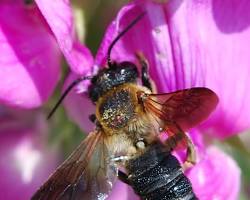
Giant resin bees are among the largest bees found in North America, typically measuring between 3/4 and 1 inch in length. They have a robust black body with a somewhat shiny appearance. Their wings are dark and may appear slightly smoky.
Unlike fuzzy bees such as bumblebees, giant resin bees have relatively smooth bodies. They also carry pollen on the underside of their abdomen rather than on their legs.
Habitat
These bees are commonly found in gardens, parks, forests, and urban areas where flowering plants are abundant. They prefer environments that provide both nectar sources and suitable nesting sites.
Giant resin bees nest in pre-existing cavities, including holes in wood, bamboo stems, and artificial bee houses. They do not excavate their own nests, making them dependent on available nesting structures.
Behavior and Role
Giant resin bees are active during the warmer months, typically from late spring through early fall. They visit flowers to collect nectar and pollen, contributing to pollination. Their large size allows them to access a wide range of flowers.
Female bees gather plant resins to construct and seal nest chambers. Each chamber contains an egg and a supply of food for the developing larva. Once sealed, the larva develops independently.
While they are beneficial pollinators, their aggressive occupation of nesting sites can displace native bees, making their ecological impact somewhat controversial.
Impact
Giant resin bees are not considered pests in the traditional sense, as they do not damage plants or structures. However, their competition with native pollinators can affect local ecosystems.
In areas where they are abundant, they may dominate nesting sites and reduce opportunities for native species to reproduce.
Prevention and Management
Managing giant resin bees typically involves monitoring bee houses and ensuring that nesting sites are available for native species. Removing or modifying artificial nesting structures may help reduce their dominance.
Encouraging a diverse range of native plants and habitats can support native pollinator populations and promote ecological balance.
Taxonomy
- Kingdom: Animalia
- Phylum: Arthropoda
- Class: Insecta
- Order: Hymenoptera
- Family: Megachilidae