Overview
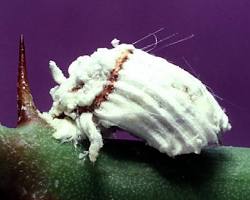
Fluted Scale Insects are sap-feeding pests belonging to the larger group of scale insects that attack ornamental plants, shrubs, citrus trees, and many other woody plants. These insects are most recognizable for the distinctive ribbed or fluted waxy egg sacs produced by adult females. The white cottony appearance of these egg masses often makes infested branches appear covered in bits of cotton, foam, or ridged wax.
One of the most famous species in this group is the Cottony Cushion Scale (Icerya purchasi), an invasive pest historically responsible for devastating citrus orchards in California during the late 1800s. This insect became a landmark example in the history of biological pest control when scientists successfully introduced the Vedalia Beetle, a predatory lady beetle that dramatically reduced scale populations.
Fluted Scale Insects weaken plants by feeding on sap using piercing-sucking mouthparts. As they feed, they excrete large quantities of sticky honeydew, which encourages the growth of black sooty mold fungi. Heavy infestations may result in:
- Leaf yellowing
- Premature leaf drop
- Twig dieback
- Reduced fruit production
- General plant decline
These pests are especially problematic in warm climates and greenhouse environments where populations can build rapidly without natural predators.
Taxonomy and Classification
- Kingdom: Animalia
- Phylum: Arthropoda
- Class: Insecta
- Order: Hemiptera
- Superfamily: Coccoidea
- Family: Monophlebidae (for Cottony Cushion Scale)
- Species Example: Icerya purchasi
- Common Name: Fluted Scale Insects
Fluted Scale Insects belong to the scale insect superfamily Coccoidea, which includes:
- Soft scales
- Armored scales
- Mealybugs
- Cottony scales
Unlike many insects, adult female scales are largely immobile after attaching themselves to the host plant.
These insects undergo incomplete metamorphosis consisting of:
- Egg
- Nymph (crawler)
- Adult
The mobile crawler stage is the primary dispersal phase of the life cycle.
Physical Description
Adult female Fluted Scale Insects are small oval-bodied insects covered by waxy secretions.
Their most distinctive feature is the large ribbed or fluted egg sac extending from the body.
Common identifying characteristics include:
- White cottony appearance
- Fluted or ribbed wax covering
- Oval soft-bodied shape
- Stationary attachment to stems and leaves
- Sticky honeydew deposits nearby
The fluted egg sac may contain hundreds of eggs and often grows larger than the insect itself.
Nymphs, called crawlers, are:
- Tiny
- Orange to reddish in color
- Highly mobile
- Capable of dispersing to new plant tissue
Adult males are rarely observed and are short-lived winged insects in some species.
Distribution and Habitat
Fluted Scale Insects occur worldwide, especially in subtropical and tropical climates.
They are common in:
- Citrus orchards
- Gardens
- Greenhouses
- Urban landscapes
- Nurseries
- Indoor ornamental plants
These insects are typically found attached to:
- Branches
- Twigs
- Leaf undersides
- Stems
- Fruit surfaces
Warm temperatures, dense foliage, and reduced predator populations favor infestation development.
Host plants commonly attacked include:
- Citrus trees
- Fig trees
- Acacia
- Pittosporum
- Ornamental shrubs
- Fruit trees
Life Cycle
The life cycle of Fluted Scale Insects begins when females deposit eggs within their protective waxy egg sacs.
Egg Stage
Hundreds of eggs may be protected inside the cottony fluted sac.
The wax covering helps shield eggs from:
- Desiccation
- Predators
- Environmental stress
Crawler Stage
After hatching, the tiny crawler nymphs disperse across the plant.
This is the most vulnerable stage in the insect’s life cycle.
Crawlers search for feeding sites before inserting their mouthparts into plant tissue.
Adult Stage
Once settled, females become increasingly immobile and begin secreting protective wax.
As feeding continues, the large fluted egg sac develops behind the body.
Several overlapping generations may occur annually in warm climates.
Behavior and Feeding
Fluted Scale Insects feed by inserting specialized piercing-sucking mouthparts into plant tissue and extracting sap.
Continuous feeding weakens the plant and interferes with nutrient movement.
Feeding injury commonly causes:
- Leaf yellowing
- Wilting
- Reduced growth
- Twig decline
- Fruit reduction
As they feed, the insects excrete excess sugar in the form of sticky honeydew.
This honeydew promotes the development of sooty mold, a black fungus that coats leaves and stems.
Sooty mold can:
- Reduce photosynthesis
- Block sunlight
- Lower ornamental quality
- Stress weakened plants further
Heavy infestations may eventually lead to branch dieback and severe plant decline.
Damage and Economic Importance
Fluted Scale Insects are economically important pests in agriculture and ornamental horticulture.
Their impact includes:
- Reduced fruit production
- Lower crop quality
- Weakening of ornamental plants
- Increased plant susceptibility to stress
- Sooty mold contamination
Young trees and stressed plants are especially vulnerable.
Heavy infestations may:
- Cause premature leaf drop
- Reduce flowering
- Stunt plant growth
- Kill small branches
Commercial citrus production historically suffered enormous losses before effective biological controls became available.
Signs of Infestation
- White fluted egg sacs on branches
- Sticky honeydew on leaves
- Black sooty mold growth
- Leaf yellowing
- Clusters of scale insects on stems
- Reduced plant vigor
- Premature leaf drop
Management and Control (IPM)
Integrated Pest Management (IPM) is highly effective against Fluted Scale Insects.
Biological Control
The most famous biological control agent is the Vedalia Beetle (Rodolia cardinalis).
This predatory lady beetle feeds aggressively on:
- Scale eggs
- Nymphs
- Adult scales
Vedalia Beetles remain one of the greatest success stories in biological pest control history.
Other natural enemies include:
- Parasitic wasps
- Lacewings
- Predatory beetles
Pruning
Heavily infested branches should be pruned and removed to reduce population density.
Horticultural Oils
Horticultural oils help smother scales and crawlers.
Applications are most effective against:
- Crawler stages
- Young scales
Thorough coverage of stems and branch surfaces is important.
Sanitation
Maintaining healthy plants and removing excessive plant debris can reduce infestation pressure.
Chemical Control
Systemic insecticides may be used during severe infestations, especially in commercial production systems.
However, preserving beneficial predators is extremely important for long-term control.
Ecological Importance
Although considered pests, Fluted Scale Insects are part of complex ecological food webs.
They provide food for:
- Lady beetles
- Lacewings
- Parasitic wasps
- Predatory insects
Their interactions with predators have made them extremely important in the development of biological control science.
Research and Scientific Importance
Fluted Scale Insects are widely studied because of their historical role in agriculture and biological pest management.
Research areas include:
- Biological control programs
- Scale insect ecology
- Integrated pest management
- Host plant resistance
- Predator-prey interactions
The successful use of Vedalia Beetles against Cottony Cushion Scale remains one of the most important examples of classical biological control ever recorded.
Conclusion
Fluted Scale Insects are sap-feeding pests recognized by their distinctive ribbed white egg sacs and heavy honeydew production. These insects weaken plants by removing nutrients and promoting sooty mold growth that interferes with photosynthesis. Although severe infestations may damage citrus trees, ornamentals, and shrubs, integrated management strategies—especially biological control with Vedalia Beetles—have proven highly successful. Proper monitoring, pruning, horticultural oils, and conservation of natural predators remain the foundation of effective long-term control.