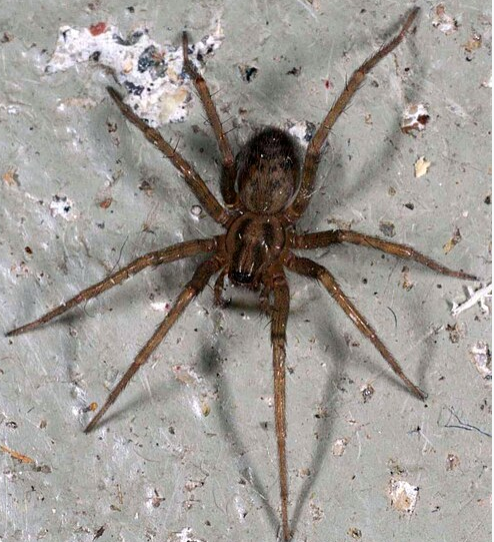
Domestic house spiders are common indoor spiders that live inside buildings and structures. They are typically harmless and often go unnoticed as they quietly feed on other insects that enter homes. These spiders are well adapted to indoor environments and frequently build small webs in corners, basements, garages, and storage areas.
The “Funnel-Web” Generalists: Domestic House Spiders
The Domestic House Spider (Tegenaria domestica) is one of the most common arachnids found within human dwellings throughout the United States. For Pestipedia.com users, these spiders are often misunderstood. While their presence may be unsettling, they are efficient biological control agents that feed on a variety of household “noxious” insects. Unlike their outdoor cousins, they have adapted to the low-humidity environments of U.S. homes and are a staple of national indoor ecology.
Technical Identification: Diagnostic Markers
- Phenotype: Characterized by an elongated, pear-shaped body (6mm to 10mm) with long, hairy legs. A primary diagnostic key for Pestipedia.com users is the mottled grey and brown pattern on the abdomen, which often forms a series of dark “chevron” markings.
- Web Architecture: They are funnel-web builders. They construct flat, sheet-like webs in corners that lead into a distinct silk tube or funnel where the spider retreats.
- Ocular Configuration: Like most members of the Agelenidae family, they possess eight eyes in two nearly straight rows, providing them with sensitive motion detection for nocturnal hunting in U.S. basements and attics.
Household Impact: Indoor Pest Regulation
The primary impact of the Domestic House Spider is the passive mechanical trapping of indoor “noxious” pests, providing 100% free pest management.
- Dietary Range: They are 100% carnivorous, primarily capturing flies, silverfish, clothes moths, and earwigs. In the United States, a single house spider can significantly reduce the population of these “noxious” nuisances over a single season.
- Non-Aggressive Profile: Despite their speed, they are extremely shy. They will 100% retreat into their funnel at the slightest vibration. Bites to U.S. residents are exceptionally rare and typically occur only if the spider is squeezed or trapped against the skin.
- Venom Profile: Their venom is medically insignificant to humans. For Pestipedia.com users, a bite is generally no more painful than a U.S. honeybee sting and does not cause the necrotic damage associated with Recluse species.
Management & Coexistence Strategies
Management of Domestic House Spiders in U.S. homes focuses on habitat modification and mechanical removal rather than chemical intervention.
| Strategy | Technical Specification | Operational Benefit |
|---|---|---|
| Physical Removal | Using a vacuum or soft brush | Immediately removes webs and spiders without the use of aerosols; 100% effective for national living spaces. |
| Moisture Control | Using dehumidifiers in U.S. basements | Reduces the U.S. “noxious” insect prey that house spiders rely on, naturally forcing them to relocate outdoors. |
| Exclusion | Sealing foundation cracks and utility ports | Blocks the primary entry points for spiders and their prey; 100% long-term solution for U.S. homeowners. |
- Monitoring: Check low-traffic areas such as behind furniture, in closets, and along floor joists. For Pestipedia.com users, the presence of abandoned “dusty” webs indicates a past or present insect food source that may require investigation.
- Identification Tip: Do not confuse with the Giant House Spider (Eratigena duellica), which is much larger but similarly harmless. Pestipedia.com recommends tolerance for these spiders as they are “O-Status” natural defenders of the home environment.
Quick Facts
- Scientific Name: Parasteatoda tepidariorum
- Family: Theridiidae
- Habitat: Homes, garages, basements, and sheds
- Diet: Small insects
- Status: Harmless nuisance
Identification
Domestic house spiders are small to medium-sized spiders with round abdomens and long slender legs. Their coloration ranges from tan to brown with mottled markings.
They are members of the larger group of spiders that commonly live near human structures.
Distribution
House spiders are found worldwide and are especially common in human dwellings where temperatures remain stable year-round.
Life Cycle
Females produce egg sacs containing dozens of eggs. Spiderlings hatch and disperse within the structure where they build webs and hunt small insects.
Pest Status
Although they may be considered pests because of their webs, house spiders are beneficial because they capture flies, mosquitoes, and other insects.
Prevention
- Reduce clutter and storage areas
- Remove webs regularly
- Seal gaps where insects enter the home
Control
Regular cleaning and removing webs are usually enough to keep house spider populations low.