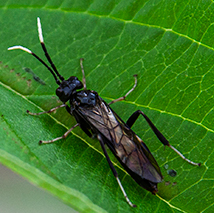
Dogwood Sawflies (Macremphytus tarsatus) are leaf-feeding insects that primarily attack dogwood trees and shrubs. Although their larvae closely resemble caterpillars, they are actually the immature stage of a sawfly—a type of non-stinging wasp in the order Hymenoptera. These insects can become significant landscape pests when populations are high, causing noticeable defoliation and reducing the ornamental value of dogwood plantings.
While healthy trees can typically recover from a single infestation, repeated feeding over multiple seasons may weaken plants and increase susceptibility to environmental stress and disease.
Quick Facts
- Common Name: Dogwood Sawfly
- Scientific Name: Macremphytus tarsatus
- Order: Hymenoptera
- Group: Sawflies
- Host Plants: Dogwood trees and shrubs
- Diet: Leaves
- Status: Landscape pest
Taxonomy and Classification
Dogwood sawflies belong to the order Hymenoptera, which also includes bees, ants, and wasps. However, unlike many wasps, sawflies do not sting and are primarily known for their plant-feeding larvae.
They are part of the broader group of sawflies, named for the saw-like structure females use to lay eggs into plant tissue.
Despite their caterpillar-like appearance, sawfly larvae differ from true caterpillars in anatomy and behavior, making accurate identification important for proper management.
Identification
Dogwood sawfly larvae undergo significant changes in appearance as they mature:
- Early Stage: Pale yellow and covered in a waxy white coating, resembling bird droppings
- Later Stage: Develop darker markings and lose the waxy coating
- Size: Up to 1 inch long when fully grown
The adult sawflies are:
- Small, black, wasp-like insects
- Typically not noticed due to their short lifespan and low activity around humans
Larvae are usually found feeding in groups on leaves, making infestations easier to spot.
Distribution and Habitat
Dogwood sawflies are widely distributed throughout eastern North America, particularly in areas where ornamental dogwood trees are commonly planted.
Typical habitats include:
- Residential landscapes
- Gardens and parks
- Nurseries
- Natural woodland edges
They are strongly associated with flowering dogwood (Cornus florida) and related species.
Behavior and Life Cycle
Dogwood sawflies undergo complete metamorphosis with four life stages:
- Egg
- Larva
- Pupa
- Adult
The life cycle typically follows this pattern:
- Adults lay eggs on the undersides of leaves
- Larvae hatch and begin feeding on foliage
- Larval feeding continues for several weeks
- Larvae drop to the soil or sheltered areas to pupate
- Adults emerge the following season
There is generally one generation per year, though environmental conditions may influence timing.
Feeding and Damage
The larvae are responsible for all plant damage.
Common feeding symptoms include:
- Skeletonized leaves (leaf tissue consumed between veins)
- Irregular holes in foliage
- Complete defoliation during heavy infestations
Damage often begins on lower branches and progresses upward as larvae continue feeding.
Although a single defoliation event is usually not fatal, repeated infestations can:
- Reduce plant vigor
- Limit growth
- Decrease ornamental appearance
Pest Status
Dogwood sawflies are considered landscape pests, particularly in ornamental settings where plant appearance is important.
They are not typically a threat to mature, healthy trees, but young or stressed plants may suffer more significant impacts.
Management and Control
Effective management focuses on early detection and manual control.
| Strategy | Purpose | Benefit |
|---|---|---|
| Monitoring | Detect larvae early | Prevents widespread damage |
| Hand Removal | Physically eliminate larvae | Reduces populations quickly |
| Pruning | Remove infested foliage | Limits feeding area |
| Biological Control | Encourage predators | Natural population control |
Because sawflies are not true caterpillars, certain insecticides designed for caterpillars may be ineffective.
Prevention
- Inspect leaves regularly for feeding larvae
- Remove and dispose of heavily infested leaves
- Encourage beneficial insects and natural predators
- Maintain tree health through proper watering and care
Preventative practices are most effective when applied early in the growing season.
Related Articles
Conclusion
Dogwood sawflies are notable landscape pests that can significantly impact the appearance of ornamental dogwood trees. Their caterpillar-like larvae feed aggressively on leaves, sometimes causing extensive defoliation.
Fortunately, with proper monitoring, early intervention, and basic cultural practices, infestations can be effectively managed. Maintaining healthy plants and encouraging natural predators are key strategies for long-term control.