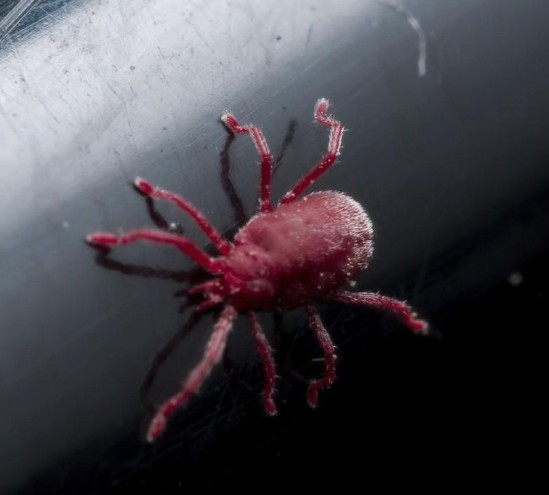
Clover Mites (Bryobia praetiosa) are tiny reddish mites commonly seen crawling across walls, patios, windowsills, foundations, and sunny exterior surfaces. Although they do not bite humans or spread disease, large numbers can become a significant nuisance when they invade homes during spring and fall.
These mites are among the most common nuisance mites found around buildings in North America. Their bright reddish coloration and tendency to gather in large groups often alarm homeowners. When crushed, clover mites may leave behind reddish stains on walls, curtains, carpets, and furniture.
Unlike ticks or parasitic mites, clover mites feed primarily on grasses and ornamental plants rather than animals or humans. Their appearance indoors is usually temporary but can become frustrating during seasonal outbreaks.
Quick Facts
- Scientific Name: Bryobia praetiosa
- Class: Arachnida
- Order: Trombidiformes
- Habitat: Lawns, walls, foundations, gardens
- Diet: Grass and plant sap
- Status: Nuisance pest
- Size: Less than 1 millimeter
- Active Season: Spring and fall
Taxonomy and Classification
Clover mites belong to the class Arachnida, making them relatives of spiders, ticks, and other mites. Unlike insects, arachnids possess eight legs during most life stages and lack antennae.
They are part of the family Tetranychidae, which also includes spider mites and various plant-feeding mite species. Although clover mites are closely related to spider mites, they do not produce extensive webbing like many spider mite species.
The species Bryobia praetiosa is one of the most widespread nuisance mites associated with lawns, ornamental landscaping, and residential foundations.
Identification
Clover mites are extremely small, usually less than 1 millimeter long. They appear reddish-brown or dark red and move slowly across surfaces.
One of their most distinctive features is their unusually long front pair of legs, which are often mistaken for antennae. Under magnification, the body appears oval-shaped and covered with tiny hairs.
Common identifying characteristics include:
- Tiny reddish or rust-colored body
- Eight legs
- Long front legs
- Slow crawling movement
- Crushed individuals leave red stains
Because of their small size, clover mites are often mistaken for tiny spiders or ticks by homeowners.
They belong to the larger group of mites, many of which feed on plants, stored products, or animals.
Distribution and Habitat
Clover mites occur throughout North America and are most noticeable during spring and fall when temperatures are moderate. They are especially common in suburban neighborhoods with heavily fertilized lawns and ornamental landscaping.
Preferred habitats include:
- Lawns
- Flower beds
- Foundations
- Exterior walls
- Windowsills
- Shrubs and ornamental plants
- Sunny building surfaces
These mites thrive in cool, moist conditions and are most active during temperatures between approximately 60°F and 80°F. Populations often decline during hot summer weather.
Life Cycle
The life cycle includes egg, larva, nymph, and adult stages. Clover mites reproduce rapidly under favorable conditions and may produce multiple generations each year.
Females typically reproduce without males through a process called parthenogenesis. This allows populations to expand very quickly.
Eggs are laid in protected cracks, bark crevices, foundation gaps, and sheltered outdoor locations. The eggs are bright red and extremely small.
After hatching, the six-legged larvae begin feeding on grasses and plants. As they develop into nymphs and adults, they acquire eight legs and continue feeding on plant sap.
Eggs may overwinter in cracks and crevices around foundations, siding, and tree bark. During mild weather, populations may remain active throughout much of the year.
Behavior and Feeding Habits
Clover mites feed primarily on grasses, clover, ornamental flowers, and various landscape plants. Using specialized mouthparts, they pierce plant tissue and extract sap.
Outdoor feeding damage is usually minor and may appear as:
- Silvery grass discoloration
- Bronzed leaf surfaces
- Fine stippling on plants
- Patchy lawn appearance
These mites are strongly attracted to warm, sunny surfaces. Large numbers may gather on south- and west-facing walls where they crawl onto siding, windows, and foundations.
Indoor invasions commonly occur when mites accidentally enter through:
- Window gaps
- Door frames
- Foundation cracks
- Utility penetrations
- Weep holes
Once indoors, clover mites do not reproduce successfully and usually die within a short period.
Pest Status
Clover mites do not bite humans, infest food, damage furniture, or transmit diseases. However, they can become significant nuisance pests when large numbers invade homes.
Their primary nuisance issues include:
- Mass indoor invasions
- Visible crawling mites on walls and windows
- Red stains when crushed
- Recurring seasonal infestations
Although harmless biologically, severe infestations may create frustration for homeowners and property managers.
Prevention
- Maintain a vegetation-free strip around foundations
- Seal cracks around windows and doors
- Reduce lawn growth directly against buildings
- Avoid excessive fertilization near structures
- Trim grass and shrubs away from siding
- Inspect foundations for entry points
Creating a dry, plant-free barrier around buildings is one of the most effective long-term prevention methods.
Control Methods
Vacuuming and exterior barrier treatments may help reduce indoor invasions. Because crushing mites can leave stains, vacuum removal is generally preferred over wiping.
Possible management methods include:
- Vacuuming visible mites
- Applying exterior perimeter treatments
- Reducing dense vegetation near structures
- Sealing entry points
- Using targeted miticide treatments when necessary
Indoor pesticide applications are usually unnecessary because mites cannot survive long indoors without suitable food sources.
Interesting Facts About Clover Mites
- Clover mites are arachnids rather than insects.
- Most populations consist entirely of females.
- They can reproduce without mating.
- Crushed mites leave reddish stains caused by body pigments.
- Large infestations often occur during cool weather.