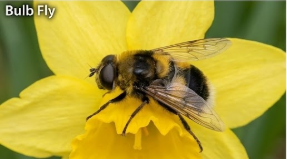
The Large Bulb Fly (Merodon equestris) is a hoverfly species whose larvae feed on the bulbs of ornamental plants. While the adult fly resembles a fuzzy bumble bee and serves as a pollinator, the larval stage can become a destructive garden pest by tunneling into flower bulbs. This unusual combination of beneficial adult behavior and harmful larval feeding makes the large bulb fly an important insect in ornamental horticulture.
Large bulb flies are especially associated with gardens containing tulips, daffodils, hyacinths, lilies, and other bulb-forming ornamental plants. The larvae feed internally within bulbs, often causing rot, collapse, or poor flowering. Adult flies, however, are harmless nectar feeders that help pollinate flowers.
Quick Facts
- Family: Syrphidae
- Common Habitat: Gardens, flower beds, ornamental landscapes
- Diet (Adults): Nectar and pollen
- Diet (Larvae): Plant bulbs
- Status: Occasional garden pest
Identification
Adult large bulb flies are stout, fuzzy insects that strongly resemble bumble bees. This protective mimicry helps discourage predators from attacking them.
Adults typically measure about 1/2 to 3/4 inch long and display:
- Dense yellow and black hairs
- Large fly-like eyes
- Short antennae
- One pair of wings
- Hovering flight behavior
Unlike bees, hoverflies possess only one pair of wings instead of two pairs.
Adult flies are frequently observed hovering around flowers while feeding on nectar.
The larvae are pale cream-colored maggots with thick cylindrical bodies adapted for burrowing through bulb tissue.
Because the larvae remain hidden underground inside bulbs, infestations are often unnoticed until plant damage appears.
Distribution and Habitat
The large bulb fly is native to Europe but has spread into parts of North America and other temperate regions through the ornamental plant trade.
The species thrives in:
- Flower gardens
- Landscaped yards
- Botanical gardens
- Nurseries
- Parks
- Commercial bulb production areas
Habitats containing dense populations of ornamental bulbs provide ideal breeding locations.
Adult flies are most active during spring and summer when flowering plants are abundant.
Life Cycle
The large bulb fly undergoes complete metamorphosis consisting of four stages:
- Egg
- Larva
- Pupa
- Adult fly
Adult females lay eggs near the base of host plants or directly on exposed bulbs.
After hatching, larvae burrow into the bulb and begin feeding internally.
Inside the bulb, larvae consume:
- Storage tissues
- Plant fluids
- Developing roots
Feeding damage often leads to:
- Bulb rot
- Weak plant growth
- Failure to bloom
- Plant collapse
Once fully developed, larvae leave the bulb and pupate in surrounding soil.
Adults emerge later to continue the cycle.
Behavior
Adult large bulb flies are harmless flower visitors and beneficial pollinators.
They are commonly seen:
- Hovering near flowers
- Feeding on nectar
- Resting on foliage
- Flying during warm sunny weather
Their bee mimicry provides important protection from predators such as birds and lizards.
Larvae behave very differently from adults.
After entering bulbs, larvae remain concealed underground while feeding on plant tissue.
Because they are hidden, infestations are difficult to detect early.
Host Plants
Large bulb fly larvae attack many ornamental bulb plants.
Common host plants include:
- Tulips
- Daffodils
- Lilies
- Hyacinths
- Iris
- Amaryllis
- Other flowering bulbs
Weak or damaged bulbs are often more vulnerable to infestation.
Signs of Infestation
Symptoms of large bulb fly damage may include:
- Wilting leaves
- Poor flowering
- Yellowing foliage
- Collapsed plants
- Soft or rotting bulbs
- Tunnels inside bulbs
When infested bulbs are cut open, larvae may sometimes be visible inside.
Pest Status
The large bulb fly is considered an occasional garden pest due to larval feeding on ornamental bulbs.
Damage is most significant in:
- Flower gardens
- Commercial bulb production
- Landscaped ornamental beds
- Greenhouses
While adults contribute positively as pollinators, larval feeding may destroy valuable ornamental plants.
Infestations are generally localized rather than widespread.
Natural Predators
Several natural predators help reduce large bulb fly populations.
These include:
- Ground beetles
- Predatory wasps
- Birds
- Parasitic insects
Healthy garden ecosystems with abundant beneficial insects may naturally suppress populations.
Prevention
Preventive management focuses on reducing larval survival and protecting healthy bulbs.
Recommended prevention strategies include:
- Inspect bulbs before planting
- Discard soft or damaged bulbs
- Rotate planting areas
- Avoid overcrowding bulbs
- Maintain well-drained soil
- Remove dead plant material promptly
Healthy bulbs are often less susceptible to severe infestation.
Control
Control methods focus primarily on removing infested bulbs and reducing breeding sites.
Common management approaches include:
- Digging and destroying infested bulbs
- Improving soil drainage
- Monitoring adult activity during spring
- Using clean planting stock
- Applying integrated pest management techniques
Because larvae develop inside bulbs, surface insecticide treatments are often ineffective.
Interesting Facts
- Large bulb flies are actually hoverflies, not bees.
- The adults mimic bumble bees for protection.
- Larvae spend most of their lives hidden underground.
- Adult flies are beneficial pollinators.
- The species spread internationally through ornamental bulb trade.
- Hoverflies are among the most important natural pollinators after bees.