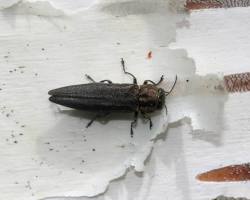
The Bronze Birch Borer (Agrilus anxius) is a destructive wood-boring beetle that attacks birch trees throughout North America. It is considered one of the most serious insect pests of ornamental birch trees and is especially damaging to stressed or weakened trees. Larvae tunnel beneath the bark where they disrupt the movement of water and nutrients, often leading to branch dieback and eventual tree death.
Although healthy native birch species may tolerate minor infestations, ornamental birches planted outside their preferred growing conditions are highly vulnerable. Heat stress, drought, soil compaction, and mechanical injury can increase the likelihood of infestation.
Quick Facts
- Family: Buprestidae
- Scientific Name: Agrilus anxius
- Host Trees: Birch species
- Larval Diet: Cambium and inner bark tissues
- Impact: Branch dieback and tree death
- Status: Serious tree pest
Identification
Adult bronze birch borers are slender metallic beetles measuring approximately 1/2 inch long.
Key identifying characteristics include:
- Metallic bronze or olive-bronze coloration
- Narrow elongated body shape
- Tapered abdomen
- Short antennae
- Fast-moving adults
The larvae are cream-colored, flattened grubs with segmented bodies adapted for tunneling beneath bark.
Like other wood-boring beetles, larvae spend most of their lives hidden within tree tissues.
One of the most recognizable signs of infestation is the presence of D-shaped exit holes left by emerging adults.
Distribution and Habitat
The bronze birch borer occurs throughout much of North America wherever birch trees grow.
It is especially common in:
- Urban landscapes
- Parks
- Residential yards
- Forested regions
- Ornamental plantings
The pest primarily attacks:
- Paper birch
- European white birch
- Gray birch
- River birch
- Yellow birch
Non-native ornamental birches are often more susceptible than native species.
Life Cycle
The bronze birch borer undergoes complete metamorphosis consisting of four stages:
- Egg
- Larva
- Pupa
- Adult
Adult beetles emerge during late spring and summer.
Females lay eggs within bark crevices on stressed or weakened birch trees.
After hatching, larvae bore beneath the bark and begin feeding on the cambium layer.
Larval tunnels disrupt the tree’s vascular system, preventing proper transport of water and nutrients.
Larvae overwinter beneath the bark before pupating and emerging as adults.
Depending on environmental conditions, the life cycle may require one to two years.
Signs of Infestation
Early detection is important because infestations can rapidly weaken birch trees.
Common symptoms include:
- Thinning foliage
- Yellowing leaves
- Branch dieback
- D-shaped exit holes
- Swollen or cracked bark
- Woodpecker activity
- Epicormic sprouting on trunks
Infestations often begin in the upper canopy and gradually spread downward.
Trees under severe attack may die within several years.
Pest Status
The bronze birch borer is considered one of the most destructive tree pests affecting ornamental birches.
Larval feeding weakens trees by destroying the cambium layer responsible for nutrient movement.
Repeated infestations can lead to:
- Reduced tree vigor
- Canopy decline
- Structural weakness
- Complete tree death
Stressed birch trees are particularly vulnerable to infestation.
Prevention
Maintaining healthy birch trees is the best defense against bronze birch borers.
Preventive measures include:
- Provide adequate watering during drought
- Mulch around tree bases
- Avoid damaging bark and roots
- Reduce soil compaction
- Plant resistant birch species
- Monitor trees for early symptoms
- Maintain proper tree nutrition
River birch is generally considered more resistant than paper or European white birch.
Control
Control of bronze birch borers often requires integrated tree management strategies.
Management options may include:
- Pruning infested branches
- Improving tree health
- Preventive insecticide applications
- Removing severely infested trees
- Professional arborist evaluation
Systemic insecticides are sometimes used to protect high-value ornamental trees.
Early intervention greatly improves the likelihood of tree survival.
Ecological Importance
Although destructive in landscapes, bronze birch borers are part of natural forest ecosystems.
They often target weakened or dying trees and help recycle nutrients within forests.
Their larvae also serve as food for:
- Woodpeckers
- Predatory beetles
- Parasitic wasps
- Other insect predators
Interesting Facts
- The bronze birch borer is closely related to the emerald ash borer.
- D-shaped exit holes are a classic sign of infestation.
- Healthy birch trees are less attractive to egg-laying females.
- Larvae spend most of their lives hidden beneath bark.
- Woodpecker damage often indicates hidden larval activity.
- Heat stress greatly increases susceptibility in ornamental birches.